
Understanding the sudden surge in popularity of pipe jigs for lingcod comes down to a surprising convergence of workshop resourcefulness and saltwater electrochemistry.
As a youngster spending summers on Texada Island, access to a dinghy meant spending long daylight hours fishing (some things never change). Without ready access to store-bought lures, gear had to be fashioned from whatever scraps could be salvaged from my dad’s workshop: shiny metal, discarded cutlery, and old offcuts of copper water pipe left over from frequent plumbing repairs. Filling those pipes with sand or melted lead from battered fishing sinkers produced rudimentary lures, but the lead-filled ones routinely out-fished everything else on bottom structure. While I didn’t realize it at the time, I had unwittingly stumbled into the world of pipe jigs.
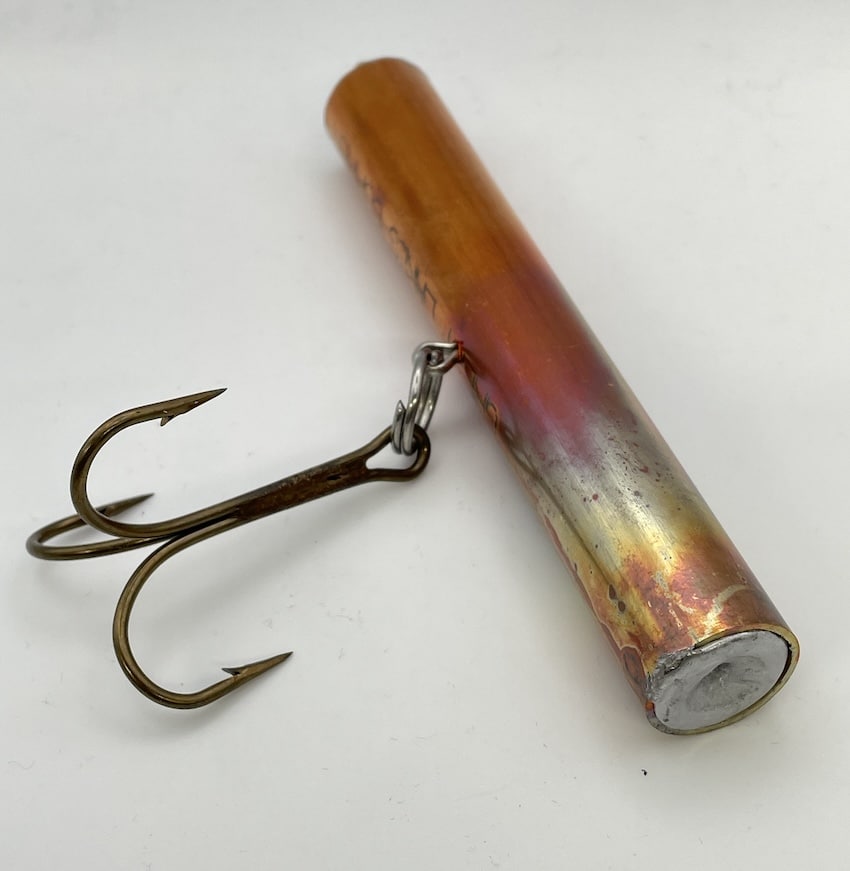
To the untrained eye, a pipe jig looks like leftover plumbing supplies fitted with a hook. Yet in recent seasons, these heavy metal cylinders have exploded in popularity among bottom fishermen, shocking anglers with their ability to drastically outproduce traditional lures when normal bites stall. The reason? They tap directly into a mysterious sixth sense that fish possess.
Why They Work: Electroreception in Saltwater
It has long been known that some species of marine life can sense bioelectricity. It was first recognized in sharks as an explanation for why they bite metal objects such as dive cages and outboard motors. Sharks and rays possess specialized jelly-filled sensory cells called the ampullae of Lorenzini that detect the weak electrical field put out by prey, allowing them to locate hidden forage in low- or no-light conditions.
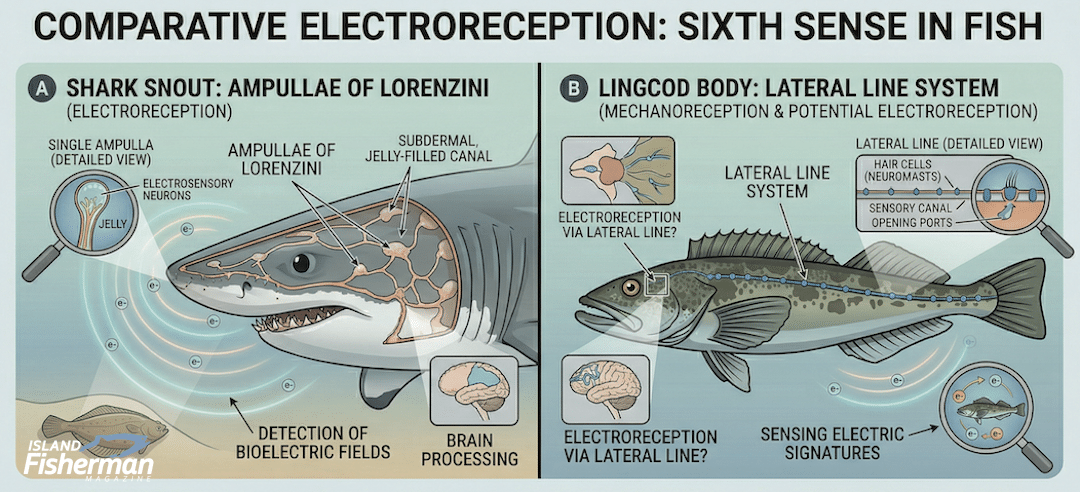
While there has been little formal research into this ability in bony fish like lingcod or halibut, it is speculated that the fish’s lateral line plays a key role in this sixth sense. We don’t yet know every species that possesses this superpower, but anecdotal evidence shows salmon, halibut, rockfish, and lingcod all key in on the bioelectricity of their prey. An old commercial fisherman once shared how he successfully trolled copper spoons at night; the salmon certainly couldn’t see the lure in the pitch black, but they found it anyway. Those copper spoons connected via steel leader to lead weights likely triggered the exact same reaction as a modern pipe jig.
The Science: Bioelectric Stimulation
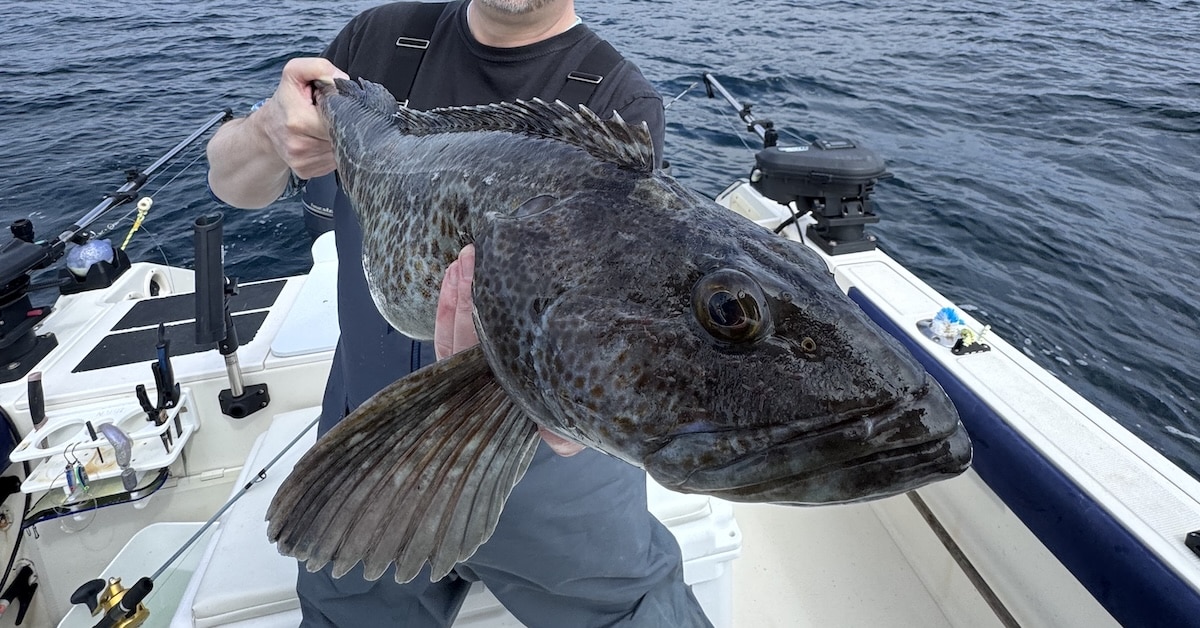
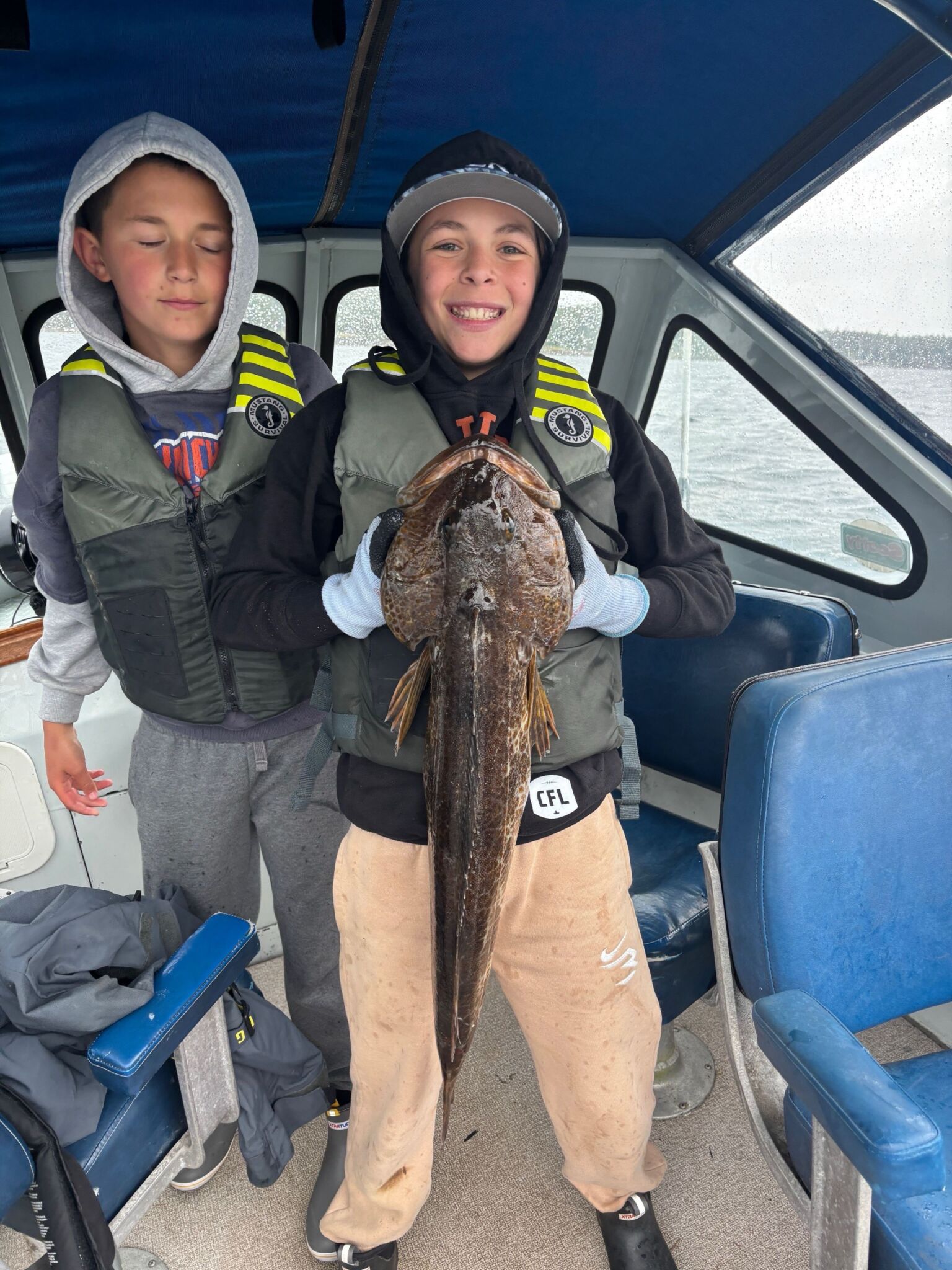
Lingcod live in rocky, turbulent environments, lying in wait for prey to enter their territory before aggressively pursuing it. The pipe jig does not look like what a lingcod would normally eat—it certainly doesn’t look like a baitfish. So why would a primarily visual hunter eat a chunk of metal? The answer is that pipe jigs for lingcod trigger a predatory response through electrochemistry:
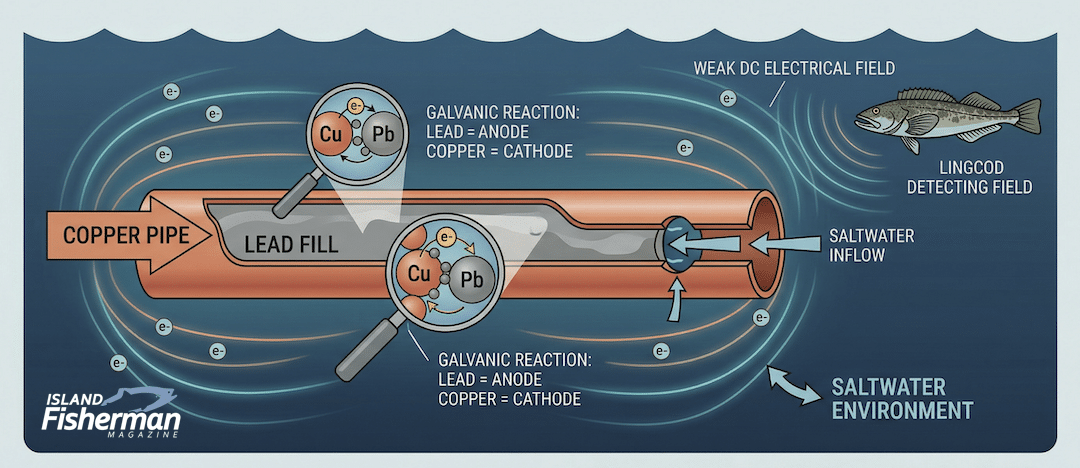
- 1. Create a Battery: Creating a battery requires two dissimilar metals and an electrolyte solution. The metals are copper pipe and lead, while seawater itself acts as the naturally conductive electrolyte.
- 2. The Galvanic Reaction: When copper and lead touch while submerged in salt water, an electrochemical reaction occurs. Because they have different electrical potentials, they exchange electrons—causing the lead (anode) to release electrons into the copper (cathode). This creates a weak DC current—in effect, a low-voltage battery.
- 3. The Strike Trigger: All marine animals generate a weak electrical field around the clock, even when hiding. Lingcod sense this field. Whether through lateral line neuromasts or an unmapped sensory channel, the electrical field surrounding the jig catches their attention, draws them in, and results in aggressive strikes—either by mimicking food or provoking extreme territorial aggression.
PRO ANGLER TIP: OLDER IS BETTER
Pipe jigs seem to improve with use. As the copper rusts, oxidizes, and turns green, the galvanic reaction shifts the electrical field, potentially mimicking natural bioelectricity even more closely. So just because your old jig is corroded and green, don’t throw it away. It might just be reaching its peak effectiveness (a rule that applies equally well to old fishermen).
Anatomy and Construction: Contact is Key
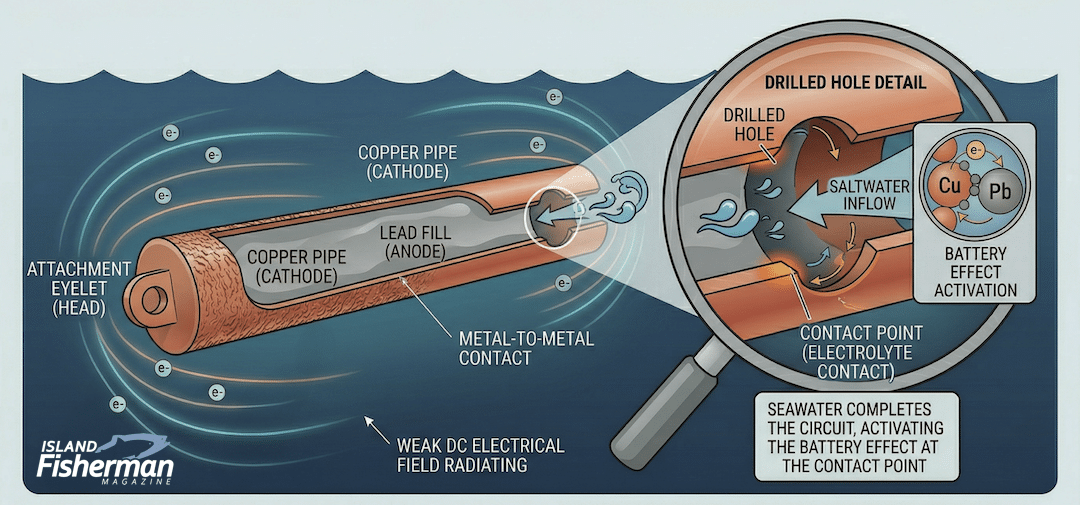
For a pipe jig to work, the lead and copper must be in direct contact with each other and with the salt water. A completely sealed jig will not produce any galvanic reaction. Either one end of the copper pipe must be left open to expose the lead face, or a hole must be drilled in the side to allow seawater to bridge the two metals and complete the circuit. Jigs sold completely sealed shut are made by builders who clearly do not understand the science behind the lure.
As we apply more science to our fishing, we learn far more about catching fish and understanding fish behavior. Applying this knowledge makes our limited time on the water much more productive, especially when the bite is slow and fish ignore conventional offerings.
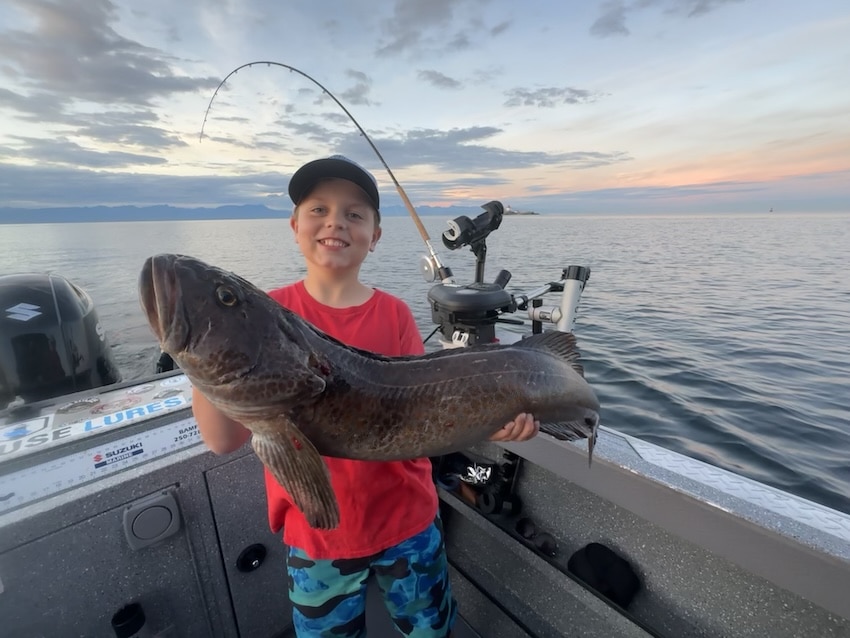
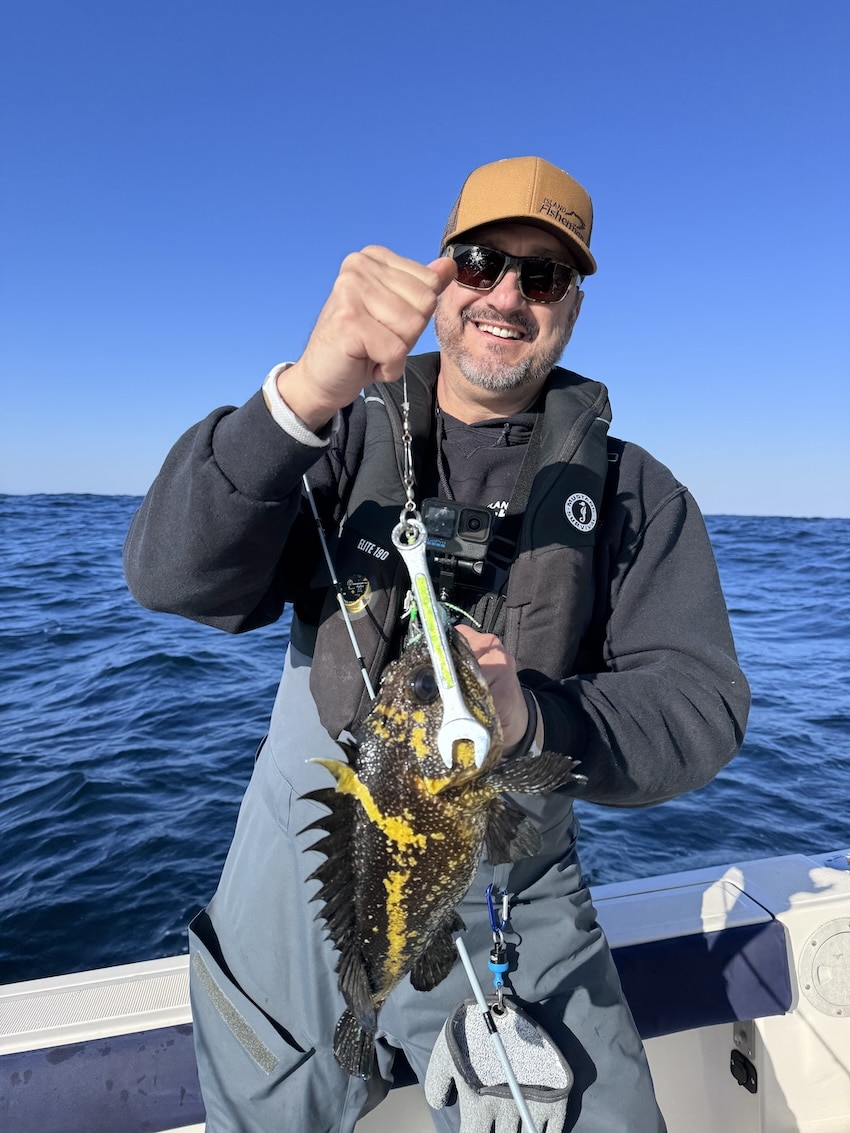
Of course, when the fish are truly on the bite, science takes a back seat—you could probably throw down an open-ended wrench with a hook wired to it, and a fish would still hit it…
REGULATORY & SAFETY NOTE
When targeting bottom species along the Pacific coast, always check area boundaries, size restrictions, and non-retention zones via the DFO BC Tidal Waters Sport Fishing Guide. Take care to avoid protected Rockfish Conservation Areas (RCAs) and ensure terminal tackle complies with barbless hook regulations.
LOCAL RESOURCES & NAVIGATION REFERENCES
- Fisheries and Oceans Canada (DFO): Official management area boundaries, tidal finfish licenses, and rockfish protection maps.
- Environment Canada Marine Weather: Coastal marine forecasts, sea conditions, and wind warnings across British Columbia waters.
MORE VANCOUVER ISLAND FISHING GUIDES
Expand your tactical edge with our in-depth West Coast guides, lodge directories, and live reports:
About the Author & Island Fisherman Magazine
Written by Steve Vavrik for Island Fisherman Magazine. Dedicated to sharing practical West Coast angling expertise, technical tackle design, and sustainable Pacific fisheries coverage. Join our angling community and subscribe today at Island Fisherman Magazine.