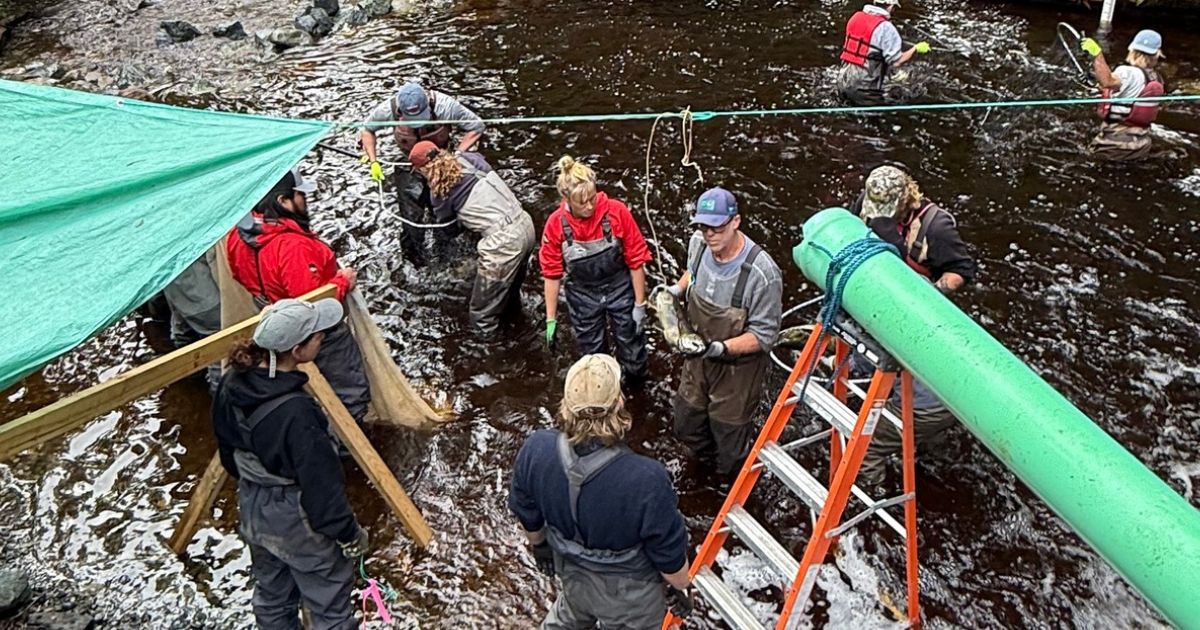
When thousands of returning salmon hit an impassable four-foot barrier at Salmon Creek (Glukamukus Creek) in Barkley Sound this fall, the local community didn’t hesitate.
Rather than watch a strong fall run stall out below an unfinished road culvert rebuild, local hatchery staff, First Nations, restoration crews, and community volunteers teamed up to form an old-school bucket brigade—gently moving 2,608 chum salmon, 61 adult coho, and 17 jack coho (2,686 salmon in total) upstream by hand so they could reach their spawning beds.
A Race Against the Fall Run
The challenge began back in October 2024, when a heavy atmospheric river blew out the original fish ladder at Salmon Creek in Yuułuʔiłʔatḥ territory. Thornton Creek Hatchery staff installed an immediate temporary patch to keep fish moving while DFO drew up plans to replace the damaged structure.
After capacity constraints delayed construction through summer 2025, a federal crew arrived in late summer 2026 to build a new ladder leading into the road culvert. However, on September 11, construction had to be halted mid-build before the concrete ladder and rock weirs could be completed.
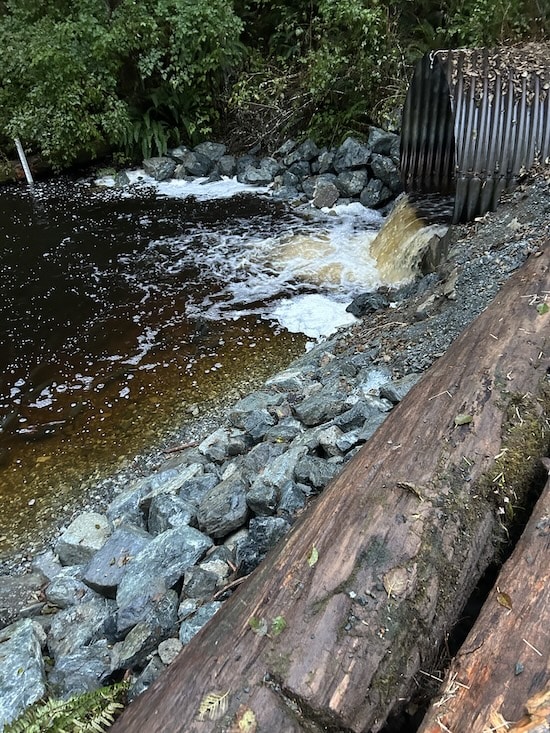
“How could they leave this stream to die on the operating table? What was the showstopper? I’d like to know,” said Thornton Creek Hatchery manager Dave Hurwitz, concerned about the timing right ahead of the fall run. “I don’t know who stuck a fork in it. I don’t really know why they stopped. They still had a couple days in the fisheries window. There was no rain coming for a few days and they were right there. Like, why didn’t they get it done?”
In a written statement to Ha-Shilth-Sa, DFO noted that work on the concrete ladder and rock weirs could not be completed “due to unsafe work conditions,” adding that phase two of the project is scheduled for late summer 2027. In the meantime, returning fall spawners needed an immediate way past the barrier—and the creek corridor needed urgent stabilization before fall rains arrived.
Chum Don’t Jump Four Feet
The half-built site left returning fish facing a three- to four-foot vertical jump just to reach the culvert. Anyone who has spent time on a coastal river knows chum are built like freight trains, not steelhead—even though chum salmon navigate thousands of kilometres across the open North Pacific to reach their home streams.
“Chum are poor jumpers. Anything over about a foot or two they are not going to be able to get up. They are very strong, but they are terrible jumpers,” said Thornton Creek Hatchery operations manager James Costello.
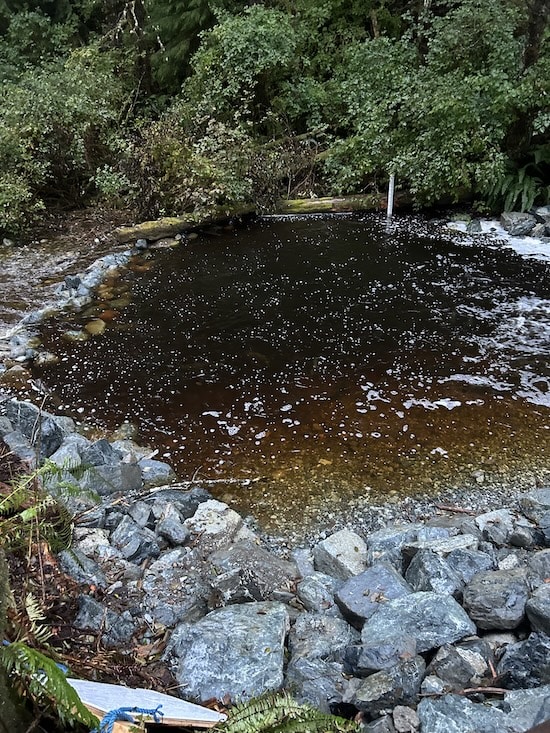
With a strong return of over 3,000 chum—alongside fall coho—pushing into the creek, the fish needed a helping hand to reach the upper spawning gravel before timing out downstream.
Neighbors Doing the Heavy Lifting
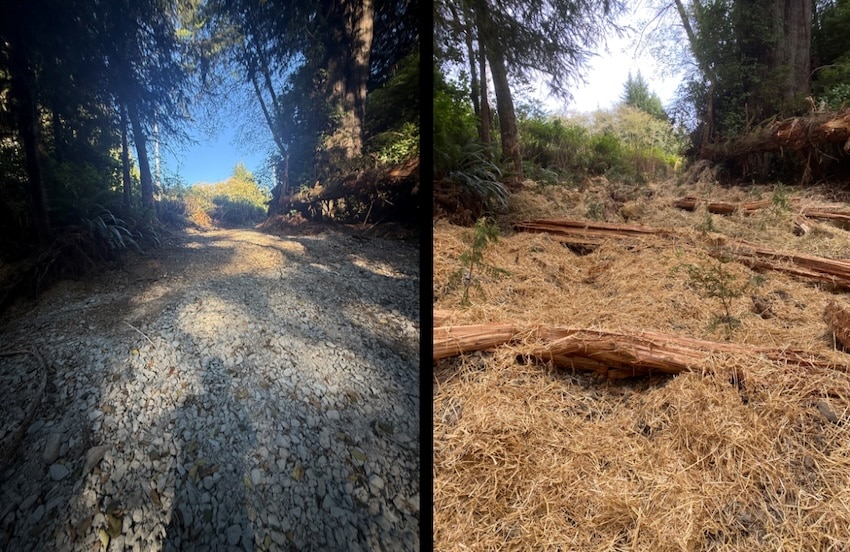
The local watershed community quickly stepped up on two critical fronts. Within days of DFO halting work and leaving the site, Redd Fish Restoration mobilized to perform emergency environmental remediation—deactivating the newly built gravel access road with heavy straw mulch and woody debris to prevent a massive sediment release into the lower spawning gravel.
With the lower spawning beds protected, Redd Fish Restoration then partnered with staff from Thornton Creek Enhancement Society, members from Toquaht Nation and Ucluelet First Nation, and local volunteers to move the returning run upstream. Working together in the creek, crews rigged a water-filled PVC transfer pipe straight into the culvert—netting heavy adult chum and coho and gently sliding them through the chute so they could continue their migration unharmed.
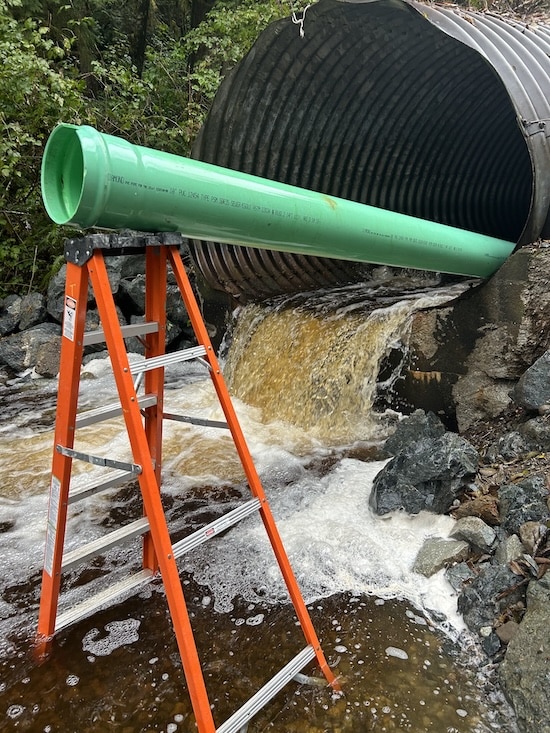
“It speaks to people working together to help make the world better,” Hurwitz said. “It’s been a ton of work, but it’s turned into a great community initiative. People have rallied around this. It’s been a great opportunity for us to show gentle fish handling.”
Ucluelet marine biologist Dane Stabel spent two days in the creek alongside roughly 15 other volunteers, moving spawners and gathering broodstock for Thornton Creek’s enhancement program—while simultaneously tracking and counting the returning salmon run.
“It’s beautiful that there are so many people that care about fish and salmon. Sometimes the charismatic mammals get all the attention, but I find salmon are a good ambassador for fish,” Stabel said. “There are very few animals who work as hard as these guys to get the next generation going.”
Stewardship on the Water
At the end of the day, West Coast salmon conservation comes down to people willing to pull on their waders, step into cold water, and take care of the fish in front of them.
As Hurwitz put it: “When you’re dealing with live animals, you can’t make mistakes. You can’t screw it up. It’s not carpentry. If we screw something up, we are robbing Mother Nature.”
When the final tallies wrapped up, the joint effort between Thornton Creek Hatchery, Toquaht Nation, Ucluelet First Nation, Redd Fish Restoration, and dedicated community volunteers had safely moved 2,608 chum salmon, 61 adult coho, and 17 jack coho to their upper spawning beds—protecting an entire brood year and safeguarding the lower spawning gravel ahead of Phase 2 of the fishway rebuild next summer.
🎣 FISHING BARKLEY SOUND & UCLUELET
Planning your next West Coast trip? Bookmark our Ucluelet Fishing Area Report—updated regularly by Thornton Creek’s James Costello when the offshore and Barkley Sound season kicks back off in April.
Original reporting by Nora O’Malley / Ha-Shilth-Sa. Photos and final escapement tallies courtesy of James Costello, Thornton Creek Hatchery, and Redd Fish Restoration.

Stay Ahead on BC Waters
Tactical rigging guides, regional run timing, DFO regulation updates, plus subscriber-only lodge deals and exclusive BC marine partner discounts. Delivered straight to your inbox.
"*" indicates required fields