
Under the latest in-season update to the 2026 BC Halibut Regulations, recreational anglers across British Columbia have received an unexpected, welcome boost to their late-season limits. In the news and media industry, PR professionals and journalists share a well-known inside term: the “Friday News Dump.” The concept is simple.
When a government ministry or large agency has unpopular news, controversial policy rollbacks, or painful regulatory cuts to deliver, they strategically release the notice late on a Friday afternoon. The thinking is that newsrooms are skeleton-crewed, editors are heading home, and the public is turning off their brains for the weekend—allowing the bad news to die a quiet, unnoticed death before Monday morning rolls around.
For BC sport fishers, an unexpected DFO notification landing in our inbox on a Friday afternoon almost always sparks an automatic cringe and an immediate brace for “Bad News Friday.” But today, the script has flipped.

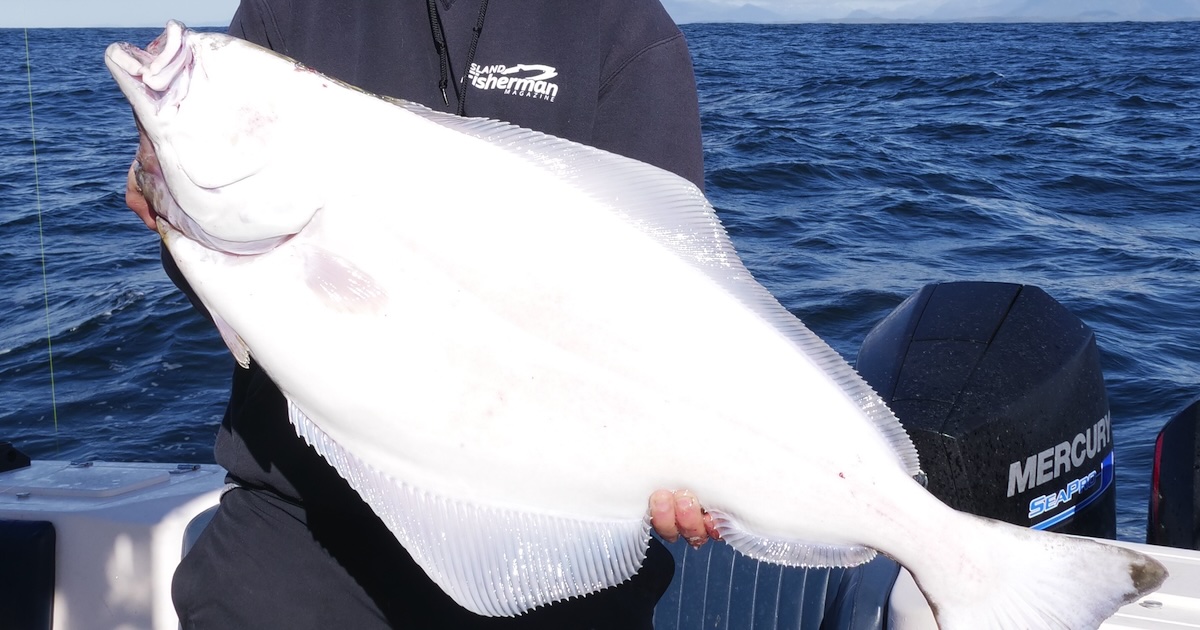
Effective 00:01 hours on September 1, 2026, the recreational daily retention limit for Pacific halibut is officially doubling from one (1) to two (2) fish per day coast-wide. DFO Fishery Notice FN0927 has hit the wire, formally superseding FN0198 and enacting Variation Order 2026-RFQ-373 through December 31, 2026. Navigating the in-season updates to the 2026 BC halibut regulations gives recreational anglers the green light to burn offshore fuel, run the drop-offs, and stock the deep freezer with premium fillets for the winter months.
Fishery Notice FN0927 is in effect from September 1 through December 31, 2026. Always verify real-time boundary closures, permanent finfish reserves, and conditions of licence via the DFO BC Tidal Waters Sport Fishing Guide before dropping gear.
2026 BC Halibut Regulations: In-Season Rule Breakdown
Before setting up on your favorite drift or gravel bar, let’s run through the exact legal parameters set out for the remainder of the 2026 calendar year. Under the framework of the 2026 BC halibut regulations, the updated recreational management measures are as follows:
- Daily Retention Limit: Two (2) Pacific halibut per calendar day.
- Possession Limit: Equal to the daily limit (two fish in possession total).
- Maximum Size Limit: No person shall retain a halibut exceeding 112 cm head-on length (or 85 cm pectoral length with the head removed, measured from the base of the pectoral fin’s forward point to the middle tip of the tail).
- Annual Aggregate Limit: The licence-year aggregate cap remains at ten (10) halibut per licence holder between April 1, 2026, and March 31, 2027.
- Immediate Catch Recording: Every retained halibut must be immediately logged on your paper Tidal Waters Sport Fishing Licence or recorded electronically through the FishingBC app, including the date, DFO management area, and head-on length.
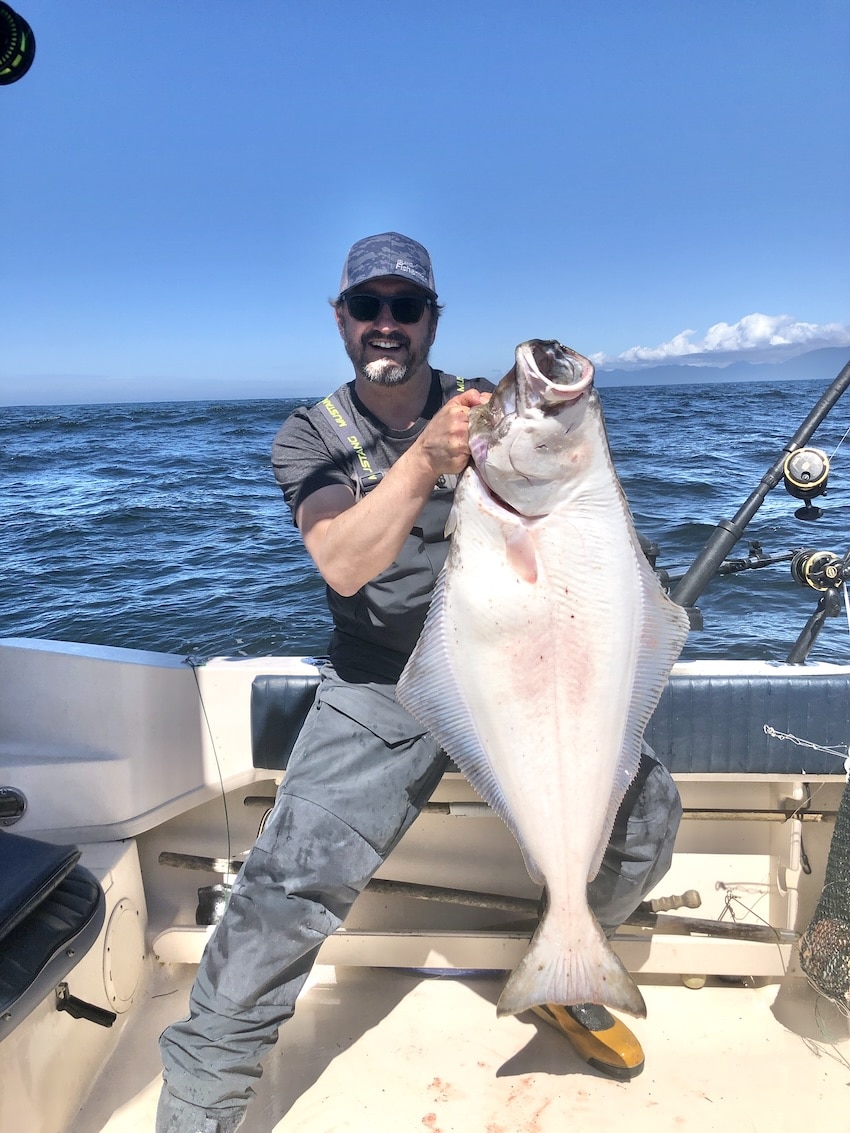
All standard spatial conservation closures remain fully active. Area 121 offshore waters outside the 12 nautical mile boundary and the core waters of Swiftsure Bank remain closed year-round to all finfish angling. In addition, all designated Rockfish Conservation Areas (RCAs) and Glass Sponge Reefs (GSRs) remain strictly off-limits. As a reminder, carrying and utilizing an inverted weighted barbless hook or purpose-built descending device is mandatory on all vessels to return any non-retained rockfish back to capture depth immediately.
The Quota Math Behind the 2026 BC Halibut Regulations
To understand why DFO doubled our daily limit instead of riding out the season on a single-fish cap, you have to look behind the curtain at the regulatory math. As we broke down in detail in our feature on the 2026 BC Halibut Regulations, recreational quotas do not appear out of thin air—they are governed by international treaties and strict allocation models.
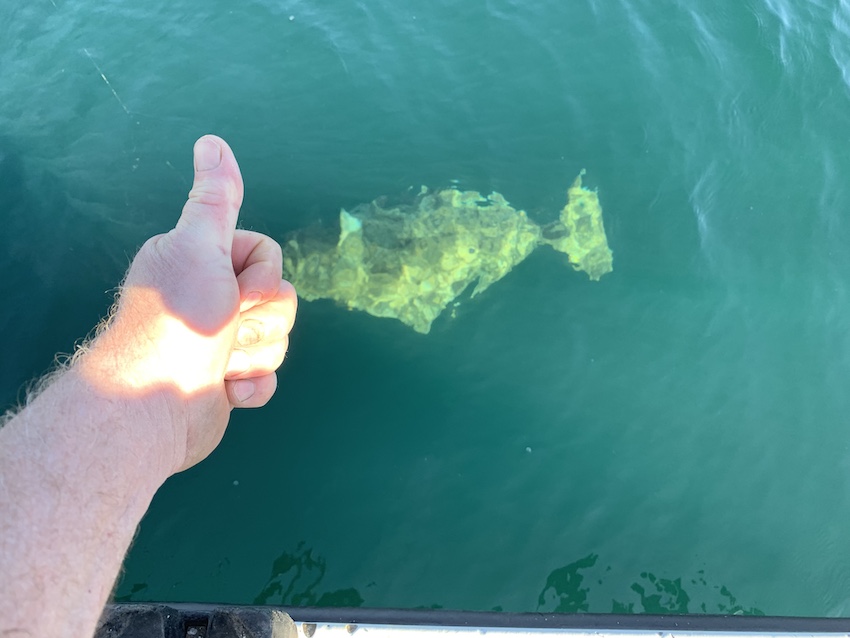
The overarching biomass is assessed by the International Pacific Halibut Commission (IPHC), a bilateral body founded in 1923 by Canada and the United States. Every winter, the IPHC establishes the coastwide Total Constant Exploitation Yield (TCEY). British Columbia is designated as Area 2B, which for 2026 received a total TCEY of 5,060,000 pounds.
Before recreational fishers get a look at that number, mandatory deductions are taken right off the top: First Nations Food, Social, and Ceremonial (FSC) priority access (423,096 lbs), non-directed commercial trawl bycatch (230,000 lbs), commercial discard mortality (160,000 lbs), and recreational release mortality (30,000 lbs). That leaves a remaining pool of 4,216,904 pounds, which is split under Canada’s allocation policy: 85% to commercial fleets and 15% directly to the recreational sector. That 15% share equals our sector’s base Total Allowable Catch (TAC) of 633,750 pounds.
The Clean Slate Advantage
In the recreational world, quota management is a one-way street. If the sport fleet exceeds its TAC in a given year, that overage is penalized with a pound-for-pound deduction from the following year’s opening quota. However, because BC anglers fished responsibly in 2025—leaving an estimated 147,000-pound underage in the water—the recreational sector entered 2026 with a zero-penalty “clean slate”. This clean slate set the stage for how the 2026 BC halibut regulations could be managed dynamically rather than defensively.
Throughout the spring and summer of 2026, creel surveys and electronic reporting confirmed that recreational landings tracked below preseason models. Rather than leaving that legitimate allocation unharvested as weather windows begin to shrink in the late fall, DFO used its Variation Order system to increase daily retention. It is a textbook example of adaptive, responsive management working in anglers’ favor.
Halibut in the Strait of Georgia: A Surprising Trend Continues
While the wild outer coastlines of Winter Harbour, Kyuquot, Nootka Sound, and Sooke naturally capture the limelight, 2026 has seen another fascinating pattern re-emerge: confirmed halibut encounters inside the Strait of Georgia. While hooking a flatfish in the inner Salish Sea remains relatively rare compared to outer-coast banks, it is far from unprecedented.
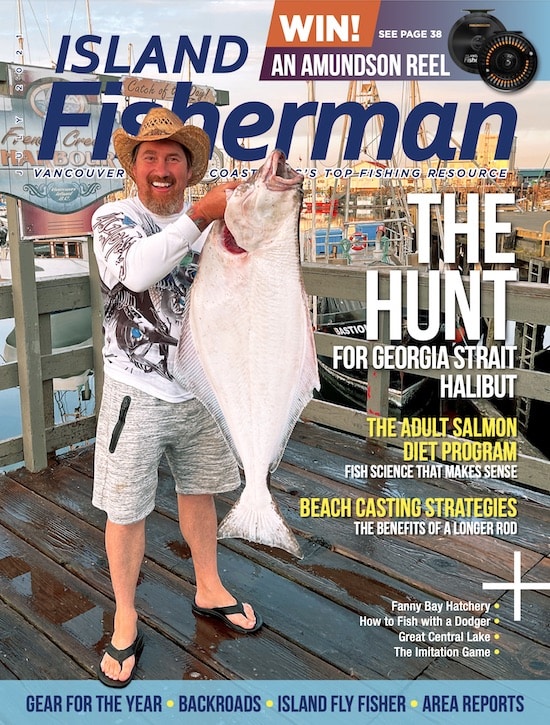
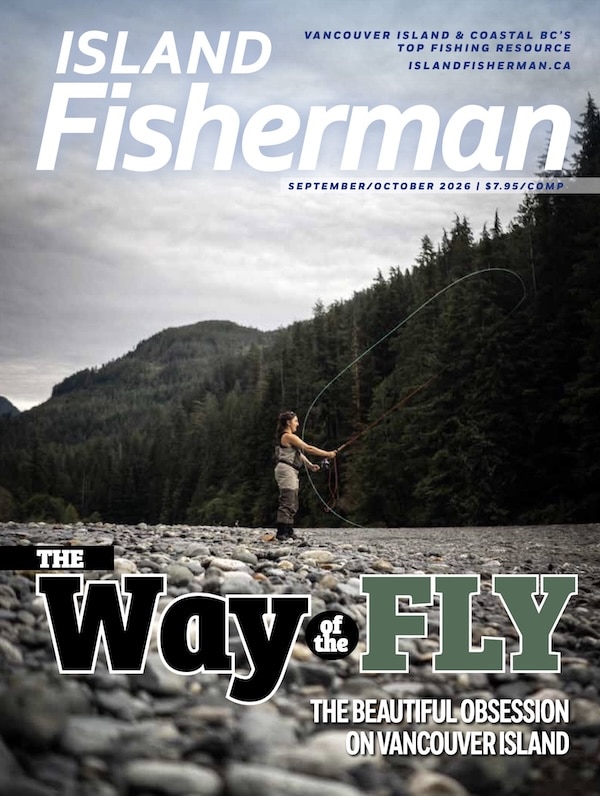
As we highlighted on our July 2021 cover, migratory and resident halibut frequently shadow schooling forage fish through Discovery Passage and the northern approaches, holding on deep ledges, contour drop-offs, and sandy tide rips along the central and southern Strait. If you are trolling for chinook or working bottom jigs along the inside this fall, keeping a heavy setup and large scent profile rigged is well worth the effort—under the updated 2026 BC halibut regulations, you just might find an unexpected inner-coast chicken to fill your daily limit.
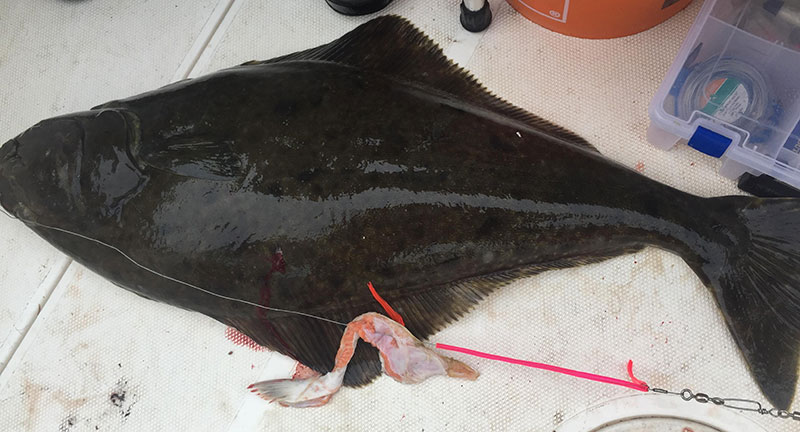
When targeting fall halibut in heavy current, pin your fresh salmon belly strips or whole herring securely to a spreader bar rig. Keep your presentation hovering roughly 2 to 3 feet off the bottom to avoid snagging bottom structure while giving cruising flatfish an unmistakable scent trail to track up-current.
Fall Tactics & Culinary Rewards Under the New Limits
Taking full advantage of the expanded 2026 BC halibut regulations means refining your on-the-water approach to make the most of every drift. If you want to expand your tactical repertoire and present large baits cleanly in complex tidal currents without constantly dragging bottom, check out our master guide on Float Fishing for Halibut.
Back at the cleaning table, reward your crew with something fresh and vibrant. Instead of heading straight for the deep fryer, try this easy, citrus-forward Halibut Ceviche Recipe that celebrates the clean texture of fresh ocean fillets.

For additional technical rigging tutorials, localized fishing reports, and past policy breakdowns, browse through our complete archive of halibut articles.
🐟 MORE VANCOUVER ISLAND FISHING GUIDES
Expand your tactics and repertoire with our top-rated guides:
Reported by the editorial team at Island Fisherman magazine. We are dedicated to providing clear coverage of West Coast fisheries policy, local salmon enhancement, and sport fishing news. Explore more conservation guides and subscribe at Island Fisherman magazine.