
If you want to completely shake up your offshore routine, mastering the art of float fishing for halibut can turn a notoriously slow day on the anchor into a highly productive trip. Let’s be completely honest with ourselves: some days are just slow on the saltwater. There are times when the flatfish never even seem to hear the dinner bell ringing at your favourite coordinates, no matter what fresh bait or heavy artificial lures you drop down. Earlier this year, while preparing for my annual early-season coastal trips, I was deep into research trying to find alternative methods to spark a reaction bite when I ran into a unique Scandinavian technique that immediately piqued my interest. I discovered a specialized European kit called “Kveiteduppen,” which literally translates from Norwegian to English as “The Halibut Dip”.
While these pre-packaged float systems are incredibly popular across Northern Europe and Scandinavian sea-angling websites, calling around to local tackle shops across Vancouver Island yielded absolutely nothing out of the box. Some local builders didn’t quite grasp what I was looking for, while a few veteran shop owners mentioned they had heard whispers of a couple of coastal charter guides experimenting with a surface buoy spread, but it wasn’t an item anyone regularly stocked. With my departure date only days away, I realized I could easily engineer my own DIY variation from scratch. That is exactly how my personal journey into tactical float fishing for halibut officially began.
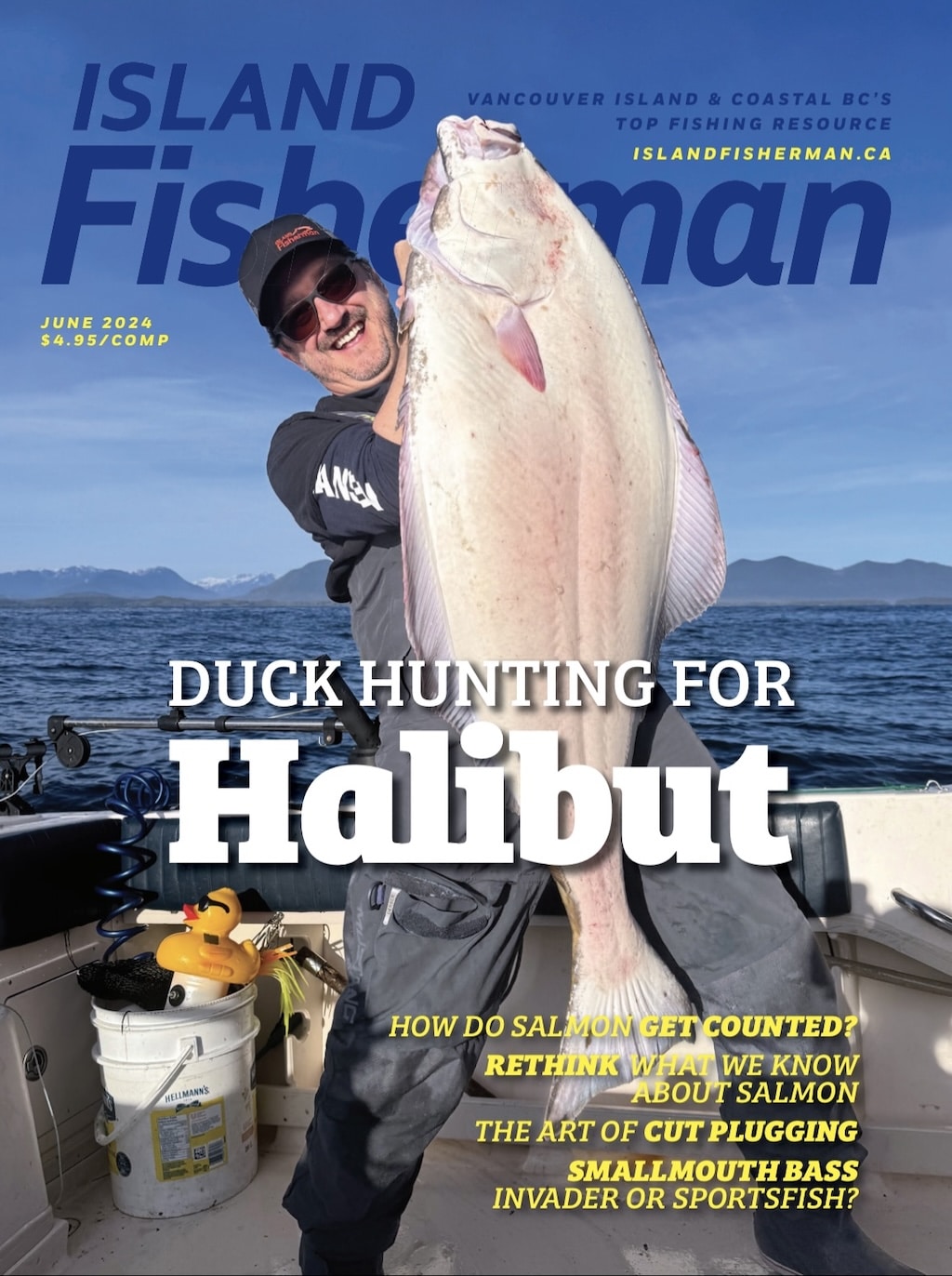
This feature was originally published as the cover story for our June 2024 print issue. Subscribe to Island Fisherman Magazine today and never miss another issue!
Traditional Bottom Rules: Tangles and Scent Trails
Before diving into the exact mechanical construction of the rig, it is worth reviewing a quick refresher on a standard West Coast flatfish presentation. For a complete baseline of this species’ unique biology and behavioral traits, check out our comprehensive Creature Feature: Pacific Halibut Guide. In a traditional scenario, the vessel is securely tied off on a specialized anchoring system over a gravel flat, reef edge, or deep underwater muddy shelf. For critical boat positioning and safety safety tips, read our checklist on Halibut Anchoring Basics.
A typical four-rod anchor spread involves running two heavy lines off the bow and two slightly lighter lines closer to the stern. To avoid catastrophic multi-line tangles in shifting tidal currents, bow lines are best set with heavy sinkers (typically 2 lbs), while the stern positions deploy lighter weights ranging from 1 to 1.5 lbs. Keep in mind that federal regulations stipulate it is strictly illegal to fish with a fixed weight or sinker greater than 1 kg (2.2 lbs). Because the vessel naturally aligns its bow directly into the prevailing current, this weight differentiation allows your stern lines to sweep safely down-current away from the bow weights. When launching your spread, always try to cast your bow weights slightly forward and let your stern rigs drop back to gain maximum physical separation in the water column.
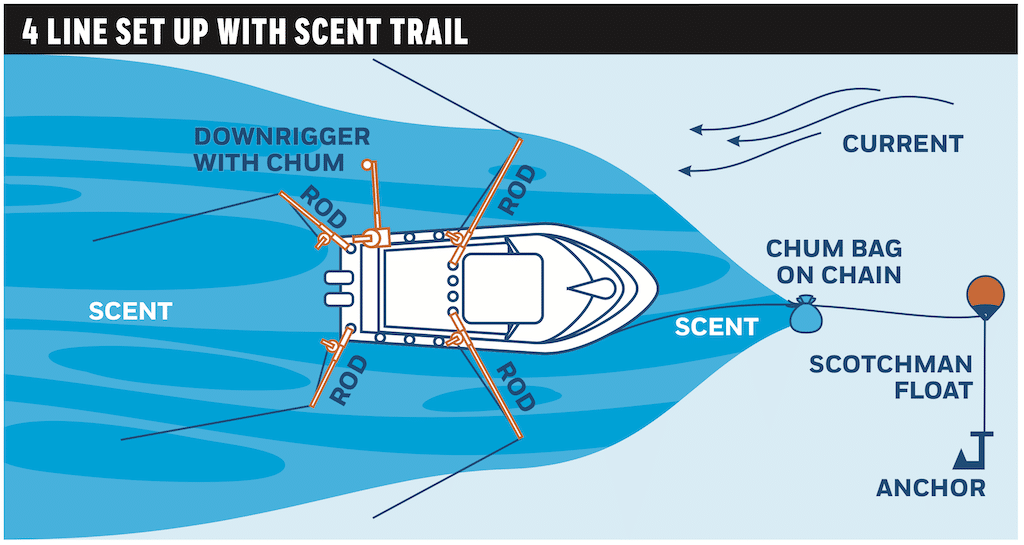
A traditional four-rod anchoring layout, highlighting how the ocean current carries a potent scent trail away from the stern.
With multiple lines working together, your choice of halibut gear plays a critical role in establishing a broad, continuous scent trail behind the transom. Deploying natural baits such as oily salmon bellies, tough octopus tentacles, crisp whole herring, or frozen mackerel is key to drawing fish from down-current. To learn how to locate these productive zones, explore our strategic overview on White Gold: How to Find Halibut. While a powerful scent trail will attract fish, it doesn’t guarantee your stern lines will see all the action; bottom structure, bait presentation, and local current variations dictate which rod gets hit first. To supplement this attraction, many anglers clip a mesh bait bag loaded with salmon carcasses directly to the anchor chain or downrigger ball to act as a primary buffet line.
The Strategic Advantages of Float Fishing for Halibut
The foundational philosophy behind float fishing for halibut is simple: it allows you to run an extra line far away from the vessel without risking tangled gear. Running four vertical lines directly beneath an anchored boat increases your risk of severe tangles if currents shift or a large fish circles the hull. By choosing float fishing for halibut, you can easily present a large bait up to 50 feet or more away from your traditional anchor spread, covering a vastly wider footprint of territory.

Visual confirmation: The bright yellow profile makes it incredibly easy to track your extra line’s positioning from the deck, even in heavy ocean swells.
The real secret to successful float fishing for halibut lies in your knowledge of the bottom topography. You must monitor the underwater landscape carefully. If your float drifts over an area that is significantly deeper than the water beneath the boat, your terminal tackle will hang suspended too high above the bottom strike zone. Conversely, if the float drifts into a shallower shelf, your weights and baits will slump limply onto the seafloor, ruining the presentation and increasing your risk of snagging rocky structures. The goal is to keep your weight barely bouncing along the substrate, allowing the surface swell to transmit a natural swimming motion directly down to your bait spread.
⚠️ Surface Line Safety Awareness
When utilizing a long-distance surface float, your main line runs along the water’s surface from your stern out to the float. Passing boaters will not recognize this setup, as they only look for your main anchor buoy. Use extreme discretion and pull the line in immediately if nearby boat traffic approaches your transom. For global stock tracking and biological reference data, you can consult the International Pacific Halibut Commission (IPHC).
Why Circle Hooks are Mandatory When Float Fishing for Halibut
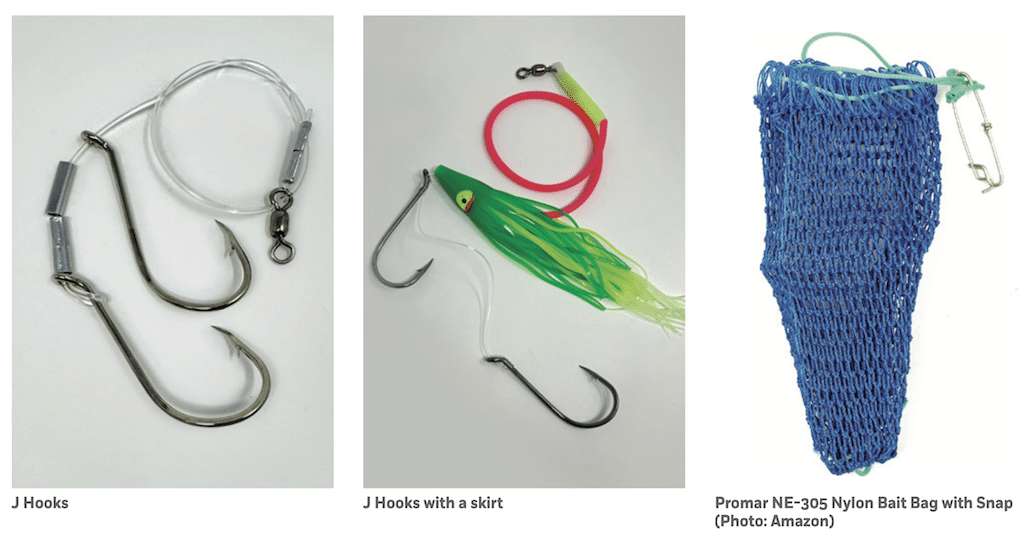
When organizing your tactical halibut gear, your choice of hooks determines your hook-up ratio. The choice between classic J-hooks and mechanical circle hooks comes down to how you track your rod tips. J-hooks require an immediate, manual hook-set the second you detect a subtle nibble or heavy strike, meaning you must watch that rod like a hawk. This is why many professional West Coast guides favour a sharp J-hook with a colourful vinyl skirt—it requires high active skill and lets you drive the point home manually.
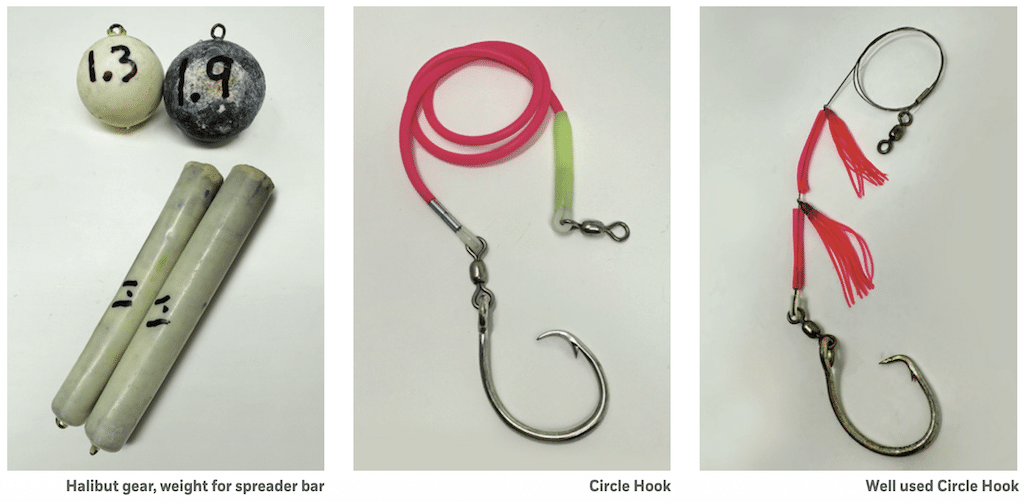
However, for a long-distance configuration, circle hooks are an absolute requirement when float fishing for halibut. Because your bait is drifting far from the hull, detecting a subtle bite at the rod tip is tough, making self-setting circle hooks a lifesaver for float fishing for halibut. When a fish takes a bait 50 feet away, it swallows the bait and moves away, allowing the hook to slide up from the throat and lock into the corner of the jaw completely on its own. When running this rig, configure your reel’s drag slightly lighter so the fish can run, allowing the natural resistance of the surface float to drive the point home cleanly without rider intervention.
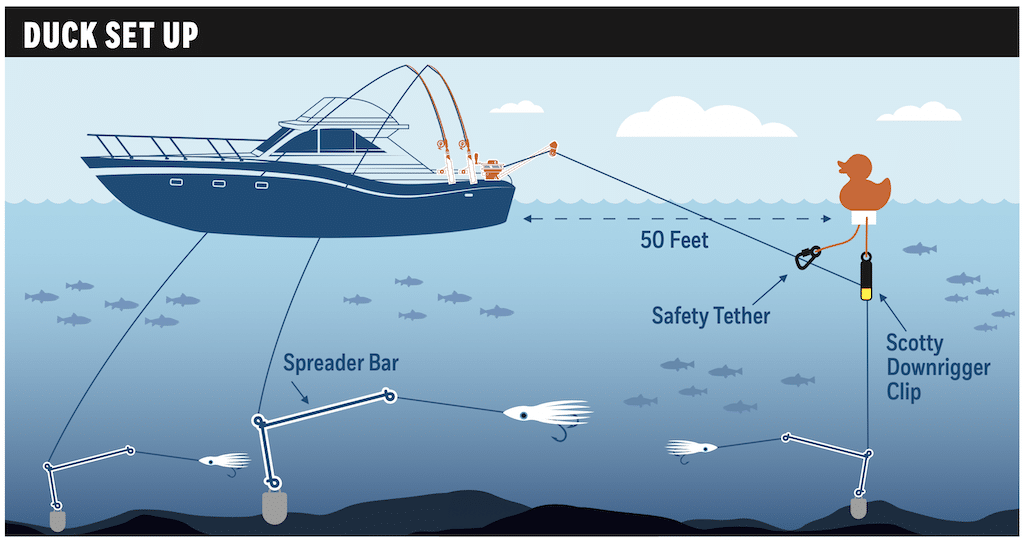
The mechanics of the Duck Rig: Spreading an extra line 50 feet away to expand your bottom coverage zone without risking mid-water tangles.
Building Your Own Rig for Float Fishing for Halibut
If you want to try float fishing for halibut this weekend, you can easily build your own release float from a solar hot tub chlorinator body. For my original prototype, I used a solar-powered, light-up hot tub chlorinator shaped like a yellow rubber duck that was kicking around my workshop. It turned out to be the perfect high-visibility canvas. This home-built setup makes float fishing for halibut incredibly cost-effective and highly entertaining.
To construct the core release assembly, follow these steps:
- The Core Axis: Run a heavy stainless steel bolt completely through the bottom plastic stem of the chlorinator body.
- The Swivel Mount: Lock down a series of stainless steel hex nuts to form a secure center gap, then attach a heavy-duty marine split ring and a large snap swivel.
- The Tension Clip: Fashion a short segment of heavy tuna line from the swivel and tie on a reliable Scotty Power Grip Plus downrigger clip.
- Buoyancy Test: Drop the completed assembly into a large bucket of saltwater with your standard 2-lb weight attached to confirm it floats high and has plenty of reserve buoyancy.
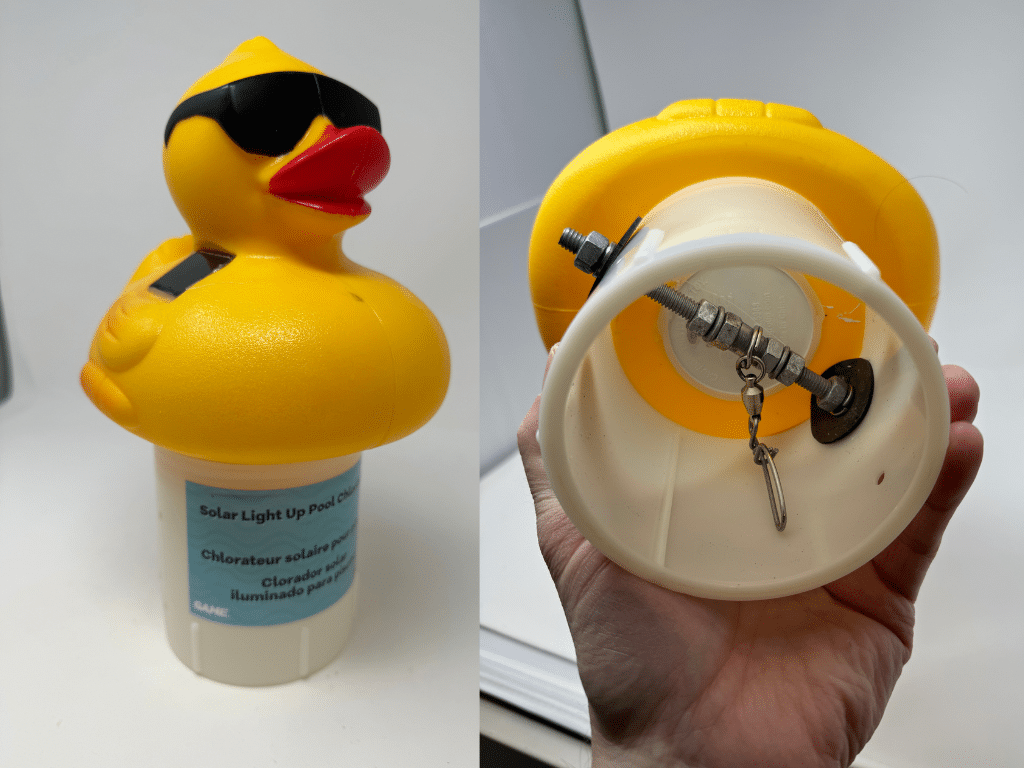
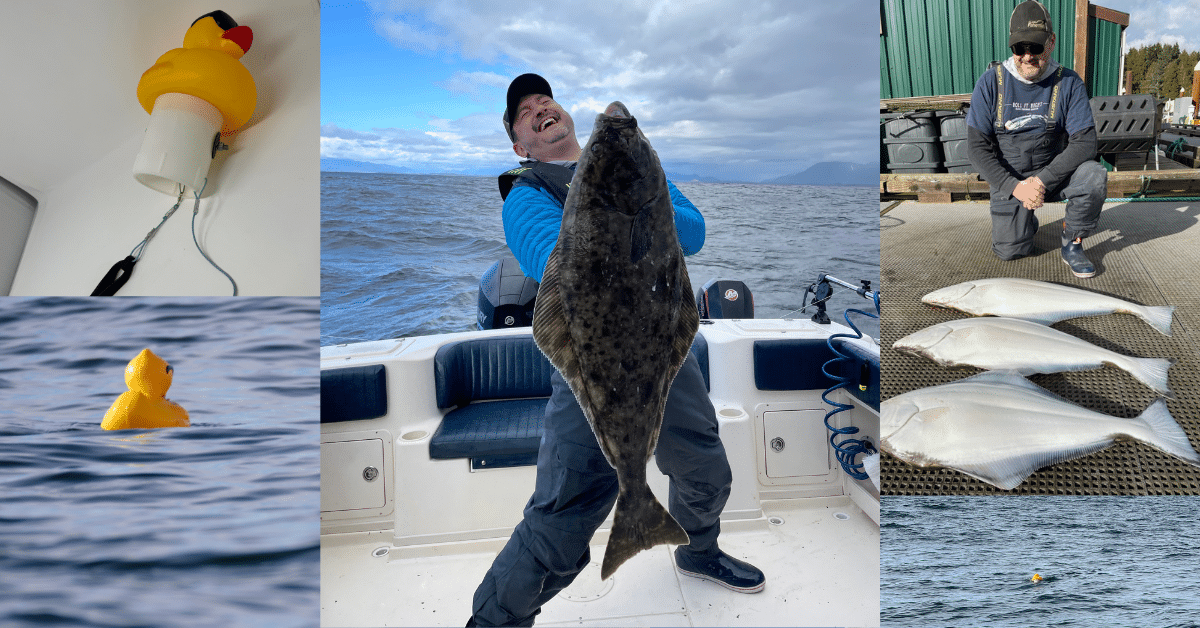
The foundation of the Duck Rig: A standard solar pool chlorinator (left) modified with a heavy-duty stainless steel internal through-bolt system (right) to securely anchor the intense pulling forces of heavy bottom gear.
The process of float fishing for halibut with this rig is simple: drop your terminal line straight off the stern down to the bottom substrate, pinch your main line securely into the yellow pads of the Scotty downrigger clip, and let out line to push the float out to your desired distance. When a fish strikes, the line pulls free from the clip, letting you fight the fish directly without any heavy float resistance.
Crucially, make sure to attach a safety tether from the top of your float using a heavy-duty locking carabiner clipped around the main line. During my initial trials, I used a standard open snap hook safety that allowed the slick braided line to slip out during a hard strike. Much like the infamous scene in Castaway, I had to watch my original prototype float helplessly away toward the horizon, yelling “I’m sorry Wilson!” across the open ocean. If you spot a yellow rubber duck floating somewhere between Tofino and Japan, you’ll know exactly where it came from. Learn from that trial and opt for a fully locking carabiner on your “Duck 2.0” build. Ultimately, adding this tactic to your offshore arsenal is a fantastic way to stack the deck in your favour.

Technical rigging and calibration: The finalized undercarriage assembly featuring the Scotty downrigger release clip and safety tether (left), followed by a mandatory freshwater bucket test to confirm the duck provides optimal buoyancy against the bottom weight.
📊 Halibut Gear & Spread Configurations
| Rigging System | Optimal Hook Selection | Weight Class | Primary Presentation Benefit |
|---|---|---|---|
| Bow Spreader Bar | Large J-Hook with Grub / Skirt | 2.0 lbs (Max Legal Limit) | Stays pinned vertically beneath the bow to prevent tangles. |
| Stern Bait Line | 50/50 Mix (Circle or J-Hook) | 1.0 to 1.5 lbs | Sweeps naturally down-current into the primary scent trail. |
| DIY Duck Float Rig | Premium Circle Hook Only | Dependent on target depth | Pushes a bonus line 50 feet away to explore fresh bottom terrain. |
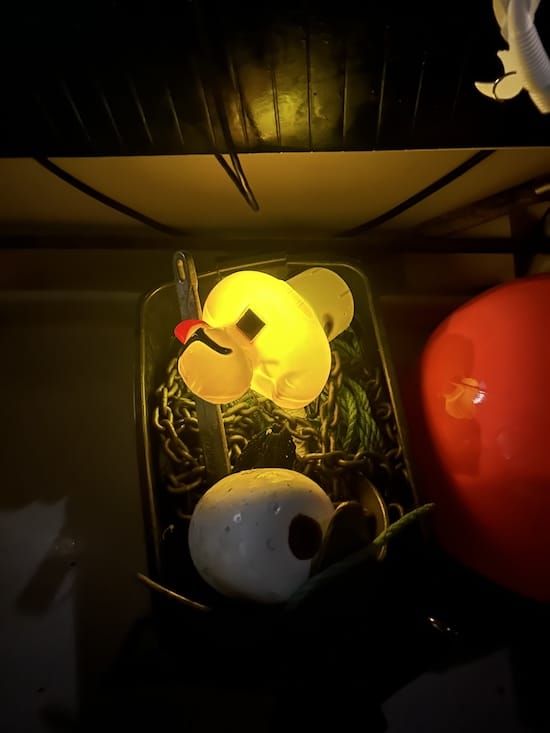
The ultimate bonus feature: Because it’s a solar pool light, the duck charges during the day and glows in the dark inside your locker, making it a breeze to find during those pitch-black, early morning launches.

🍽️ From Ocean Floor to Dinner Table
Now that you know how to expand your territory by float fishing for halibut, make sure you process your fresh fillets with absolute precision. Read our legendary, foolproof guide to How to Make Easy Halibut Ceviche to treat your catch with the culinary respect it deserves.
Words and Photos by Joel Unickow, publisher of Island Fisherman Magazine. Feature cover photography by Rob Frawley.
Island Fisherman Magazine — supporting local innovations and the West Coast lifestyle.