

That Sinking Feeling: The Complete West Coast Guide to Sinking Fly Lines
Mastering sinking fly lines is an absolute necessity for West Coast anglers because, unless an active insect hatch is underway, game fish are almost exclusively feeding deep below the surface. Fly fishing is frequently seen by many, especially the uninitiated, as a wonderful, gravity-defying experience of casting a line back and forth in the clean air, gently laying a dry fly on the water’s surface, and watching a fish rise to smash it.
The cold truth of the matter, however, is that subsurface presentation is where the vast majority of local fish are caught. To consistently intercept these deep-feeding fish, you have to get the fly directly into their strike zone, which requires swapping out your floating line for a dedicated sinking profile.
Wet lines are inherently far more complex than standard floating configurations. Unlike floaters, which are engineered primarily for surface control, mending, and topwater presentation, heavy-density lines must balance core weight distribution, overall sink speed, and tracking consistency through variable water columns.
Gaining a clear, technical grasp of these structural fundamentals will help you choose the exact right line configuration for the target depth, current speed, and angling style you are dealing with across British Columbia’s diverse watersheds.
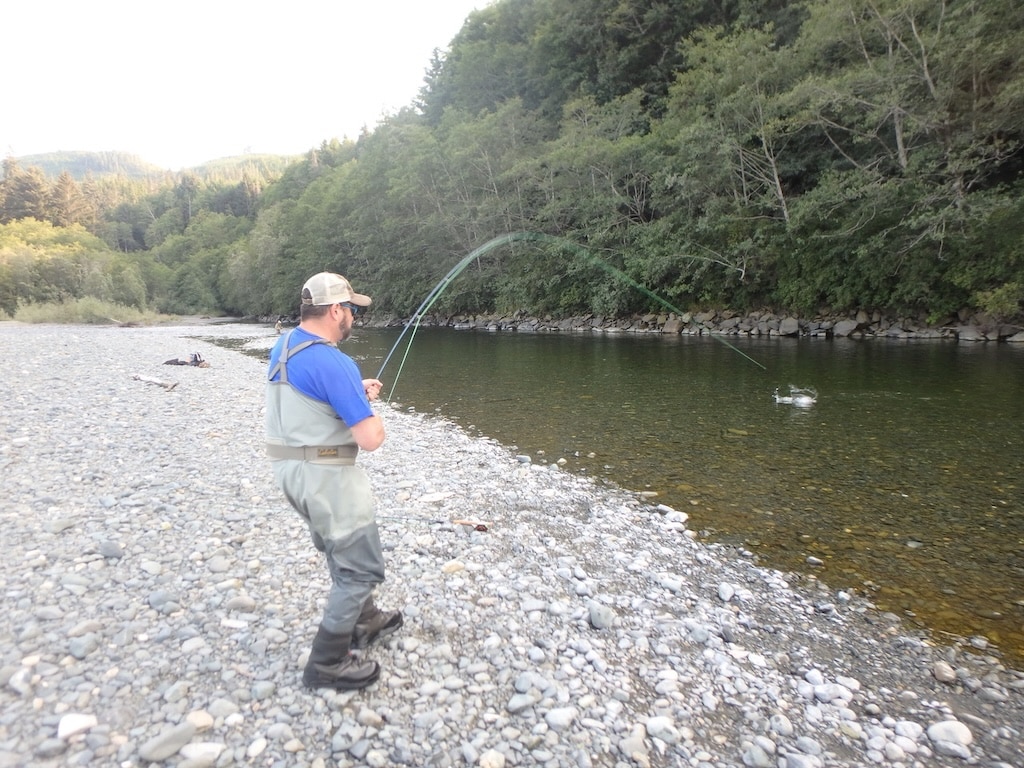
Catching a pink salmon on a float line with sink tip
Understanding Sink Rates and Tungsten Density Mechanics
Wet lines drop through the water column because their outer vinyl coating is thoroughly impregnated with micro-tungsten chips. The physics are straightforward: the more tungsten chips embedded per linear inch of line, the faster it sinks. This is why sinking configurations have varying sink rates, which are standardized across manufacturers using generic Roman numeral classifications.
The standard industry sink rates vary slightly in name between individual brands, but generally follow a designated system from Type I (Intermediate) up to Type VI (Extra Super Fast) and heavy lead core lines. The actual rate at which these lines sink varies anywhere between 1.25 inches per second to 7 inches per second or greater, heavily influenced by the specific line weight and core density.

Product inspection and Labrador approved: A fresh box of Scientific Anglers premium fly line purchased from Fred’s for lake fishing showing the exact weight and sink rate specs discussed.
To consistently drop your fly into the strike zone, you must align these standard ratings with your target fishing depth.
⚠️ The “U-Belly” Presentation Problem
In a standard wet line, tungsten chips are distributed evenly throughout the vinyl coating. However, because the line tapers toward the end, there is less material—and less total tungsten weight—in the narrow tip than in the thick belly. This causes the tip to sink slower than the belly, creating a large “U” or sag in your line. The longer it sinks, the bigger the “U” belly gets, dragging your fly unnaturally and risking immediate bottom snags.
To resolve this dynamic presentation issue, top-tier manufacturers developed what they call a level sink or density-compensated line configuration. Level sink lines feature an increased concentration of tungsten chips per inch inside the tapered front portion of the line, allowing it to sink evenly across its entire length.
This lets the fly fisher get their fly down to the substrate at the exact same time the rest of the line arrives, preventing the belly from hitting the rocks first. Depending upon the type of insect you are trying to imitate, you may want a perfectly flat presentation, while other times a natural belly loop is desired.
Decoding Tapers and Anatomical Configuration
The vast majority of modern performance sinking fly lines measure between 25 and 35 metres in total length and are constructed out of several distinct tapered sections: the tip, front taper, belly, rear taper, and the trailing running or shooting line. Each zone provides specific casting, aerodynamic, and tracking benefits:
- The Tip: The narrowest, most forward section designed for a clean connection and presenting the fly softly.
- The Front Taper: Swells from thin to fat, transferring casting energy forward to turn over the fly smoothly and evenly.
- The Belly: The heaviest portion of the line that carries the weight required to load the fly rod and carry the cast outward.
- The Rear Taper: Narrows down from the heavy belly to transition cleanly into the running line section.
- The Running Line: Thin, slick, and lightweight, engineered to shoot through the guides with minimal friction for maximum distance casting.
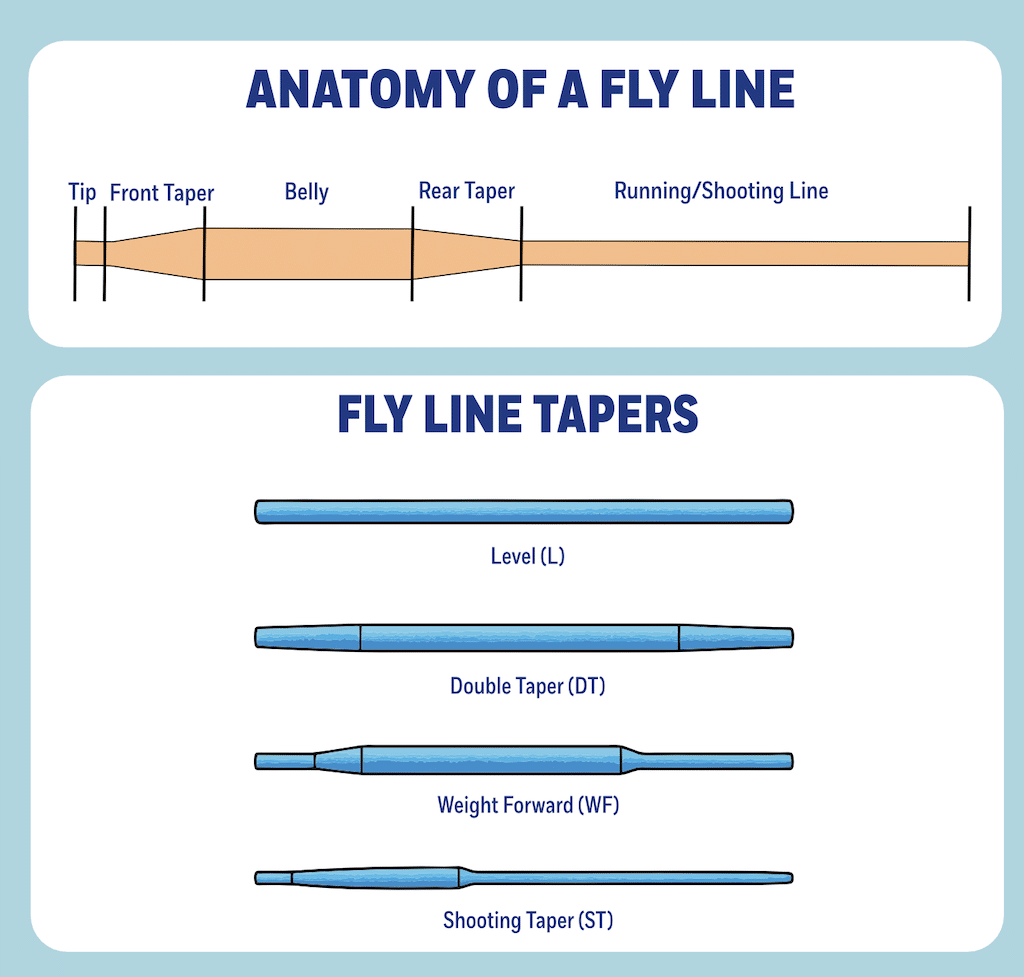
Fly lines come in four main profiles: level, double taper, weight forward, and shooting taper. A level taper line is the exact same diameter from end to end. It is typically the least expensive profile available but offers highly limited utility for technical casting. Double taper (DT) and weight forward (WF) are the clear favorites among West Coast fly fishers.
Double taper lines start thin at the tip, taper up to their maximum diameter within the first 8 metres, remain uniform across the center 25 feet, and taper back down identically at the opposite end. This symmetrical weight distribution supports incredibly delicate presentations. They offer the added advantage of being completely reversible—when one end wears out, you can reverse the line on your reel and fish the fresh side. However, double tapers do not support long-distance casting like a weight forward profile does.
A weight-forward taper sacrifices delicacy of presentation for pure casting distance. This configuration concentrates the majority of the weight inside the front 30 feet (the taper and belly). The caster loads the rod using this front section, and when the cast is released, the heavy head shoots out across the water, pulling the thin trailing running line effortlessly behind it.
For extreme distance, advanced anglers turn to a shooting taper (or shooting head)—a specialized 10-meter head incorporating a heavy weight-forward taper without any integrated running line. Anglers loop slick Dacron backing directly to the butt of the head, virtually hurling the line out over the water much like a spin-caster launching a spoon.
The Reality of Sink Tip Combinations
Sink tip lines combine a floating line body with a dedicated front portion that sinks. These hybrid lines excel when fishing shallow areas in lakes or rivers where a standard floating line won’t get your fly deep enough fast enough, but where a full sinking line will carry the fly too deep too quickly or snag rocks and debris in a stream. Physically, there are three classes of floating/sinking combinations, varying only in the length of the sinking portion:
- Sink Tip: Incorporates 10 feet of sinking line at the tip section.
- Sink Taper: Features exactly 20 feet of sinking line at the front.
- Sink Head: Contains a long 30-foot sinking section built for casting distance.
In everyday tackle shop talk, these strict definitions are pretty much ignored, and everyone calls them sink tips regardless of the actual tip length. You must read the manufacturer packaging carefully to check what length the sinking section actually is. Conveniently, the sinking portion of a combination line is manufactured across all the same standard sink rates found in full wet lines.

📊 Comprehensive Fly Line Technical Specifications
The following responsive reference table details standard commercial line labels, tapers, weights, exact sink rates, and their designated effective depths across British Columbia fisheries:
| Line Label | Line Taper | Line Function / Specification | Sink Rate (ips) | Effective Depth (ft) |
|---|---|---|---|---|
| WF-6-F | Weight Forward | Floating (6-Weight) | N/A | Surface presentations |
| WF-6-S Type I | Weight Forward | Intermediate Sinking | 1.25 – 1.75 | 1 – 2 feet deep |
| DT-6-S Type II | Double Taper | Slow Sinking | 2.5 – 3.0 | 2 – 4 feet deep |
| L-6-S Type III | Level | Fast Sinking | 3.5 – 4.0 | 3 – 7 feet deep |
| DT-5-S Type IV | Double Taper | Extra Fast Sinking | 4.25 – 5.0 | 10 – 20 feet deep |
| WF-5-S Type V | Weight Forward | Super Fast Sinking | 5.25 – 6.0 | 15 – 25 feet deep |
| WF-5-F/S Type VI | Weight Forward | Extra Super Fast Sinking | 6.25 – 7.0 | >25 feet deep |
| WF-6-F/S Type I | Weight Forward | Floating/Sinking (Intermediate Tip) | 1.25 – 1.75 | 1 – 2 feet deep |
| DT-6-F/S Type II | Double Taper | Floating/Sinking (Slow Sink Tip) | 2.5 – 3.0 | 2 – 4 feet deep |
| L-6-F/S Type III | Level | Floating/Sinking (Fast Sink Tip) | 3.5 – 4.0 | 3 – 7 feet deep |
| DT-5-F/S Type IV | Double Taper | Floating/Sinking (Extra Fast Tip) | 4.25 – 5.0 | 10 – 20 feet deep |
| WF-5-F/S Type V | Weight Forward | Floating/Sinking (Super Fast Tip) | 5.25 – 6.0 | 15 – 25 feet deep |
| WF-5-F/S Type VI | Weight Forward | Floating/Sinking (Extra Super Fast Tip) | 6.25 – 7.0 | >25 feet deep |
Tactical Selection of Sinking Fly Lines for BC Waters
So, in practical terms, what should you fish with here on Vancouver Island? Well, that depends entirely upon your local circumstances, seasonal water conditions, and target species.
Island Rivers
Our coastal rivers vary widely in physical size and depth from one watershed to the next, but also change dramatically from season to season. Typically, the faster and deeper the water flows, the heavier and faster the profile of sinking fly lines you will need to fish the water effectively. Assuming you are trying to get your fly down to the river bottom and keep it securely locked in that strike zone as it drifts downstream, you will need a minimum of an Extra Fast Type IV sinking line profile.
If the river run is deeper than average knee depth, step up to a Type VI or heavier setup. Crucially, remember to tie short leaders, or your fly will buoy up in the current and never reach the bottom substrate. In moving waters, it is always better to have a line that sinks too fast than one that drifts high because it sinks too slowly.
When trolling sinking configurations in local lakes and you find your fly picking up bottom debris or weeds, simply wind in about 10 feet of line. Continue making small length adjustments until you run clean. It is always better to sink too fast and reel in line than to fish a line that fails to reach the bottom because it sinks too slowly.
Island Lakes
Our regional lakes are not exceptionally deep unless you are fishing the major interior bodies of water. Before launching, always do your research and check out local bathymetric maps regarding the specific lakes you want to target. As a general baseline, deploying Type III or Type IV sinking fly lines is highly recommended. This density lets you get your fly down to the bottom zone and keep it there while trolling, and it doesn’t take forever to drop if you are casting from an anchored boat or float tube.

Author Bill Luscombe with a premium Vancouver Island rainbow trout taken deep on a wet line using a black Woolly Bugger.
Special Estuary Situations
Here on Vancouver Island, we are blessed with special estuary fisheries during the annual salmon runs. These environments require a line that lets you fish shallow water (often less than 3 metres deep) and retrieve your fly quickly without digging straight into the bottom. Returning pink salmon are usually found in shallower water than coho, but both are targeted effectively with Type I intermediate sinking fly lines or clear sink tip lines.
Furthermore, because estuary water can be gin-clear, salmon can be highly leader/line shy—especially the coho. Opt for a 30-foot clear intermediate sink tip for this specific fishery. After many years of local experimentation, this configuration stands out as the single most effective and productive tool available.
🎣 Rig Your Setup Like a Professional
Now that your line configuration is dialed in for the water column, make sure you’ve got the right rod for the job. Read our definitive guide on How to Pick a Fly Fishing Rod for Power to achieve perfect presentation symmetry across all conditions.
Words and Photos by Bill Luscombe, a veteran West Coast angling authority specializing in subsurface fly presentation tactics. Island Fisherman Magazine — supporting local fly fishers and the coastal lifestyle.