
2026 BC Halibut Regulations: Quota & Size Limits Explained
On February 26, 2026, the DFO officially announced the 2026 halibut management measures, and as usual, the “dockside lawyers” from Sooke to Port Hardy are in full session. To get a real handle on the upcoming season, we need to unpack how these regulations are built—because what the DFO announces on a license doesn’t always reflect the full reality on the water.
The IPHC Decision: Why Canada Took a 7.2% Hit
The management of Pacific halibut is governed by the International Pacific Halibut Commission (IPHC), a treaty-based organization between Canada and the United States established in 1923. Each year, the IPHC reviews scientific data to set the Total Constant Exploitation Yield (TCEY) for the entire coast. Once the total limit is set, it is negotiated and divided into regulatory areas, with British Columbia designated as Area 2B.
While BC (Area 2B on the IPHC) took a 7.2% cut, no other region saw a change or reduction. This was largely political and US delegations argued for a larger share of the coastwide pie. According to National Fisherman, “Serving as the non-voting head of the U.S. delegation was Drew Lawler, a political appointee to NOAA. During private negotiations, U.S. representatives threatened a seafood trade embargo unless Canada agreed to reduce British Columbia’s share.”
The Canadian commissioners were forced to accept a reduction to protect our broader seafood export market from potential trade friction. “After some challenging discussions where livelihoods were threatened, I did what I felt was best for the Canadian stakeholders and the halibut resource,” Canadian commissioner Peter DeGreef, a commercial fisherman, said during the public portion of the meeting. “Now we’re taking the cut in Canada knowing that the halibut stock in Canada will ultimately reap the benefits and the rewards. I wish that other areas would have done the same.”
Because of ongoing coastwide concerns about halibut stocks, the International Pacific Halibut Commission (IPHC) has set the coastwide catch limit at a historic low. For the Canadian Pacific region (Area 2B), the Total Constant Exploitation Yield (TCEY) is set at 5,060,000 lbs. While that sounds like a crisis, BC’s recreational sector is less effected and in a more stable position than headlines suggest. However, to understand why the reductions to the recreational “slice” seems smaller than that big number, first you have to look at the deductions that happen before we ever touch a fish.
Calculating the 2026 Recreational Allocation
| Category | Poundage (lbs) | Explanation |
|---|---|---|
| Total TCEY (Area 2B) | 5,060,000 | The grand total of all halibut removals allowed in BC for 2026. |
| Minus First Nations FSC | -423,096 | Priority access for Food, Social, and Ceremonial needs. |
| Minus Non-Directed Bycatch | -230,000 | Halibut caught incidentally in other fisheries (e.g., Trawl). |
| Minus Commercial Discard | -160,000 | Mortality from the directed commercial fishery (e.g., lost gear). |
| Minus Recreational Discard | -30,000 | Estimated mortality from released fish in the recreational sector. |
| Catch Limit for Allocation | 4,216,904 | The remaining pool to be split between Commercial and Recreational. |
| Commercial Allocation (85%) | 3,584,368 | The designated share for the commercial fleet. |
| Recreational Allocation (15%) | 633,750 | Our final “base” Total Allowable Catch (TAC) for the season. |
Halibut Regulations Key Changes: Overage vs. Underage and the “Clean Slate”
In the recreational world, management is a one-way street. If we exceed our quota (an overage), the recreational sector must deduct that exact amount from the following year’s starting line. In 2024, an overage resulted in a 30,000 lb deduction from the 2025 season.
However, looking only at the “Base Allocation” can be misleading. To understand the 2026 season, we have to look at the Net Available TAC—the actual pounds we are allowed to catch after these adjustments are settled. Because we are starting 2026 with a clean slate and no overage penalty, our actual fishing capacity is only 16,500 lbs lower than it was at the start of 2025.
| Year | Base Rec. Allocation | Overage Adjustment | Net Fishable TAC |
|---|---|---|---|
| 2024 | 973,200 lbs | 0 | 973,200 lbs |
| 2025 | 680,250 lbs | -30,000 lbs (from 2024) | 650,250 lbs |
| 2026 | 633,750 lbs | 0 (Clean Slate) | 633,750 lbs |
Why the Math Matters:
While the total allocation for BC dropped this year, the actual impact on our coolers is dampened because we didn’t over-harvest in 2025. The 2025 season finished with a significant underage of 147,000 lbs. As specified by the framework, those pounds do not get added to our 2026 total but leaving them in the water is exactly why we aren’t facing a penalty right now. We are starting 2026 within striking distance (16,500 lbs) of last year’s actual fishing capacity.
Why the Double Standard for Commercial?
The commercial sector does get to carry over an underage of up to 10%. Commercial boats operate under Individual Transferable Quotas (ITQs). Every single halibut they land is weighed at a certified dockside station and tracked electronically. DFO allows them to manage their “bank account” with carryovers.
The Calendar Trap: Why March 31 Isn’t the Finish Line
A common point of confusion is the discrepancy between the license year and the quota year. Your Tidal Waters Sport Fishing Licence runs from April 1 to March 31, but the IPHC sets the Total Allowable Catch (TAC) on a strict calendar year (Jan 1 – Dec 31).
This means any halibut you catch in February or March 2026 does not come from the prior year “leftover” fish. It is immediately deducted from the 2026 allocation. You aren’t using up last year’s slack; you’re spending 2026’s “bank account” before the summer season even begins.
Pleasing the Masses: What Anglers Actually Want

To navigate these tightening quotas, the SFI and SFAB conducted a survey of over 2,013 respondents were comprised of independent anglers (84.60%), guides (11.92%), and resort employees (3.48%).
Who Responded to 2026 Halibut regs
With over 55.44% of respondents fishing the West Coast of Vancouver Island, making everyone happy is impossible. However, the consensus on priorities is clear:
- Summer Access is King: 78.99% of anglers ranked June to mid-September as their top priority.
- Size Over Season: When forced to choose from various options, 44.91% (largest choice group) would accept a shorter season if it meant a larger average halibut size.
- The “Summer Lock”: Given the choice to “lock in” just one management goal, 32.29% (largest choice group) chose a shorter season with bigger fish.
Why the April 1st Opening Matters for Coastal BC
You might ask: If the survey shows people are willing to accept a shorter season for bigger fish, why did the SFAB recommend that DFO still opens the season on April 1? The answer lies in the Symmetry of Opportunity. While the majority of respondents (55.44%) are WCVI-based, the SFAB must also consider the interests of South Vancouver Island who rely on early spring windows when tides and weather allow for safer offshore access while trying to keep the season open until December which is important for North Coast anglers.
As the halibut biomass and available Total Allowable Catch (TAC) continue to decline, the SFAB faces a difficult balancing act: satisfying the majority’s preference for a shorter season with larger fish versus the needs of those seeking the longest possible season. By opening in April this year, the SFAB established a ‘baseline’ of opportunity across all regions while gathering survey data to fine-tune future management. These are vital steps as we adapt to this new era of declining biomass. Regarding in-season adjustments, the DFO has developed new Variation Orders that allow for increased daily retention should data indicate we are trending toward a TAC underage.
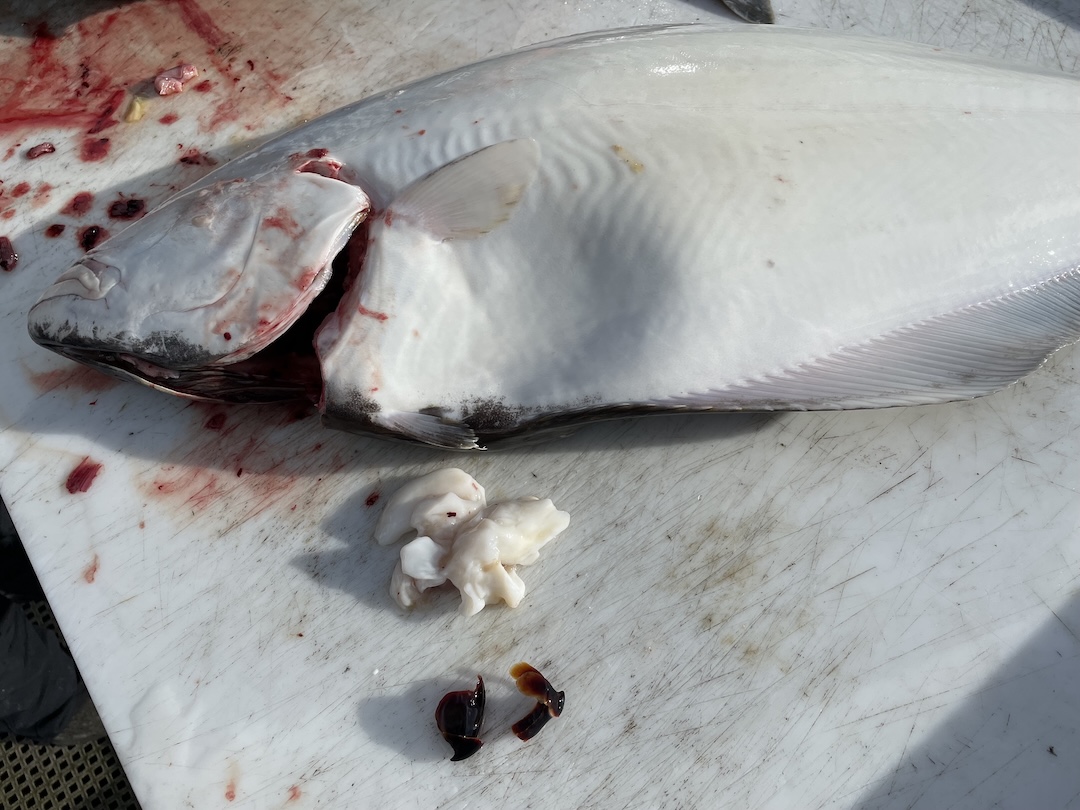
BC Halibut with octopus beaks (photo: Joel Unickow)
The 2026 Verdict: What to Expect on the Water
Despite the headlines about “historic low” coastwide limits, the outlook for BC’s recreational sector is remarkably stable compared to where we were this time last year.
- Stability is Key: Thanks to a disciplined 2025 season with no overage, we are only facing a 5% decrease in “actual” fishable pounds (a drop of 16,500 lbs) rather than the scary 7.2% drop seen in the gross allocation numbers.
- The “Clean Slate” Bonus: Starting the season without a 30,000 lb penalty is a massive win. It means management measures (like size and daily limits) have a much better chance of staying consistent throughout the summer without emergency mid-season closures.
- Size Limits for 2026: To protect that 633,750 lb limit, expect the DFO to maintain the conservation-minded status quo:
- Daily Limit: 1 halibut
- Possession Limit: 1 halibut
- Max Size: 112 cm (approx. 40 inches) head-on
Need more articles (i.e. how to) on Halibut fishing? Click here.
What are the 2026 BC Halibut Regulations?
For the 2026 season, the BC recreational halibut fishery (Area 2B) has a Total Allowable Catch (TAC) of 633,750 lbs. The season officially opens April 1, 2026, with a daily limit of 1 fish and a maximum size limit of 112 cm (head-on). Due to a clean slate from 2025, the “actual” fishable poundage remains very close to last year.