


Mother and son having a great time fishing Sockeye in the Alberni Inlet. Photo: Doug Lindores, Slivers Charters Salmon Sport Fishing.
Ultimate Guide to Alberni Inlet Sockeye Fishing: Tactics, Gear, and Hot Spots
Sockeye salmon (Oncorhynchus nerka) are world-renowned for their deep crimson-red flesh, rich omega-3 fatty acid content, and their remarkable, grueling migration back to their natal creeks, streams, and rivers. To the general public, they are the iconic, bright red salmon that thousands of tourists travel to witness in their freshwater spawning grounds during the autumn months across British Columbia. However, to Pacific Northwest anglers, they represent one of the most thrilling and rewarding sport fisheries on the West Coast.

Sockeye salmon Photo: Eiko Jones Photography
The Legendary Sockeye Salmon Runs of British Columbia
There are many massive wild sockeye fisheries across North America. Alaska’s Bristol Bay is widely recognized as the largest wild sockeye fishery in the world. Closer to home in British Columbia, the Fraser River boasts returns that vary significantly from year to year, occasionally seeing massive cycles of 25 to 30 million salmon. Notably, the 2026 returning sockeye run to the Fraser River is expected to bring exceptionally high numbers.
Right here on Vancouver Island, Port Alberni boasts a world-class sockeye run returning to the Somass-Stamp River system. While the total returns may not reach the astronomical heights of the Fraser River, the Somass run can easily exceed one million pieces, with average years consistently yielding 600,000 to 800,000 returning salmon.
| Metric / Location | Run Profile Details |
|---|---|
| Peak Return Window | Mid-June to Late July |
| Average Annual Run Size | 600,000 to 800,000 salmon |
| Peak Return Potential | Exceeding 1,000,000 pieces |
| Primary Summer Holding Lakes | Sproat Lake & Great Central |
Understanding the Sockeye Salmon Life Cycle
To successfully target these fish, it helps to understand the sockeye salmon life cycle. Sockeye typically operate on a strict four-year life cycle. In the autumn, female sockeye lay anywhere from 2,000 to 5,000 eggs in gravel nests called “redds,” which they dig into the clean gravel beds of freshwater streams or lake shores.
The eggs incubate safely under the gravel through the winter. In late winter or early spring, they hatch into immature sockeye known as alevins. These tiny alevins remain buried in the gravel, feeding entirely off an attached yolk sac until mid-spring.
Once the yolk sac is fully absorbed, they emerge from the gravel as “fry” and migrate into nearby freshwater lakes. At this stage, sockeye fry feed primarily on tiny aquatic insects and zooplankton. Sockeye are unique because they will remain in these freshwater lakes for up to one or two years before migrating out to the ocean as “smolts.”
Before entering the Pacific Ocean, sockeye undergo a profound physiological transformation called smoltification, which alters their internal chemistry to allow them to survive in saltwater. Once at sea, sockeye grow rapidly into mature adults. As three- or four-year-old fish weighing anywhere from four to eight pounds, they navigate thousands of miles back to the exact stream where they were born, using the Earth’s magnetic field as a natural GPS.
Upon reaching fresh water, the life cycle comes full circle. Both male and female adult sockeye transform into a marvelous, bright red color with distinct green heads. Their journey ends after the fertilization process (the spawn) in their home stream, where they die and nourish the ecosystem for the next generation.

The Magic of Summer Mornings in the Alberni Inlet

These happy people from Mexico, Belize, and Qualicum had a wonderful day fishing with Doug (author of this article) of Slivers Charters Salmon Sport Fishing and landed several Sockeye Salmon in June of 2025.
Once regarded almost exclusively as a commercial prize, sockeye have rightfully evolved into an incredibly popular recreational sport fish. Every spring and summer, vast schools of sockeye journeying from the North Pacific Ocean enter the pristine waters of Barkley Sound, make their way up the elongated Alberni Inlet, and push into the Somass-Stamp River system.
There is something undeniably magical about a June or early July summer morning in the Alberni Inlet when the sockeye arrivals peak. The inlet truly comes alive at dawn; navigation lights flicker across the glassy, calm water as an absolute armada of eager anglers heads out in search of schools of chrome-bright salmon. The inlet, which sits quiet for months out of the year, suddenly buzzes with the collective hum of trolling motors, the clicking of downriggers, and the unmistakable scream of an angler’s reel clearing the rod holder.

The magic of sockeye fishing Alberni Inlet BC is undeniable
Unlike Chinook or Coho salmon, sockeye are sleek, lightning-fast, and notoriously unpredictable. Trolling for them in the protected waters of the Alberni Inlet has rightfully earned its reputation as one of Vancouver Island’s most thrilling and productive summer sport fisheries. From mid-June through very late July, the Alberni Inlet transforms into a major marine migration highway packed with dense schools of fresh, ocean-bright sockeye.
Sockeye Salmon Behaviour, Identification, and Environmental Factors
Key Sockeye Identification Features
Anglers should note that sockeye look vastly different from other salmon species while in the ocean. They feature:
- Deep forest-green backs
- Bright, shimmering silver bellies
- Large, penetrating eyes
- White or pale gums completely devoid of teeth
The Plankton Diet and Its Impact on Trolling Tactics
Unlike predatory Chinook and Coho that aggressively hunt forage baitfish like herring and anchovies, sockeye feed almost exclusively on plankton, krill, and tiny crustaceans during their marine life cycle. This specialized diet is exactly what gives their flesh its beautiful, signature bright red or orange coloration.
Because they feed mainly on micro-plankton, trolling for sockeye requires an entirely different tactical approach than targeting other salmon. Success depends on extreme precision, boat control, and the presentation of specialized micro-lures.
Tracking the Thermocline and Water Temperatures
Most successful anglers spend their time actively searching for school profiles on their sonar. Sockeye travel in incredibly tight, dense groups. In the early portion of the summer season, these schools can typically be found suspended in the cooler water column between 35 and 50 feet deep.
By mid-to-late July, as the surface water of the inlet warms significantly, the fish dive deeper to find comfort, meaning sockeye can more reliably be found anywhere from 75 to 100 feet deep.
Sockeye salmon fishing is highly dependent on environmental factors. When the water temperature in the inlet and the freshwater river system warms to 17 or 18 degrees Celsius, a natural thermal barrier forms. This dramatically slows down the salmon’s upstream migration, causing them to pool and school up in massive numbers within the Alberni Inlet itself.
These dense aggregations begin to form in multiple key locations ranging from the immediate Port Alberni Harbour all the way down the inlet for approximately ten miles. With such massive schools of fish stalled in the saltwater, trollers are handed a phenomenal sport fishing opportunity, as these schooling salmon become highly competitive and will aggressively strike well-presented mini plankton-type lures.
Top Alberni Inlet Sockeye Hot Spots
Be sure to visit these specific primary locations:
- Lone Tree Point
- Cous Creek
- China Creek
- Leaning Tree
- The Slide
- The Narrows
- The Nahmint-Franklin-Ten Mile Point Area
Alberni Inlet Sockeye Fishing: Gear, Flashers, and Lures
| Gear Parameter | Target Specification / Rigging Setup |
|---|---|
| Trolling Speed Range | 1.7 to 1.9 mph (interspersed with tight S-turns) |
| Primary Flashers | Hot-spot flashers in Green, Purple, and Green-Plaid patterns |
| Alternative Attractors | West Coast style traditional flashers in Green, Blue, or Black |
| Primary Lure Options | MP (Mini Plankton) hoochies in Pink/Blue or Pink/Black finishes |
| Secondary Lure Choices | An MP 15 or high-vis Bubblegum mini plankton hoochie |
| Leader Dimensions | Varying lengths between 16 inches and 25 inches based on boat speed |
| Flasher Presentation | 8-flasher spread (4 hookless “dummy” flashers, 4 lines with lures) |
| Downrigger Spacing | Run tight to boat (5-6 ft back), staggered 12-15 ft apart vertically |
Flashers and Lure Selection
Sockeye are best targeted utilizing a slow, methodical troll paired with high-visibility attractors. High-activity Hot Shot flashers in Green, Purple, and Green-Plaid are industry standards. Several traditional West Coast flashers in solid green, blue, or black are also incredibly effective choices.

Trailing immediately behind the flasher, you want to run an “MP” (Mini Plankton) hoochie. The most productive mini plankton hoochies are coloured in contrasting pink-and-blue or pink-and-black combinations. An MP 15 or a classic “bubblegum” mini plankton hoochie is also an essential choice that should be in every tackle box.
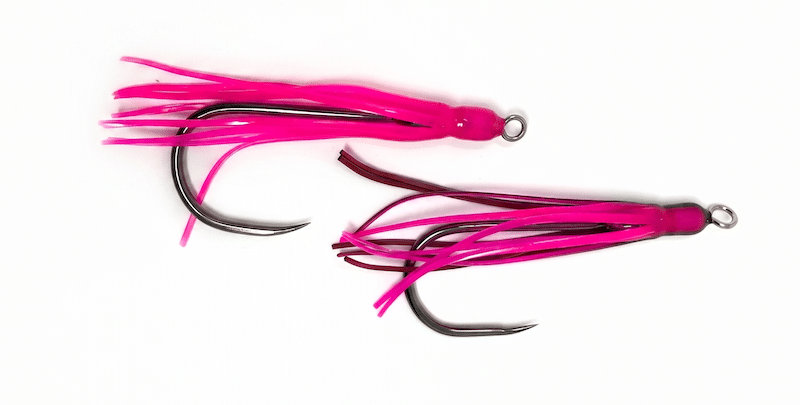
MP hoochies, or Mini Plankton hoochies, are highly effective, small soft-plastic squid lures primarily used for targeting sockeye salmon, particularly in British Columbia’s Alberni Inlet and Barkley Sound.
Because sockeye are strictly visual feeders, leader length from the flasher to the hoochie is critical and must be adjusted in accordance with your trolling speed, which should ideally hover between 1.7 and 1.9 mph. Leaders generally vary anywhere from 16 inches to 25 inches or more depending on the specific preferences of local guides.
The “Wall of Color” Downrigger Technique
Sockeye are intensely attracted to vast arrays of colour and movement. Because of this schooling curiosity, it is not uncommon for West Coast anglers to fish with as many as eight flashers simultaneously behind the boat to create a massive school simulation. This aggressive setup typically accounts for four “dummy” flashers (attached directly to the downrigger cannonballs without hooks) and four active flashers running on independent rod lines with lures.
⚙️
How to Fish with Dummy Flashers
Learn how to hook up inline attractors directly to your downrigger cannonballs. Create a massive “wall of color” simulation without adding extra drag to your fishing rods.
Heavy downriggers are absolutely essential for this style of fishing. Anglers must stagger the various flashers—both with and without hoochies—at varying depths to effectively blanket the water column until a productive depth pattern develops.
To maximize the visual attraction, all of your gear, including the dummy flashers, should be kept remarkably tight to the back of the boat. Ideally, a setback of 5 to 6 feet from the downrigger wire is perfect, and your flashers can be staggered 12 to 15 feet apart vertically.
🎣
Stacking Fishing Lines Like a Boss
An in-depth look at downrigger setups, line release options, and spacing protocols to help you successfully deploy multiple lines without tangles.
Detecting Subtle Bites and Mastering the Troll
Anglers must keep a watchful eye on their rod tips, as sockeye bites can be surprisingly subtle. Unlike the violent, rod-burying strikes of a large Chinook, a sockeye bite may move the rod tip very little, often exhibiting a quick, rhythmic downward motion that can easily be missed if you aren’t paying attention.
To trigger stubborn fish, experienced anglers will frequently make tight, continuous “S-turns” while trolling down the inlet. This maneuver triggers reactions strikes because the gear on the inside track of the boat will briefly slow down and drop, while the gear on the opposite outside track speeds up, instantly changing the action of the lure and creating an irresistible presentation.
Landing the Acrobatic Sockeye
Don’t let their subtle bites fool you: once securely hooked, sockeye instantly transform into incredibly hard-fighting, acrobatic salmon. They are famous for twisting, turning, tearing across the surface of the water, and leaping wildly right alongside the gunwales of the boat. While landing a sockeye is pure fun, their soft mouths and erratic head shakes mean it can be incredibly difficult to successfully net them, requiring a calm hand and a steady boat rhythm.

Feisty sockeye jump like crazy, so landing them is a real treat!
A Vancouver Island Summer Tradition
Sockeye fishing in the historic Alberni Inlet is a spectacular, accessible fishery enjoyed by anglers of all generations and skill levels. While successfully landing a limit of bright salmon certainly makes a day trip memorable, it is the overarching West Coast experience that cements it in the mind.
Trolling surrounded by the breathtaking scenery of towering forested mountains, watching mature bald eagles drift effortlessly overhead, and keeping an eye out for the odd, pesky harbour seal following the salmon schools makes a day on these waters feel truly like heaven. For local island anglers and visiting international tourists alike, there is simply no better sign that a West Coast summer has officially arrived than seeing a bright, silver sockeye flashing and jumping wildly behind the boat in the Alberni Inlet.
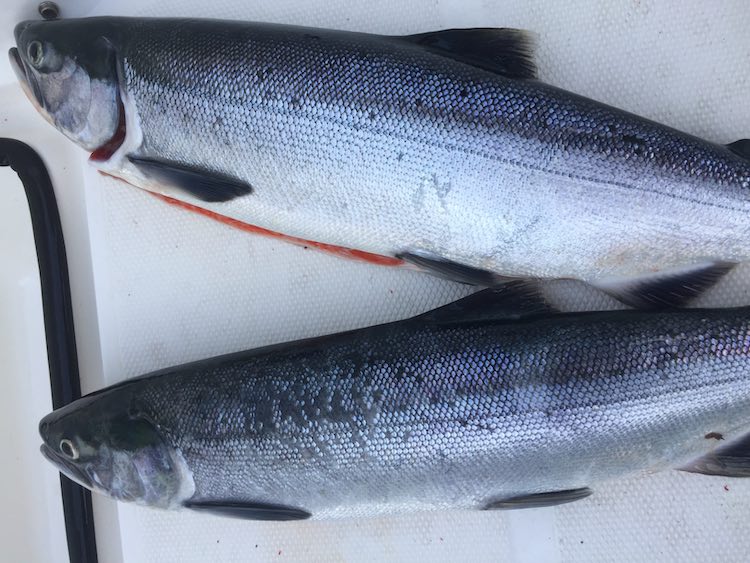
Port Alberni sockeye
Local Expert
Doug Lindores is the owner of Slivers Charters Salmon Sport Fishing, guiding anglers to premium fishing success across Vancouver Island’s most productive West Coast waters.
Stay Informed on BC Fishing
For more breaking updates, regulatory changes, and community reports, visit our news hub.