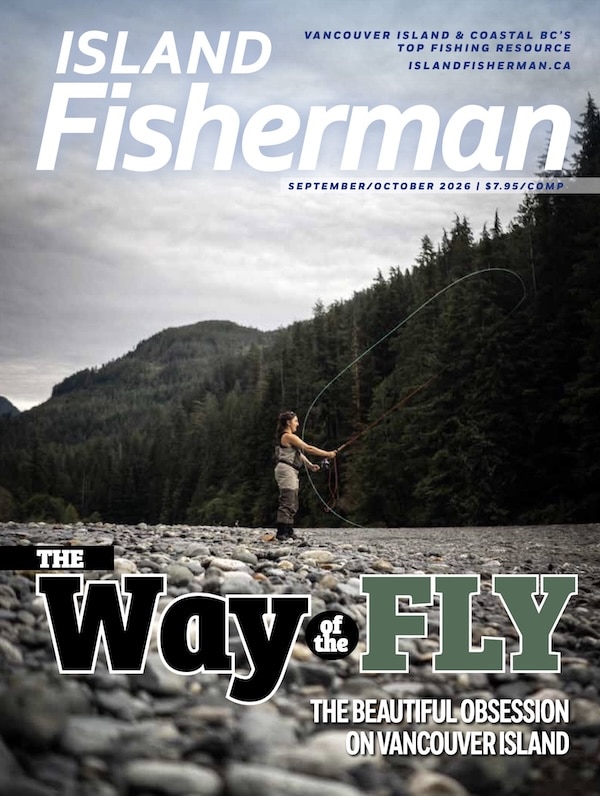


The DFO has released the next stage of its Salmon Allocation Policy (SAP) review, and it opens a debate on who gets priority access to B.C.’s most prized salmon. Since 1999, recreational anglers have held priority access to Chinook and coho salmon after conservation and First Nations food, social, and ceremonial needs were met, but on December 1, 2025, DFO released a discussion paper outlining recommendations that could strip away this recreational priority in favour of increased commercial allocations.
The debate over who gets to catch BC’s salmon (the commercial fleet or the angling public) is often charged with emotion. But when you strip away the history and look at the hard data, a very clear picture emerges. This isn’t about commercial vs. recreational; it’s about how we get the best return for Canadians from a precious, public resource. Here is the economic comparison, at a glance.
The Jobs Gap: One Sector is Growing, the Other is Shrinking
When it comes to employment, there is no contest. The recreational fishing sector is a massive, decentralized economic engine supporting small businesses in every coastal town. The commercial salmon fleet, by contrast, has become a small, highly mechanized industry.
The “Anchor” Effect of Salmon

Results of the Pacific tidal recreational fishing survey, 2023 DFO iSEA
While anglers fish for many species (like halibut and lingcod), Chinook and coho salmon are the anchor tenants. They are the primary draw that gets the angling public on the water, fills lodges, books guides, and sells boats. Overall, the recreational sport fishing industry in BC supports approximately 9,110 jobs and $643M to the GDP. You cannot remove priority access to these salmon without collapsing the entire job pool that depends on the opportunity to catch salmon.
What is BC’s Recreational Fishery Worth?
| Metric | Recreational Fishery (Entire) | Commercial Salmon Fishery |
| GDP Contribution | ~$643 Million | $12 Million (Direct) |
| Employment | 9,110 Jobs | 881 Jobs (Direct) |
| Total Sales/Output | ~$1.276 Billion (Gross Sales) | $23 Million (Landed Value) |
| Primary Value | (Value generated by the pursuit and tourism infrastructure) | (Value generated by harvesting and exporting biomass) |

Combined Tidal and Freshwater Fast Facts created from DFO iSEA survey data. Source Salmonforever.ca
GDP & Economic Output: The Value of “High-Margin” Fishing
The fundamental difference between the two sectors is their business model:
- Commercial Model: Volume-based extraction. The goal is to harvest as many fish as efficiently as possible to sell at a price per pound model.
- Recreational Model: Service-based experience. The value is generated by the activity of fishing—hotels, fuel, gear, guiding fees, marina fees, boat sales and servicing and restaurant meals—regardless of whether a fish is retained.
This makes a single Chinook or coho salmon caught by an angler exponentially more valuable to the Canadian economy than the same fish sold at a dock.
The Bottom Line: The Commercial Salmon fleet generates less of the GDP and supports less of the jobs that the Recreational Fishery provides.

DFO 2023 Economic profile of the BC salmon fishery
Note from the above that 881 people with a total income pool of $7.9m equals annual income per person of $8,967.08. Even doubling this income (giving the commercial fishery the entire recreational fishery catch), the income per person would only be $17,934.
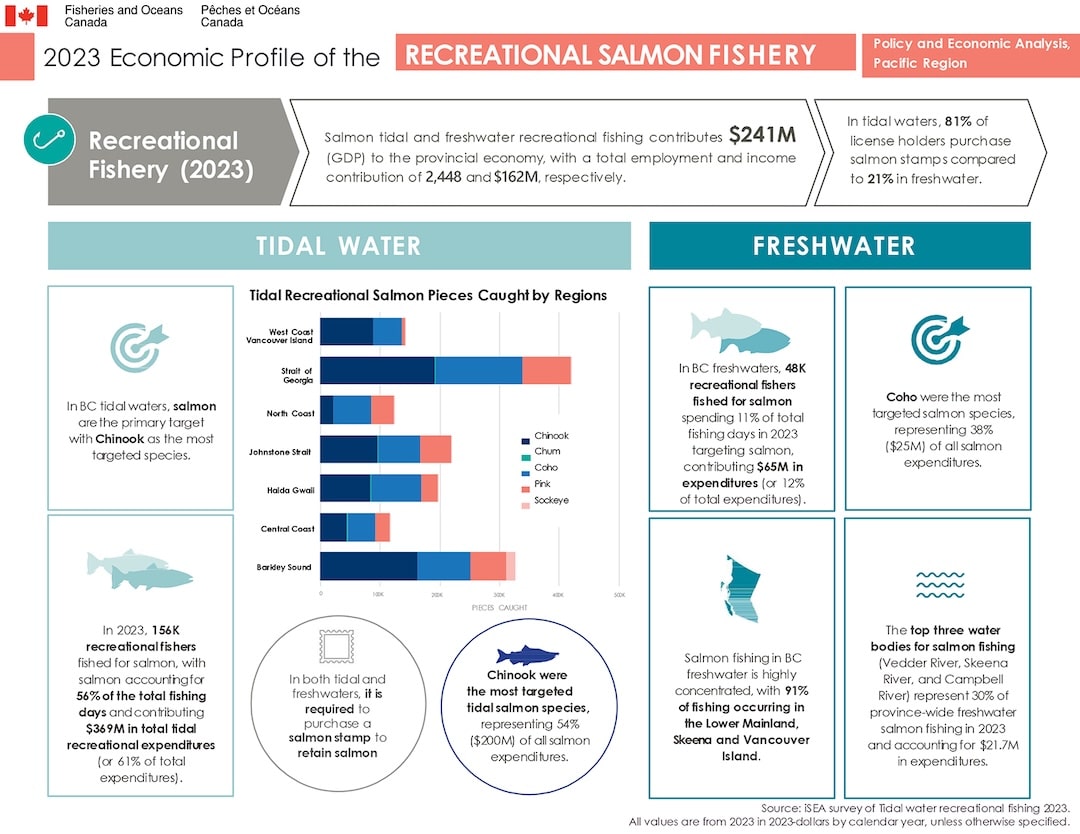
Note from the above that 2,448 people with a total income pool of $162m equals annual income per person of $66,167.47.
Food Security? Not Quite.
A common argument for commercial priority is “food security” for Canadians. Data tells a different story.
- Export Commodity: The majority (60-70%) of wild BC commercial salmon is exported to international luxury markets in Japan, the USA, and Europe. It is a high-priced export product, not a staple food source for Canadian families. According to the 2023 Economic Profile of the BC Salmon Fishery by DFO, the total value of wild salmon exports ($58 Million) significantly exceeds the total landed value ($23 Million), confirming that the industry is heavily export-oriented rather than focused on domestic consumption.
- Local Consumption: The recreational fishery is a primary source of high-quality food for hundreds of thousands of BC residents and their families.
Recreational salmon fishing is more than just food. For over 320,000 licensed participants, the fishery connects them to salmon creating significant life-long family traditions. Recreational fishers are salmon people and opportunity to go fishing is the cultural life-blood for many B.C. communities.
The Financial Reality of the Fleets
The Commercial Fleet: The commercial salmon fleet has shrunk from ~4,500 vessels in the 1990s to under 450 active vessels today. It is a sector in long-term decline, characterized by:
- Negative Margins: Without rare, high-volume return years, many vessel owners do not cover their operating costs.
- Public Subsidies: The sector has required repeated taxpayer-funded bailouts, such as the Pacific Salmon Commercial Licence Retirement Program, to remain solvent.
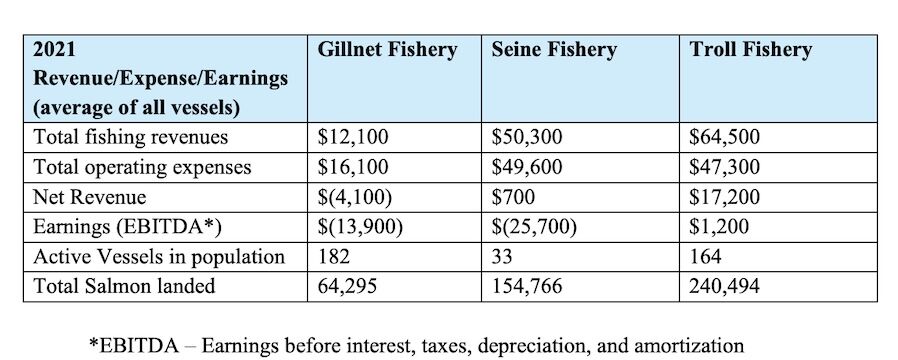
DFO Cost and Earnings Survey 2021 Economic Analysis Unit
Pacific Region
The Recreational Sector: This sector is a net contributor to government revenue. Anglers pay millions of dollars annually in license fees, and via the Salmon Conservation Stamp. It directly funds community salmon restoration initiatives. It is a user-pay system that supports the resource it relies on.

Conclusion: Prioritizing the “Many”
When the government’s stated goal is to save jobs and generate revenue, the data provides a clear path. Reallocating salmon to the commercial sector prioritizes the demands of a shrinking, subsidized group (the “few”) at the direct expense of a thriving, diversified economy that supports over 9,000 families (the “many”).
Look, I’m not a politician. But it stands to reason to optimize the economic benefit of our salmon resource for all Canadians, after the needs of conservation and First Nation Food, Ceremonial, Social (FSC) and rights-based commercial fisheries are accounted for, policy must prioritize the sector that delivers the highest value per fish. In 2025 and moving forward, that is unequivocally the Recreational Fishery.
Participation for Feedback to DFO
Feedback regarding the Salmon Allocation Policy is encouraged. Submit your comments by email to [email protected] no later than January 9, 2026 (Extended to January 23, 2026).
*According to DFO’s Results of the Pacific tidal recreational fishing survey, 2023 over the past 23 years (2000-2023), tidal water recreational fishing expenditures averaged $743 million annually (in 2023 dollars). Of those expenditures, it calculates that $412 million was the average annual value added to the provincial GDP.
Additional Sources: DFO 2023 Economic Profile of the BC Salmon Fishery; BC Stats Fisheries & Aquaculture Sector Reports; Sport Fishing Institute of BC Economic Analysis, SFI: Forever Salmon, DFO Results of the Pacific tidal recreational fishing survey, 2023.