
Mark-Selective Fisheries Can Be Successful, If…
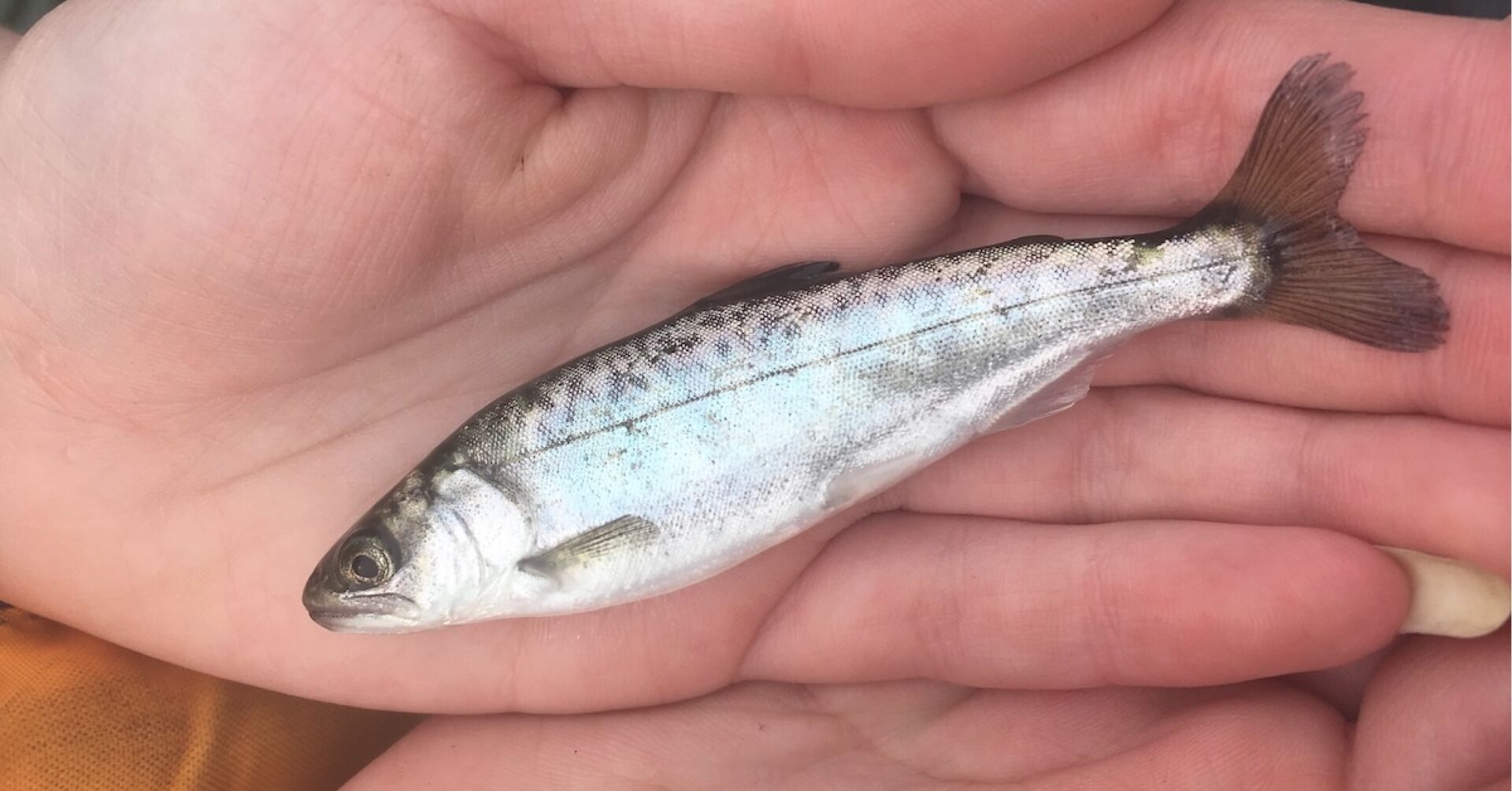
Selective fishing is a management term for strategies that allow fishermen to separate abundant salmon stocks from those at conservation risk. Mark-selective fisheries (MSF) is one component. It’s based on targeting adipose fin-clipped hatchery salmon while releasing wild salmon, whose fin is still attached. Understanding MSF and its management implications is critical for the future of BC’s public salmon fisheries.
. Mark-selective fisheries (MSF) is one component. It’s based on targeting adipose fin-clipped hatchery salmon while releasing wild salmon, whose fin is still attached. Understanding MSF and its management implications is critical for the future of BC’s public salmon fisheries.

Tagging trailer dispensing the fin-clipped fry into pens. (Photo: Fisheries and Oceans Canada)
The following remarks are from a 1999 keynote address by Terry Tebb, then Regional Director of Fisheries Operations for Fisheries and Oceans (DFO). They were sourced from the Record of the Selective Fisheries Multi-Stakeholder Workshop held in Richmond, BC.
“In 1998 David Anderson, Minister of Fisheries and Oceans, announced, ‘fundamental and long-term change in salmon fisheries to achieve a sustainable fishery in the future'”. The purpose was to ensure conservation objectives are met while allowing safe harvest of target stocks or species. Tebb’s speech noted in a New Directions document, “Selective fishing is a fundamental part of this change”. Elsewhere, the Record says, “First Nations, recreational, and commercial fisheries will use selective methods to harvest salmon”. The workshop summary offers a look at the department’s thinking at that time, supported with the known data on Chinook mortalities for each fishery and gear type.
Twenty sets of recreational data came from seven hook-and-release mortality studies done between 1990 and 1999 in BC, Oregon, California, and Washington, trolling or mooching a variety of hook styles, hook sizes, and gear types. Nine of the results came from trolling with hardware and cut plug herring, and five from mooched cut plug herring. These showed release mortalities ranging from 0% to 15%.
The Most Damaging Recreational Fishing Style is Rarely Used in BC
California drift mooching with anchovies caused the highest release mortalities, ranging from 31% to 73%. This fishing method, done from large stationary charter boats, is essentially absent from BC recreational fisheries. Consequently, those mortality results should not be associated with any BC marine recreational fishery discussion or analysis of mark-selective fisheries (MSF).
Why is This Background Information Important?
It is relevant because release mortalities are playing an increasing role in fishery management decisions. Otherwise, that workshop summary could pass as a current DFO document with this exception: For a decade, Environmental-Non-Governmental-Organizations (ENGOs) have conducted an intense campaign to close highly valuable recreational fisheries or shift them to terminal and in-river fisheries. That continuing narrative relies on unproven assumptions that limiting public access to Chinook is a better strategy than comprehensive whale avoidance protocols favoured by the angling community.
Little Progress Towards Mass Marking (MM) and Mark-Selective Fisheries (MSF)
Mass marking is the key to developing sustainable recreational fisheries. It involves adipose fin-clipping most hatchery Chinook and coho, primarily at federally operated hatcheries. The missing adipose fin makes it easy to identify hatchery salmon for retention, distinguishing them from wild salmon that must be released.
Unfortunately, Canada only clips adipose fins in about 10-15% of its hatchery production, meaning the remainder masquerade as wild fish. By comparison, Washington State’s Department of Fish and Wildlife has marked almost 100% of its hatchery production since the 1990s by order of the state legislature, according to Jake Rice from their Salmon and Steelhead Fisheries Management Division.
Rice explained there were concerns about moving to this program, particularly its effect on the coded wire tag (CWT) program and its impact on wild salmon. However, after extensive impact evaluation, including at the Pacific Salmon Commission, today the majority of Chinook and coho produced in Washington are mass-marked. Rice added, “Without the mark-selective tool, many additional areas would be closed or reduced to meet conservation objectives”. He pointed out that Puget Sound salmon face significant hurdles to recovery unrelated to fishing. However, he considers “the mark-selective fishery in Washington a success,” in spite of operational costs.
Owen Bird is the executive director of the Sport Fishing Institute of BC (SFIBC). When asked what needs to happen to accelerate hatchery marking and selective fishing initiatives, he responded this way. “MSF is a strategy that could be most effectively utilized if it was paired with mass marking of Canadian hatchery production and with improved and well-communicated best release practices”. By applying selective fishing in times and areas where analysis and historical data show a high prevalence of hatchery fish, encounters with stocks of concern can be minimized.
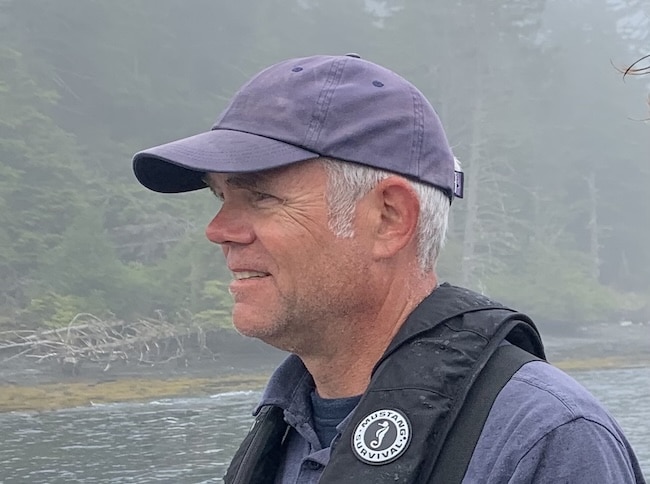
Owen Bird, Executive Director of the Sport Fishing Institute of BC, advocating for mark-selective fisheries and mass marking.
Bird added, “Tagging trailers could be far better utilized”. DFO has five mobile marking units designed to be used in different locations, “yet at least two have remained stationary for several years”.

Tagging trailer (Photo: Fisheries and Oceans Canada)

Inside a tagging trailer (Photo: Fisheries and Oceans Canada)
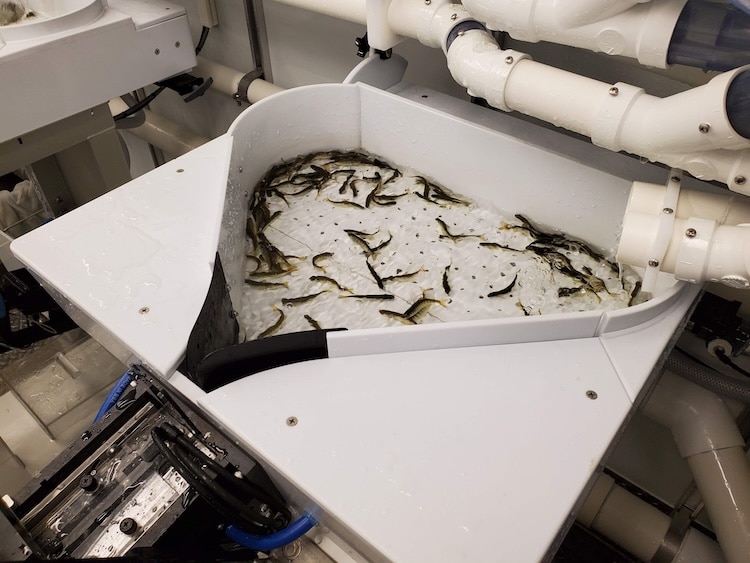
Clip processing (Photo: Fisheries and Oceans Canada)
The SFIBC website explains MM and selective fisheries are not the only management tools available. This organization believes selective fisheries must be supported by combinations of gear restrictions, bag and possession limits, targeted time and area closures, and size limit adjustments, all married to salmon habitat restoration and salmon enhancement strategies.
ENGOs Express a Polar Opposite View
In the opinion of the recreational angling sector, ENGOs unjustly target public access to salmon fishing and are not above message manipulation and data cherry-picking. There is a March 2023 Raincoast.org article titled “Mark-Selective Fishery: A backgrounder,” with the subheading “New fishery targets Chinook within critical habitats of Southern Resident killer whales”. This backgrounder seems to smear recreational businesses and government with the statement “It appears a small group of commercial [recreational] interests, along with their supporters within the government, have managed to drive this proposal forward without due process and review”.
According to Bird, “This claim is inaccurate and sensational and would not ordinarily deserve comment. However, it must be noted that for decades the south coast recreational fishing community, businesses and anglers alike, has been a leader in salmon habitat restoration and enhancement, with volunteer and financial support”. Howard English’s work on the Goldstream River is just one example. It began in the 1960s and earned him the title “Father of Salmon Enhancement in BC”. Anglers played a key role in this ongoing volunteer project from the very beginning.

Goldstream River (Photo: Tom Davis)
The Raincoast document lays out their reasons for opposing these fisheries. However, those opinions are rendered suspect because the backgrounder’s subheading is false, to the extent that some consider it more than just an honest mistake. These are not new fisheries. They existed for decades and have been managed as Chinook non-retention fisheries since 2019. Are the ENGOs referring to authorized data collection in reference fisheries? Who knows, because the backgrounder fails to provide a single detail explaining what they are. If not, they might be selective fisheries that re-opened because years of accumulated CWT, run timing, and ocean distribution data confirmed there was near zero to minimal impact on Chinook stocks of concern.
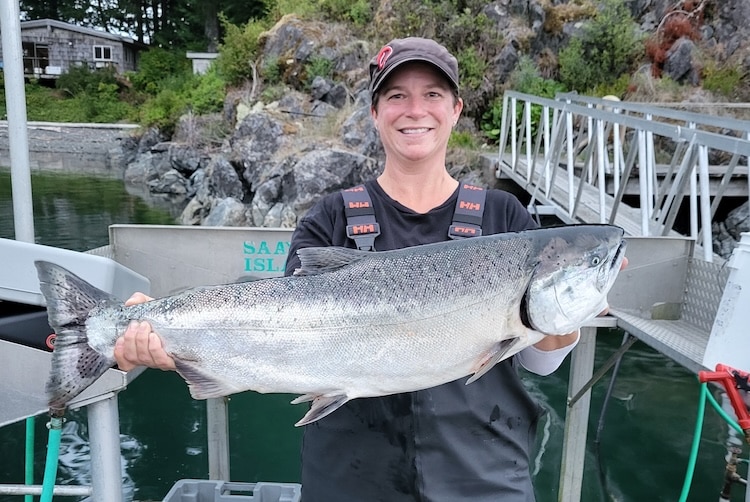
Angler Kristen Shardlow holding a large hatchery-produced Chinook salmon, highlighting the success of BC recreational fisheries. (Photo: Ian Shardlow)
Bird provides some clarity. “It is inaccurate to characterize mark-selective and reference fisheries as new. These are not new fisheries, but rather a new and more precise way of assessing impacts on stock composition”. He added, “Reference fisheries are test fisheries conducted in the same areas and times that mark-selective fisheries are permitted by DFO. These fisheries use either guides or DFO samplers to collect and analyze catch data and stock composition of Chinook presence and compare results against historical records”.
Has Common Sense Fisheries Management Left the Building?
Dr. Carl Walters is a respected fisheries biologist and professor emeritus at UBC’s Institute for the Oceans and Fisheries. He was asked, “Can properly managed and monitored selective fisheries be successful?”. His answer was precise: “Yes, provided there are gear restrictions to prevent high release mortalities of wild fish intercepted at the same time as marked fish”.

Dr. Carl Walters, respected fisheries biologist and UBC professor emeritus
He also responded to an opinion that management measures put in place during past periods of salmon scarcity seem to be the same as the management measures in place during current periods of salmon abundance. “It absolutely makes no sense that DFO has not responded at all to increases in abundance when it was so quick to do the opposite during salmon declines. This failure to take advantage of opportunity for fishing when it arises is absolutely irresponsible, and in the case of the Fraser fisheries has likely led to millions of dollars of lost income for fishermen”.
Biologist Brian Tutty spent decades with DFO. He believes MSF is necessary for the survival of public angling in key coastal areas. Tutty is qualified to discuss Upper Fraser stream-type Chinook, the same runs that are restricting important fisheries. He was part of the team that discovered they have different life histories than fall-run BC Chinook stocks. He believes that failing to keep abundant hatchery salmon and inadequate marking of hatchery fish increase release mortalities during Chinook non-retention. He attributes this inflexible management strategy to “few DFO managers understanding how recreational fisheries function”. Tutty recommends modest “daily retention limits of wild and/or hatchery fish to reduce the number of salmon that anglers release”.

Former DFO biologist Brian Tutty, who advocates for mark-selective fisheries to ensure the survival of public angling in BC
The spanner in the works is DFO’s slow-walk towards selective fishing. When asked about its current position on recreational selective fisheries, DFO’s responses were unclear.
- Question: Is MSF a policy that DFO still supports?
DFO: “Planning for fish marking in 2026 is underway and will be based on priorities for managing hatchery fish, future fisheries, and stock assessment needs.” - Question: Where does DFO stand on increasing MSF for conservation and sustaining fisheries in Johnstone, Georgia, and Juan de Fuca Straits?
DFO: “Trailers have been used in southern BC to support Salmon Treaty tagging programs and to mass mark Chinook in priority areas like the west coast of Vancouver Island and the central coast… This helps improve how hatchery production is managed and assessed.”
Marking needs to take place to support recreational fisheries in the regions identified in the second question. DFO’s answers seem to confirm there has been little progress developing MSF policies since that 1999 Selective Fisheries workshop.
- DFO: “Since 2020, several pilot recreational MSFs have been introduced and evaluated… DFO is now considering the results of these pilot initiatives, along with feedback received during consultations, to determine future opportunities for MSFs.”
That’s years of evaluation. Even if they increased marking rates now, it will be three more years before those Chinook reach legal size and anglers can keep some.
2025 Coastal BC Fisheries Management Survey
According to the April 2025 Island Fisherman survey titled Coastal BC Fisheries Management in which 577 people responded, the mindset of readers is pretty clear: