

The Juanes Lab
The Adult Salmon Diet Program (ASDP) is a project based out of the University of Victoria, funded by the Pacific Salmon Foundation (PSF). The goal of the program is to improve our understanding of Chinook and coho salmon diet dynamics along the British Columbia coast.
Since the founding of the program in 2017, the ASDP has processed more than 6,700 salmon stomachs contributed by more than 250 local anglers who form a network of avid citizen scientists. Thanks to these contributions, we are able to characterize the diets of Chinook and coho salmon in BC. This allows us to understand when and where different prey species are important and lets us monitor how this may change over time.
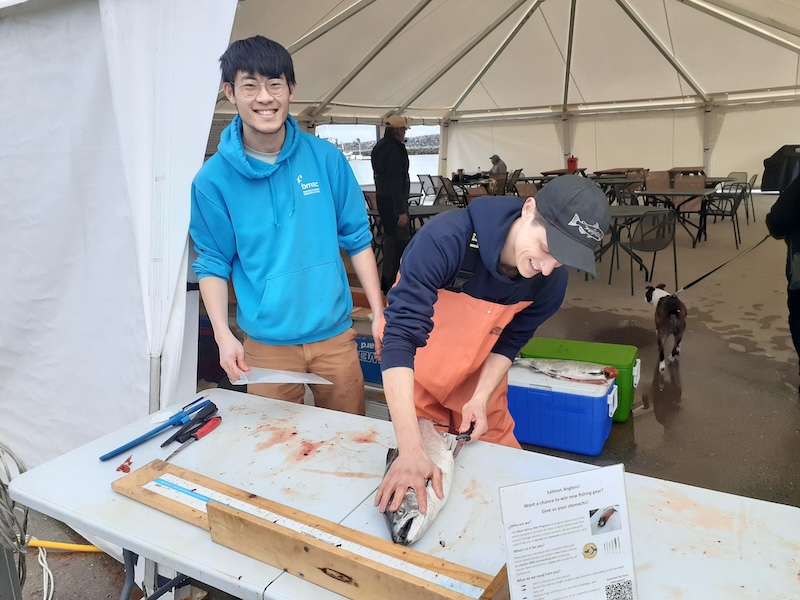
ASDP team members collecting entrails from salmon caught during the 2025 Sidney Anglers Association Derby. (Photo: Ron Barnhart, Sidney Anglers Association)
Salmon and What They Feed On
For the curious angler, it’s almost second nature to look into the gut of a freshly caught salmon to see what it has been feeding on. For a Chinook or coho caught in BC, one might expect to find the stomach full of bait fish such as herring. While herring are a dominant part of their diet, Chinook and coho salmon are opportunistic feeders that will eat what is available to them. Their diets include a variety of prey ranging from fish species like herring and sand lance to invertebrates like crab larvae and krill.

Robert Reinhardt with stomach contents while angling (Photo: Joel Unickow)
Our program consistently receives many Chinook salmon samples every year thanks to our anglers.
However, a high abundance of coho salmon in the Strait of Georgia in 2023 and 2024 has resulted in an increased number of coho stomachs submitted to our program in the last two summers. This recent influx gives us a unique opportunity to closely compare the diets of Chinook and coho caught between June and October across four regions: the Strait of Juan de Fuca, the Gulf Islands/Haro Strait, the Strait of Georgia, and West Coast Vancouver Island.
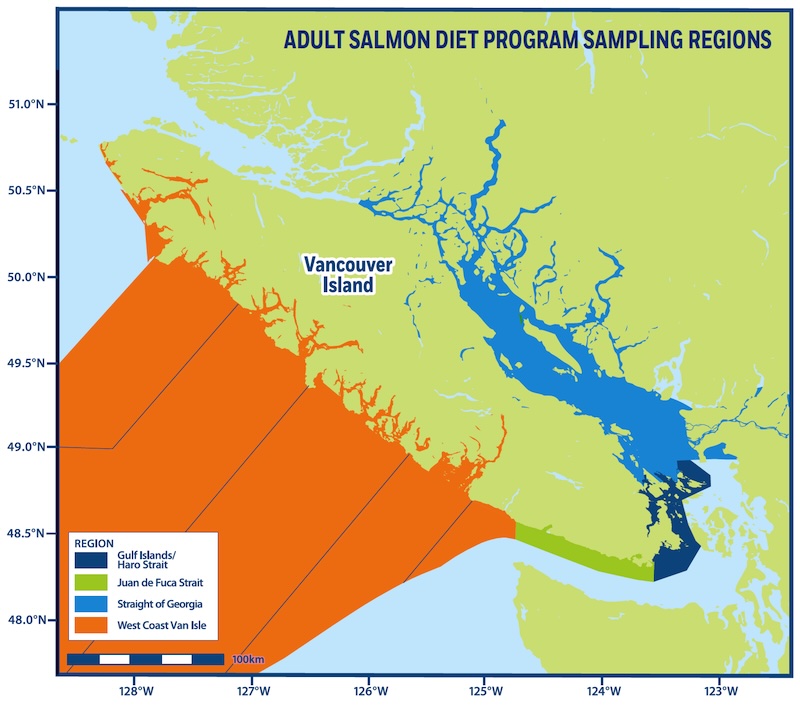
Current Adult Salmon Diet Program sampling regions. Regions are grouped by diet similarities and colour-coded accordingly.
Chinook VS. Coho
While Chinook and coho salmon share many of the same prey, there are some key differences between these two species. One difference lies in regional variation. We have grouped this analysis into the aforementioned four regions based on diet similarity and sample availability.

Diet comparison between Chinook and coho salmon in British Columbia coastal regions. Diet proportions are calculated based on prey weight.
Unsurprisingly, herring is the most dominant prey item in all four regions for both Chinook and coho salmon. Herring are a common prey fish species on the BC coast and are important in the diets of many local and migratory predators, including salmon. While herring is a key prey item for both Chinook and coho salmon, it is more important to Chinook, especially in the Strait of Juan de Fuca and the Strait of Georgia. Sand lance is another important prey item for both salmon species, and they are a key contributor to Chinook salmon diets in the Gulf Islands/Haro Strait region. “Other fish species,” including cod, lanternfish, rockfish, and juvenile salmon, are present in the diets of both species across all regions.
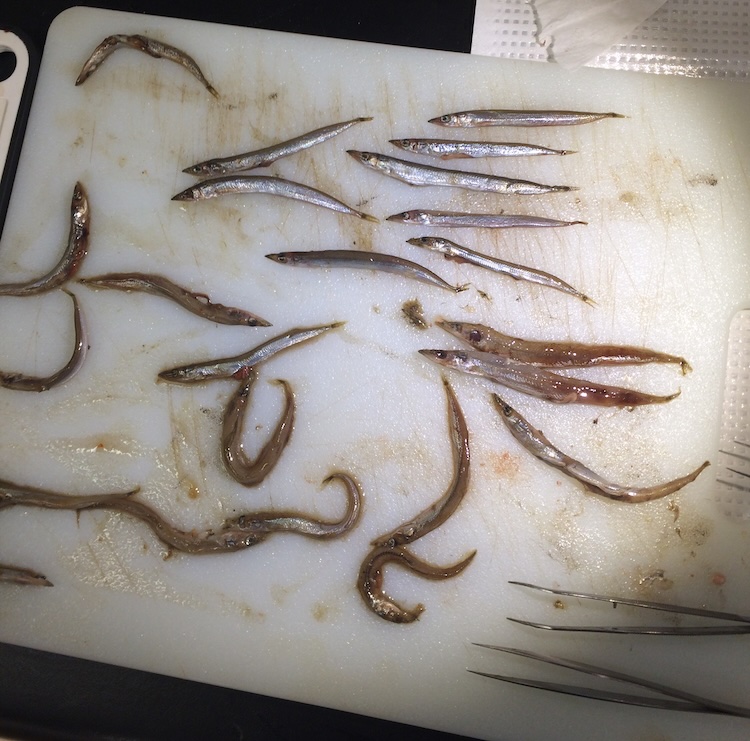
Pacific Sand Lance (Photo: Juanes Lab)
However, these other fish species are more common in coho salmon diets, indicating that they may consume a broader variety of fish prey than Chinook. In addition, squid comprise a substantial portion of the diet for both Chinook and coho in the West Coast Vancouver Island region but are rarely observed in other regions.
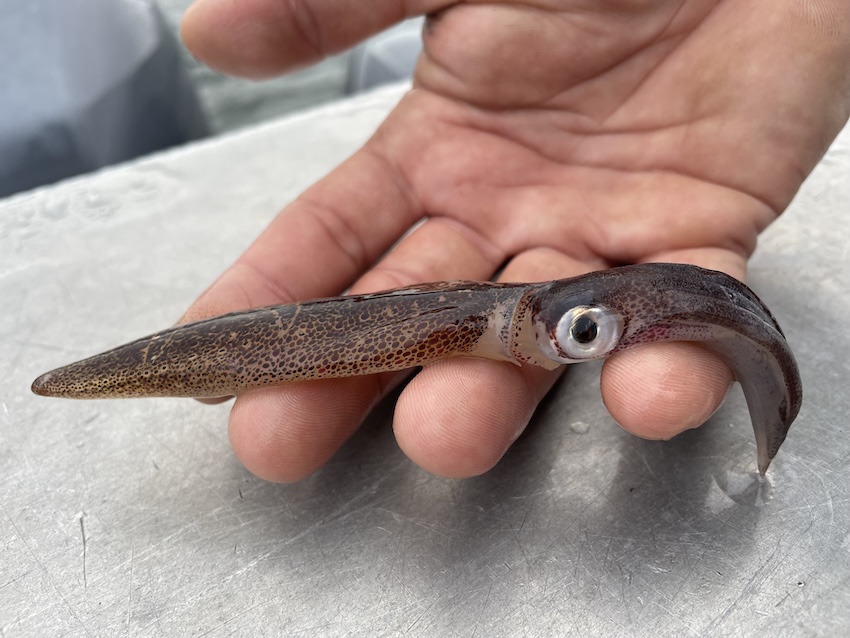
Squid caught in Tofino BC (Photo: Joel Unickow)
Interestingly, small invertebrate prey items are far more prevalent in coho diets than in Chinook diets across all regions. These invertebrate prey include krill, amphipods, and crustacean larvae, and they are eaten by coho in different amounts depending on the region they are in. In the Strait of Juan de Fuca and West Coast Vancouver Island, crustacean larvae and krill make up the majority of invertebrate prey, with few amphipods. In the Strait of Georgia, amphipods and crustacean larvae make up the majority of invertebrate prey, with few krill. In the Gulf Islands/Haro Strait region, all three prey items occur in coho salmon diets in similar proportions with the addition of shrimp, but they all play a relatively minor role in this region.
These dietary differences are advantageous to both species, helping them coexist in shared habitats by reducing foraging competition. In general, coho have a more varied diet than Chinook. This dietary flexibility reflects a complex interplay between factors such as body size, food preference, and foraging habitat. Like all salmon, both Chinook and coho are gape-limited feeders, meaning that they can only consume prey that fit in their mouths.

Examples of prey items found in salmon stomachs (not to scale). A) Amphipod, B) Krill, C) Herring, D) Crab larva, E) Eulachon, F) Anchovy, G) Poacher, H) Squid, I) Pink salmon, J) Flatfish, K) Surfperch
As adults, coho are smaller than Chinook, which is a potential constraint that limits their ability to prey on large adult herring, which larger Chinook salmon are more capable of consuming. Not surprisingly, larger coho tend to consume more herring, while smaller individuals rely more heavily on smaller prey. However, body size is likely not the whole story. Even among fish of similar body size, coho still tend to consume a higher proportion of non-herring prey than Chinook, suggesting that coho may also be less selective in what they eat. Where they typically forage also plays a role by influencing the types of prey they may encounter.
Juvenile fish, such as rockfish and salmon, along with crustacean larvae, are often found near the surface closer to shore and are more common in coho diets than in Chinook diets. In contrast, schooling fish species such as herring, which are of higher importance in Chinook diets, occupy a broader range of depths in the water column. For many anglers, these feeding patterns may seem familiar and are likely already reflected in fishing practices such as trolling depth and gear selection.
In an ever-changing ecosystem, keeping an eye on what salmon are eating provides valuable insights into how each species may respond to changes in prey availability. While only one piece of the puzzle, these insights help us better understand salmon ecology and guide effective management for both the prey species and their predators.
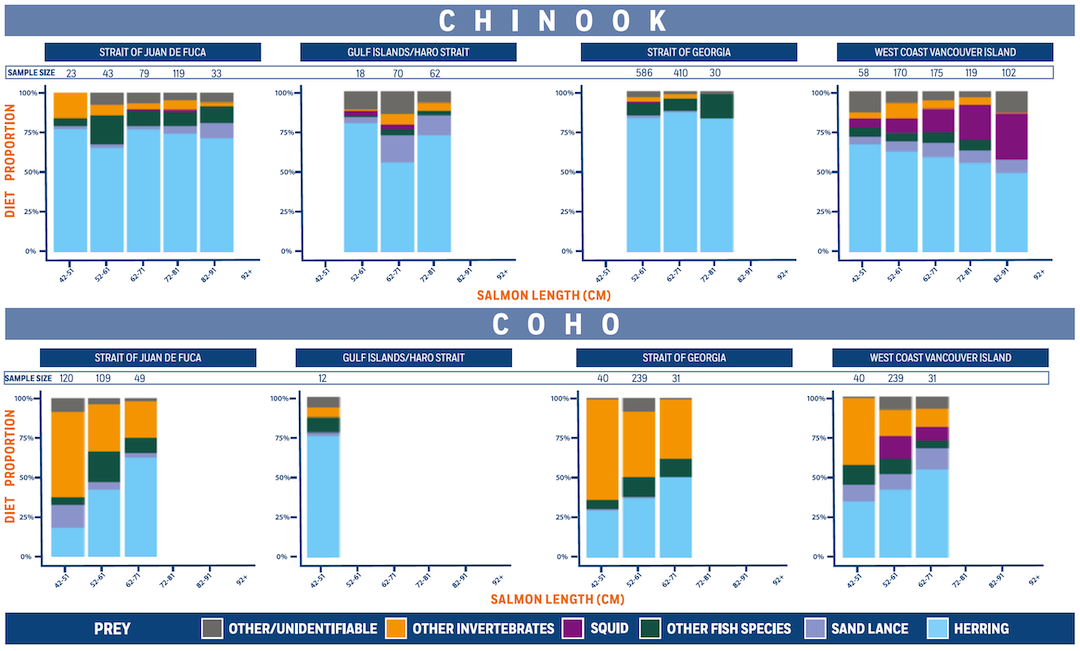
Diet comparison between Chinook and coho salmon in British Columbia coastal regions by 10-cm length classes. Length classes with fewer than 10 samples are omitted. Sample sizes are shown above each bar. Prey categories are regrouped for simplicity. Diet proportions are calculated based on prey weight.
Going Forward: Sampling
In January 2025, Nathanael Tabert—who has been coordinating the ASDP since 2023—started his master’s degree using data from the program. We will be modelling spatial and temporal changes in salmon diets, so please stay tuned for future updates.
We will continue to collect samples through 2026 and build our ever- growing network of citizen scientists. This project would not have been possible without our dedicated and science-curious anglers, so again, we thank all our contributors for their continued support!
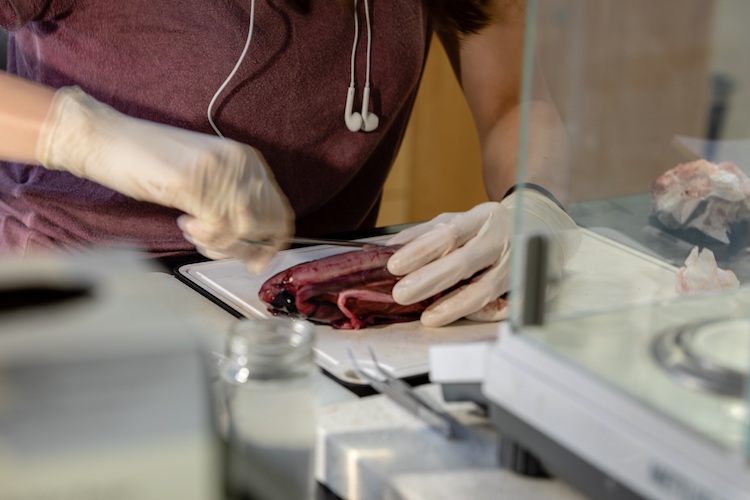
Stomach processing in the lab. Photo courtesy of RAWork Media
How To Participate: Quick, Easy, and with Great Prizes!
We are always looking for anglers to participate in our program!
Each stomach submitted earns an entry into our year-end prize draw. This year the prize pool includes an Islander MR2LA reel, an Amundson TMX5SE reel from Island Fisherman, and an AP Tackleworks spoon set! In addition, participating anglers will also receive a personalized report summarizing their catch data as well as a summary of the program’s findings for the year. We hope that you will consider taking part in the Adult Salmon Diet Program!
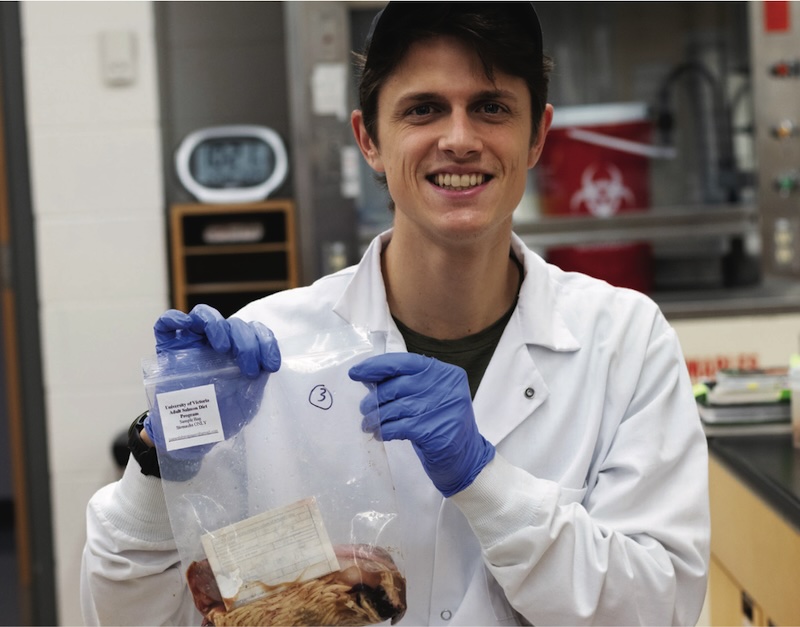
Make sure to submit your samples with complete data cards to keep the ASDP team smiling! (Photo: Kristina Duchscher)
Check out our website, follow us on Facebook, or contact us at [email protected] to express your interest, and we will get you set up with collection baggies and waterproof data cards (also available at collection depots, or contact us to have them mailed to you). For every stomach, fill out a data card with all the key information (date, catch location, species, fork length). When cleaning your catch, place all the organs in the collection baggie with the completed data card and freeze it as soon as possible. You can drop off your samples at one of our collection depots or contact us to arrange a pickup.

This article appeared in Island Fisherman magazine, never miss another issue—Subscribe today!