
2026-2027 BC Salmon Fishing Regulations: New Openings, Catch Limits, and Gear Changes
The 2026-2027 BC Salmon Fishing Regulations are primarily governed by the Integrated Fisheries Management Plan (IFMP), the annual roadmap that dictates the rules for every salmon fishery in British Columbia. Developed by Fisheries and Oceans Canada (DFO), it is a legal framework designed to balance the needs of harvesters with the survival of wild stocks. Before the rules are finalized, DFO collects feedback from across the province, a process currently captured in the “2026-2027 Draft IFMP Feedback Package“—a massive 363-page feedback package. Clearly, the IFMP process is complex, and for 2026-2027, it is intended to give each harvest group an opportunity to provide insights.
Feedback by the Numbers: Who is Asking for Change?
The following table shows the volume of requests submitted by each sector this year. Note that while high-level summaries often only count “12” recreational issues, that number ignores the dozens of specific formal motions found deeper in the report.
| Sector | Group | # of Issues/Motions Noted |
|---|---|---|
| First Nations | 24 Different Nations/Tribal Councils | 378 |
| ENGO | MCC (Pacific Marine Conservation Caucus) | 68 |
| Recreational | SFAB, BCFFF, and BCSFAC (Combined) | 37 |
| Commercial | Area G, Area C, BCPSA, and Joint Fleets | 21 |
The “Paper Divide”: Why Recreational Data Seems Small
Readers looking at the DFO’s high-level summary tables may think recreational anglers only submitted 12 requests. This is because the DFO’s summary table (pages 4–45) only lists issues from the BC Federation of Fly Fishers (BCFFF). To find the true impact of the recreational sector, you have to look at the Sport Fishing Advisory Board (SFAB) section, which contains 20 formal motions passed in April 2026, and the BCSFAC response, which adds 5 major challenges to DFO policy. When added together, the recreational sector has submitted 37 distinct requests for better access and more flexible management.
Why are “ENGOs” in a Fishing Report?
You will notice 68 issues submitted by the MCC (Pacific Marine Conservation Caucus). These are Environmental Non-Governmental Organizations, such as Raincoast Conservation and Watershed Watch, rather than active fishing groups. While they don’t represent harvesters, DFO gives them a seat at the table. They advocate for stricter closures and lower catch limits across all sectors.
The irony of the MCC’s involvement is hard to ignore: DFO is the conservation authority. If the IFMP is truly about balancing extraction with preservation, DFO should be the voice of conservation, leaving the discussion of harvest logistics and socioeconomic impacts to the actual harvest sectors. Instead, DFO has outsourced the ‘conservation voice’ to ENGOs, creating a dynamic where non-harvesting groups are influencing the granular details of a fishery they don’t participate in. It’s an upside-down structure: the regulator is essentially letting third parties manage the harvesters.
The First Nations “Volume of Work”
With 378 separate requests and independent forums with DFO regarding fisheries management, First Nations are the most vocal harvest sector in salmon management today. Their feedback focuses heavily on “constitutional priority,” arguing that their food and ceremonial needs must be met before a single recreational or commercial hook hits the water. They are pushing DFO to move away from “open until closed” fishing and instead adopt a “closed until open” model that requires proof of stock health before any season begins.
Commercial Economic Survival
The 21 issues from the commercial sector represent a fight for the fleet’s survival. Groups like the Area G troll fleet are pushing back against “plug-only” restrictions and fighting to move Chinook opening dates back to August 1st to ensure their operations remain financially viable.
The recently released 2026-2027 Salmon Integrated Fisheries Management Plan (IFMP) Feedback Package reveals a significant struggle between recreational anglers, commercial fleets, and First Nations to define the future of BC fishing. For the average Island Fisherman reader, these documents are a dense maze of acronyms, but the outcome will impact whether you can keep a Chinook in Saanich Inlet or what gear you’re allowed to use in the Strait of Georgia.
1. The Players: Who is Asking for What?
Recreational Anglers (SFAB & BCFFF)
The Sport Fishing Advisory Board (SFAB) seeks to maintain “in-season” flexibility. They want real-time abundance models for the Fraser River to trigger openings for healthy stocks, like Fall 4-1 Chinook. Locally, they are asking to scrap recent non-retention rules in Saanich Inlet (Areas 18 and 19), noting that Cowichan Chinook have smashed escapement goals for a decade.
Meanwhile, the BC Federation of Fly Fishers (BCFFF) is sounding a different alarm, calling for massive 77-day closures to all applicable fisheries to protect Interior Fraser Steelhead, which they describe as being in a “state of crisis”. They argue that the current 27-day and 42-day window closures have failed to stop the decline of the species. This 77-day figure aligns with scientific observations that 95% of the run migrates through the Lower Fraser within a 77-day window.
First Nations (IMAWG, Maa-nulth, Tsartlip)
Groups like the Island Marine Aquatic Working Group (IMAWG) continue to demand a total overhaul of the recreational sector. Their vision includes a “closed until open” model for sports fishing, mandatory reporting of all released fish, and separate licenses for guides. The Tsartlip (W̱JOȽEȽP) are specifically targeting the management of Goldstream Chum, arguing that DFO’s current targets are based on scientifically invalid data from 1970.
Commercial Fleets (Area G Troll)
The Area G troll fleet is fighting for survival, stating the current rules are no longer economically viable. They are asking DFO to move the Chinook opening back to August 1, remove the “plug-only” restriction, and provide a clear piece of the projected large Fraser sockeye run.
2. The Data Duel: Major Contradictions
The core of the conflict lies in how different groups interpret the numbers.
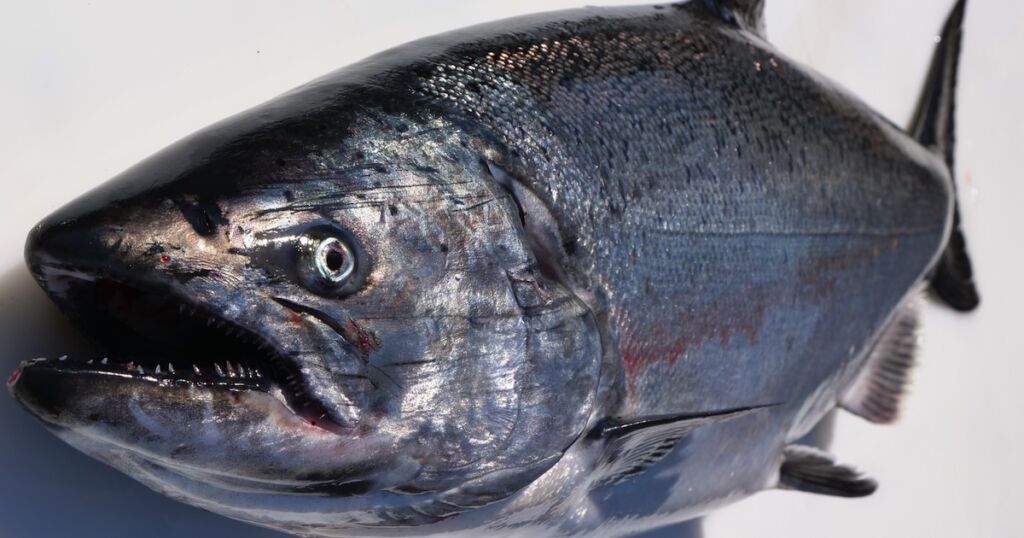
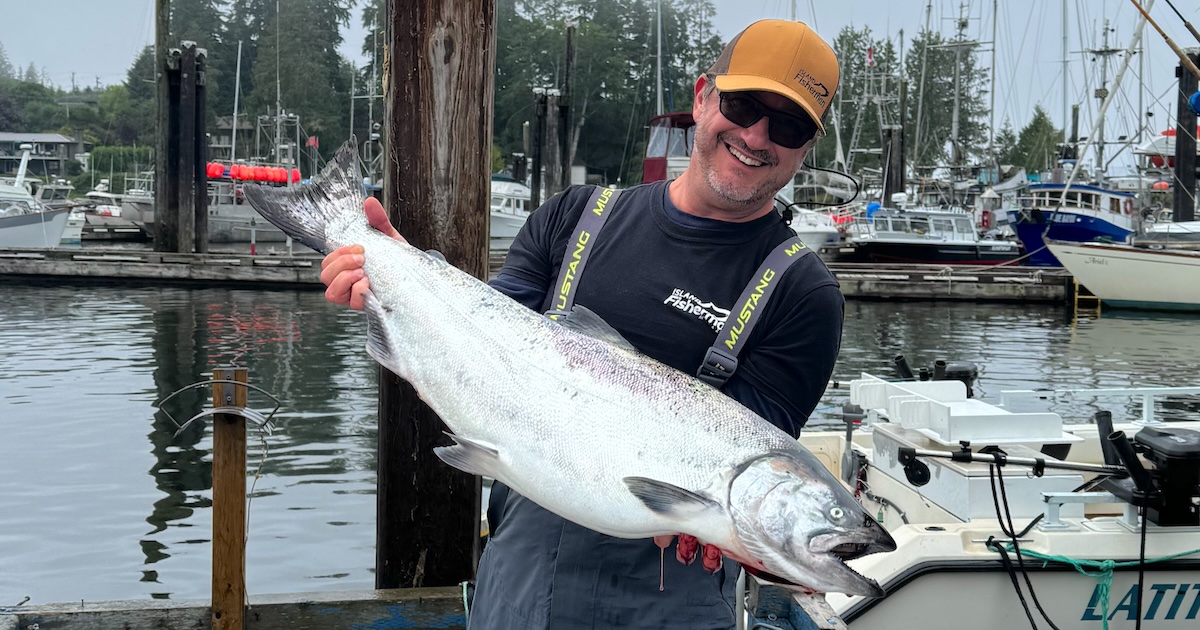
Hatchery Chinook (Photo: Joel Unickow)
- The “Crisis” View: First Nations and ENGOs point to the Pacific Salmon Foundation (PSF) 2024 State of Salmon Report, which indicates that over 70% of salmon populations in BC and the Yukon are currently below their long-term averages. However, it is important to note that many of those 70% have historically been small or very small in numbers. Meanwhile, some specific runs are currently at historic highs; for example, the Thompson 4-1 Chinook returned at record levels in 2025, contributing to a combined aggregate of nearly one million fish between the late summer and fall 4-1 runs.
- The “Rebound” View: Anglers counter with DFO Skeena River coho indices, which hit a 15-year high in 2023. They argue the Central Coast is suffering from an “assessment crisis” (lack of monitoring) rather than a true biological collapse.
Counting the Goldstream Chum
The Tsartlip (W̱JOȽEȽP) highlight that the current Management Escapement Goal (MEG) of 15,000 for Saanich Inlet chum is based on a habitat survey from June 1970. They argue this 55-year-old data, taken during “extreme low flows,” is an invalid foundation for modern management and demand sonar technology for better counts.
3. SRKW Prey: Office Modeling vs. On-the-Water Reality
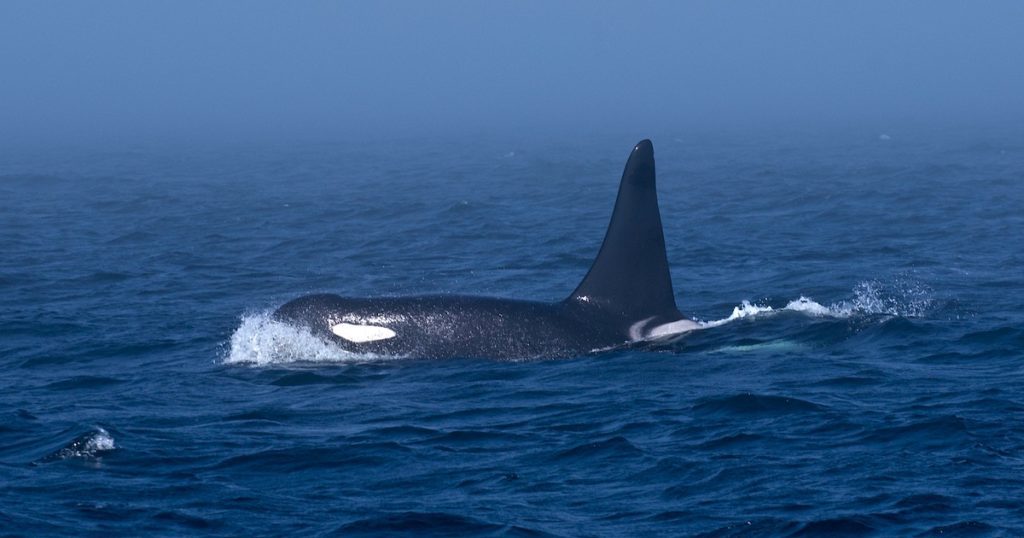 Southern Resident Killer Whales SRKW Photo: Dan Kukat, Springtide Charters[/caption>
A major point of contention for Island trollers and anglers is the data used to justify Southern Resident Killer Whale (SRKW) closures – spoiler – there isn’t any data!
- The Model: Conservation groups push bioenergetic modeling (Couture et al. 2022), which suggests SRKW energy intake is lowest in the spring and summer.
- The Field Observation: Commercial fleets cite field research by Dr. Andrew Trites (UBC Marine Mammal Research Unit). Area G representatives met with Dr. Trites and reported that his on-the-water observations show “abundant chinook” in the Strait of Georgia and WCVI.
- Direct Reference: Dr. Trites noted that “there is more Chinook available for this stock [SRKW] than there is for the much larger population of NRKW” and stated there is “no evidence to suggest that fishing commercial or sports fishing of chinook in their northern range… will have any impact on the health of this population of orcas”. Other reports from UBC, DFO, and WDFW have all indicated that the abundance of Chinook in the Strait and Salish Sea is far in excess of the nutritional requirements of SRKW.
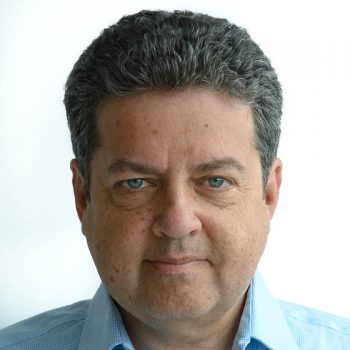
Andrew Trites
Professor, Institute for the Oceans and Fisheries
Associate Member, Department of Zoology
Director, Marine Mammal Research Unit
4. What is DFO Doing?
The DFO is currently weighing these conflicting inputs to finalize the 2026-27 plan. Key actions include:
- Mass-Marking and MSF: DFO is moving toward mass-marking 90% of hatchery production. This is intended to allow for more “hatchery-only” (Mark-Selective) fishing, though First Nations worry this will only increase total handling mortality on wild stocks.
- Gear Restrictions: DFO is considering a ban on treble hooks and hooks larger than 3/0 in certain Chinook non-retention areas.
- Fraser Sockeye Options: With a projected return of 7.7 million Sockeye, DFO is choosing between three plans. Option 1 (Escapement Weighted) prioritizes rebuilding the run, while Option 2 (Harvest Weighted) allows for higher catch levels for all sectors.
- Window Closures: Expect continued or expanded 5-week window closures to protect Early Stuart Sockeye and Interior Fraser Steelhead.
The Bottom Line
While early indications on the water are encouraging for the 2026 salmon fishery, the season is shaping up to potentially include restrictions and gear rules that we haven’t seen before. We can expect and hope that DFO will continue working to balance and optimize economic viability, where the recreational sector is a clear leader, alongside conservation and other priorities.
For official technical guidance and regional updates, anglers are encouraged to monitor the DFO Pacific Region IFMP Consultation Portal.
Stay Informed on BC Fishing
For more breaking updates, regulatory changes, and community reports, visit our news hub.