
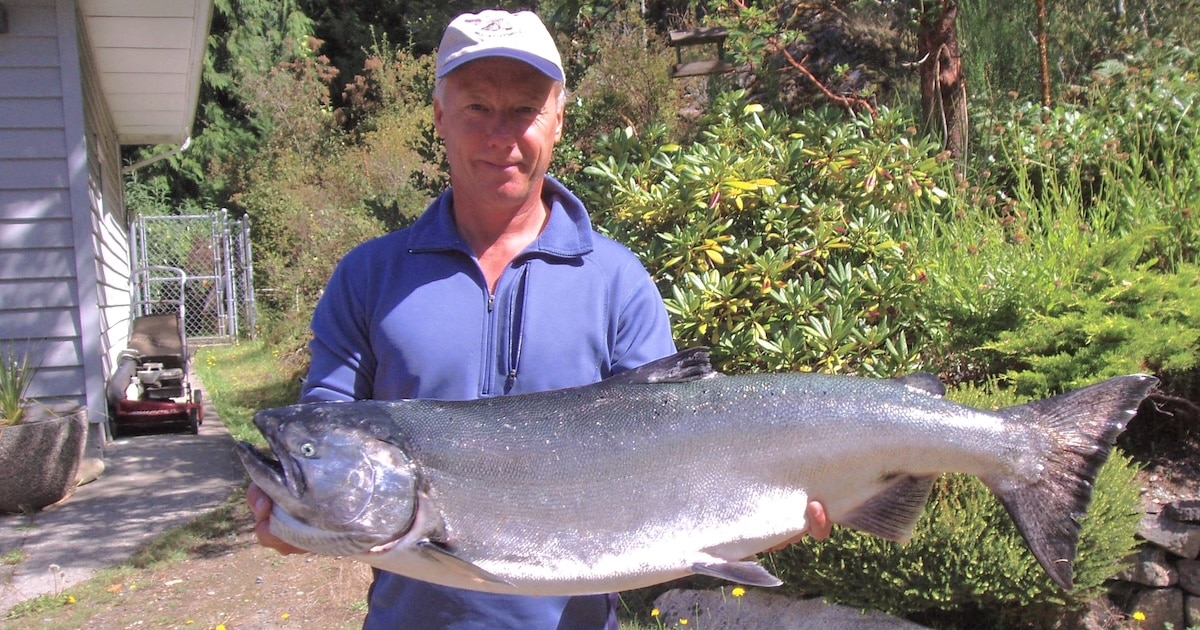
Dave Kalyn with a mature wild Chinook Photo: Tom Davis
In August, anglers can keep Chinook in most popular BC south coast waters, but not in areas closed to protect Southern Resident Killer Whales (SRKW). Most anglers and fishing guides know these restrictions do little to protect whales; instead, they exact costs on angling opportunities and the recreational fishing economy in the affected communities. Hopefully, the DFO whale recovery team recognizes this and quickly adopts a “moving avoidance bubble” strategy. On the positive side, were big salmon from healthy stocks to be caught during the opening.
This article deviates from the usual “what to use and where to go fishing” format. I’ve included some specific “how-to” tips from respected charter captains, but the focus is to understand Chinook run types, migration routes, and timings, as well as how the physical changes they undergo during migration require modifying gear and tactics. The story content is weighted towards trolling, but the information will still be helpful for other fishing styles.

Gary West 40 lb Photo: Tom Davis
Chinook Run Types, Migration Patterns, and Run Timing

The DFO (Fisheries and Oceans Canada) uses a 1-4 scale to categorize salmon stock outlooks, with 1 indicating conservation concern and 4 indicating abundant returns.
“One size fits all” does not apply to Chinook. There are three distinct run types: Spring-run Chinook begin entering rivers in May and stay there until spawning starts in late summer. They are first in because they travel the furthest to their spawning grounds.
Conservation concerns for Fraser River spring-runs (and some summer-runs) are the reasons for 6 years of Chinook non-retention in key south coast fisheries. But by August, anglers should not encounter any spring Chinook.
Summer-run Chinook enter the rivers in July. They spawn in some BC coastal and interior streams. There are stocks of conservation concern, while others, like the summer Thompsons, have greatly exceeded escapement goals.
Fall-run Chinook appear in late July. The dominant age classes are 3- and 4-year-olds. This explains why the low teens to high twenties adult size range is a bit small, with a few exceeding 30 lbs. They are the most hatchery-supported Chinook on the coast and make up the bulk of Chinook late summer anglers will encounter. Fall-run Chinook spawn in coastal streams from mid-September to December, and important key stocks are generally healthy.
Fall-runs “beach crawl.” This means they migrate north near the BC coastline as juveniles and return to their home rivers via the same route during their last year of life.
Adults race against time to get to the spawning grounds, appearing at the same locations at the same times each year.
I grew up near Sidney, BC, where I fished with my father for Cowichan fall-runs. He used to say he could set his watch by their arrival time. This reliable trait applies to most fishing areas, and knowing this is a big advantage for anglers.
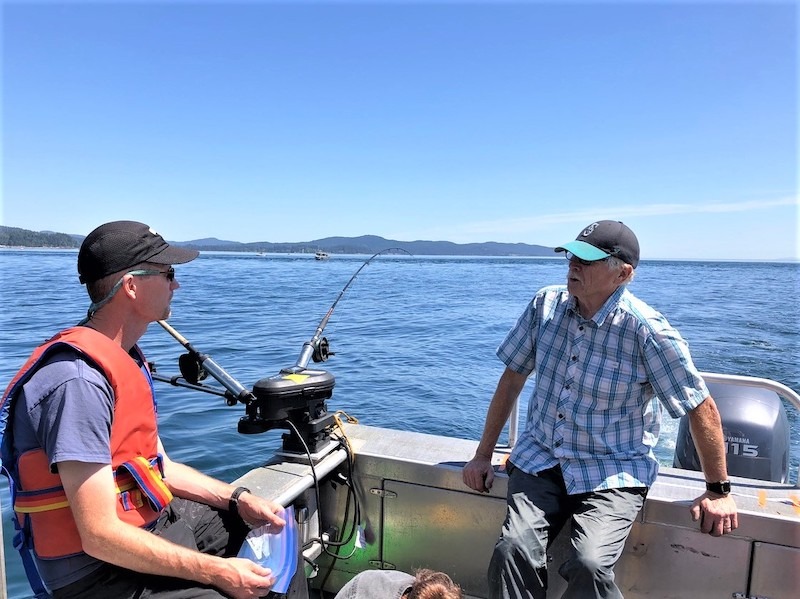
UBC Scientific Fishing Vessel, Tom Davis and Rob Marshall Juan de Fuca
Tides Matter
Learn which tides produce the best bites. I believe anglers do better on the incoming tide. Why? Because Chinook hitch a ride on the flood current to conserve energy and get to the rivers faster—and they bite. It’s a good idea to fish an hour before low water and stay as long as possible through the flood. The incoming tide cycles new fish past you until the entire run has arrived in the terminal area.
Chris Speed owns Built for Speed Fishing Charters in Horseshoe Bay. He says he likes the low water switch to the flood and long leaders with herring and anchovies. Chris also spreads his gear out and stays away from crowds, while adding this advice for bait
fishermen: “Pre-rig your baits the night before using them.” Contact Chris at builtforspeed.ca for guided trips near Vancouver and check out his tips in the Vancouver Area Report.

Chris Speed Built for Speed Fishing Charters
Chinook that remain around the river mouth go through significant colour changes. This is especially true with fall runs that can start darkening during their ocean migration. Coastal river spawning beds are often just a few miles upriver, so it’s not unusual to
find dark Chinook mixed with bright ones in terminal locations.
Darrell Jobb owns Western Star Charters at French Creek Harbour and is the Island Fisherman area reporter for French Creek. In August he guides clients near the Big and Little Qualicum Rivers. Darrell recommends flashers and short leaders with small, visible lures like pink hoochies for Chinooks that have transitioned from feeding to an aggressive “territorial bite” response. He also suggests releasing dark fish so they can spawn. I agree, especially if they are large, egg-laden females. You can familiarize yourself with proper release techniques here.
Like many BC anglers, Darrell supports salmon recovery by volunteering at the Marion Baker Hatchery.

Darrell Job Marion Baker Volunteer collecting brood stock
Current Direction Affects Fishing Locations
In the Juan de Fuca Strait, the best fishing occurs on the flood current near points of land that jut into the strait. The flood pinches Chinook against the shoreline at these points, forcing anglers to concentrate in small fishing areas. Savvy fishermen stay right through strong flood currents because it brings fish to them. The same principle applies when fishing narrow, steep-sided inlets. The current is less severe there so trolling near shore is easier, and it’s the best strategy for shore-hugging Chinook.

Fishing Juan De Fuca Photo: Joel Unickow
This doesn’t mean you can’t catch them during the ebb. You can, but tactics need to change. During an outgoing tide, Chinook seek low-current areas to rest while waiting for the next flood to arrive. Look for areas minimally affected by outgoing tides—like back eddies behind islands or points of land, sizeable bays, or deep-water shoreline pockets no larger than a public swimming pool.
Fishing these little pockets gets my heart rate going, because they’ve paid off with big fish, while anglers a stone’s throw offshore were drawing blanks. To find these pockets, pay attention to visible cues like accumulated flotsam or baitfish jumping inside a pocket indentation. Make a pass through it or cast a jig into it.
Fishing Tactics Depend on Location along the Migratory Highway

Fall Chinook migration paths (Source: IFM)
South Coast fall-run Chinook come from wild and hatchery stocks in Puget Sound, the Lower Fraser River, the Georgia Strait, and the west coast of Vancouver Island (WCVI). They follow the migration patterns outlined previously. WCVI Chinook travel as far as Southeast Alaska, while Georgia Strait fish only reach BC’s Central Coast.
Feeding habits change on the return migrations, but when and where? One way to answer this is to divide the changes into three parts:
- They continue feeding through the early migration stage.
- A transition phase reduces feeding intensity.
- They stop feeding entirely.
The changes might be gradual or quick and may differ between stocks. To compensate for these uncertainties, progressively adjust your gear and tactics.
I’m a dedicated bait fisherman when it comes to chasing big Chinooks. Here’s a hypothetical fishing adventure that begins in Southeast Alaska and ends at the head of Alberni Canal, which explains how I would adjust my gear and tactics.
Southeast Alaska Chinook are still in feeding mode. I would fish the same gear I use in southern BC between April and June. That’s a tight, snappy roll with 5″ to 5 1/2″ whole bait, 42″” to 54″ behind a full-sized flasher, fished deep at normal trolling speed.
In early July, when these fish hit the northwest tip of Vancouver Island, they should be transitioning off feeding. I like 5 1/2″ to 6″ herring or anchovies rolled slower on 54″ to 60″ leaders behind full-sized flashers “at normal trolling speed. I’d also start looking for fish at shallower depths.
When they hit Barkley Sound, I’ll run 6″ baits, or larger, on at least 60” leaders with a wide, wobbly roll, trolled slower and shallower.
Once they enter the terminal area, I would roll the bait very slowly, keep the bait sizes large and leader lengths long while trolling very slow and shallow.
During migration, Chinook undergo physical changes that include sexual organ development and darker skin colour, while males develop bigger teeth and a hooked upper jaw. These factors, along with increasingly aggressive behaviour as a precursor to spawning battles, explain the shift from “feeding bite” behaviour to “aggressive bite” behaviour. These are important reasons why anglers should adapt their gear and angling strategies.
The fishing philosophy explained in the hypothetical example also applies to spoons and, to a lesser degree, plugs that do not require flashers. Hoochies are different animals. Traditionalists follow the gear progression template, but guides like Darrell Jobb suggest that sticking with small pink hoochies and short leader lengths pays off in terminal fisheries, essentially the polar opposite of the bait trolling strategy.

Cliff Moors, owner and operator of CCCharters
Cliff Moors operates Cliff’s Chinook Charters and is Island Fisherman’s Comox Area Reporter. In August he fishes for Puntledge River fall Chinook near Courtenay, and he is another pink hoochie fan. He suggests “anglers position gear as shallow as 20′ and troll dead slow.”
He also favours the “Qualicum Special,” which is a Purple Haze hoochie with an MP 2 stuffed inside it. Cliff says the payoff for his customers is a big hog hammering a lure and peeling off 100 yards of line in one go. That gets the heart beating.
This article appeared in Island Fisherman magazine, never miss another issue—Subscribe today!