
This month (February 2026), the DFO added a “What will not change” section to its Salmon Allocation Policy (SAP) review page. It includes phrases that sound reassuring, such as “Pacific salmon will remain a shared public resource” and “The revised SAP will not extinguish any sector’s access.”
Salmon as “Common Property” to Canadians
Until this month, the status of salmon as “Common Property”, the legal principle that salmon belong to all Canadians, was in serious doubt.
The fact that the DFO has now explicitly stated that salmon will remain a “shared public resource managed… on behalf of all Canadians” is a massive win for the public. It means the “ownership” of the fish remains with you. But “owning” the fish and having the “priority” to catch them are two very different things.
The 5 Nations Court Mandate
The DFO didn’t start the Salmon Allocation Policy review to be difficult; they started it to address a legal reality. A 2018 court ruling (the Ahousaht or “5 Nations” case) found that the current recreational priority for Chinook and coho was an “unjustified infringement” on the rights of those five Nations to sell fish.
The DFO’s task is to find a way to honor that court-ordered sale fishery. The danger is that some fishing representatives are using this legal opening to advocate for the total removal of the recreational priority.
Life at the Back of the Line: The Death of Predictability
If the recreational sector is demoted to last place—behind both court-ordered sale fisheries and traditional commercial fleets—the “public resource” becomes a “leftover resource.” For the thousands of families, guides, and lodge owners who depend on the water, this isn’t just a policy shift; it is an economic death sentence.
The “Wait Your Turn” Model: In this scenario, the recreational season could be barred from opening until every other sector has finished their harvest. This creates a “Wait Your Turn” reality where the public is only allowed to fish after the commercial quotas are reached.
The End of Bookings: Predictability is the backbone of the $1.3 billion sportfishing industry. Lodges and guides often book clients six to twelve months in advance. If the opening date is “whenever the commercial fleet is finished,” that predictability vanishes. No tourist will book a $5,000 trip, and no local will invest in a new boat if the season is a “maybe.”
The Collapse of Coastal Communities: This isn’t just about the person on the boat; it’s about the town on the shore. Coastal communities from Port Renfrew to Prince Rupert rely on “fishing dollars” to survive. When a season is unpredictable, the economic hemorrhage spreads to local hotels, restaurants, gas stations, and grocery stores. If the guides aren’t working, the local mechanic isn’t fixing engines, and the local waitress isn’t clearing tables. We are talking about the survival of over 9,100 direct jobs and the very tax base that keeps these small towns afloat.
The Scraps Model: In low-abundance years, the “residual” model means the public likely wouldn’t see a season at all. By the time it’s the public’s turn, the harvestable surplus could already be gone.
“Fixed Quotas” are an Economic Death Sentence
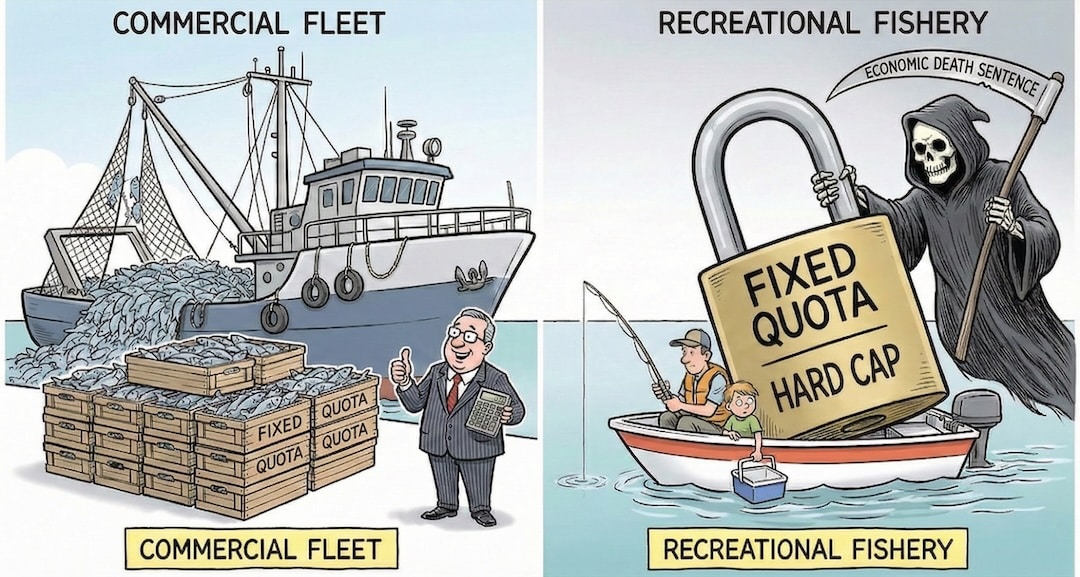
A major problem within the Salmon Allocation Policy review is the push to manage the public recreational fishery using commercial-style “fixed quotas” or hard caps. To understand why this is a disaster, you have to look at how the two sectors actually operate.
The Recreational Driver: Time and Predictability
A commercial fishery succeeds through volume and speed—they need to fill the boat as fast as possible because they get paid by the pound. The public recreational fishery, however, is based on time and predictability. Its massive economic value isn’t generated by hitting a harvest target, but by maximizing the time people can spend on the water buying fuel, booking hotels, hiring guides, and eating at local restaurants.
To see why a fixed quota fails the public, imagine the Okanagan wine country. A commercial vineyard machine-harvests its grapes as fast as possible to sell in bulk by the ton. But the Okanagan wine tourism economy relies on people visiting tasting rooms over a predictable, multi-month season. Tourists don’t just buy a bottle of wine; they book hotels in Kelowna, hire tour guides, and eat at local restaurants. These local service providers invest heavily in infrastructure and enter into contracts months before the first guest arrives. Their survival depends on a stable, full-season operation.
Now, imagine if the government suddenly imposed a strict “hard cap quota” on the total volume of wine tastings allowed in the province. Because of a busy June, the Okanagan hits its quota in mid-July, and the government forces every tasting room to lock its doors immediately. Tourists who booked August vacations have their trips ruined, and the local hotels, restaurants, and tour guides are left with fixed costs they cannot cover.
This is the exact effect of hard caps in recreational fishing management. When you manage a public fishery with a strict numerical quota, a sudden “quota reached” notice wipes out a season’s worth of business planning overnight. It destroys the consistent, reliable access that gives the public fishery its value. Forcing an industrial-scale quota onto an experience-based public fishery collapses the economic ecosystem of coastal communities while offering no added conservation benefit.
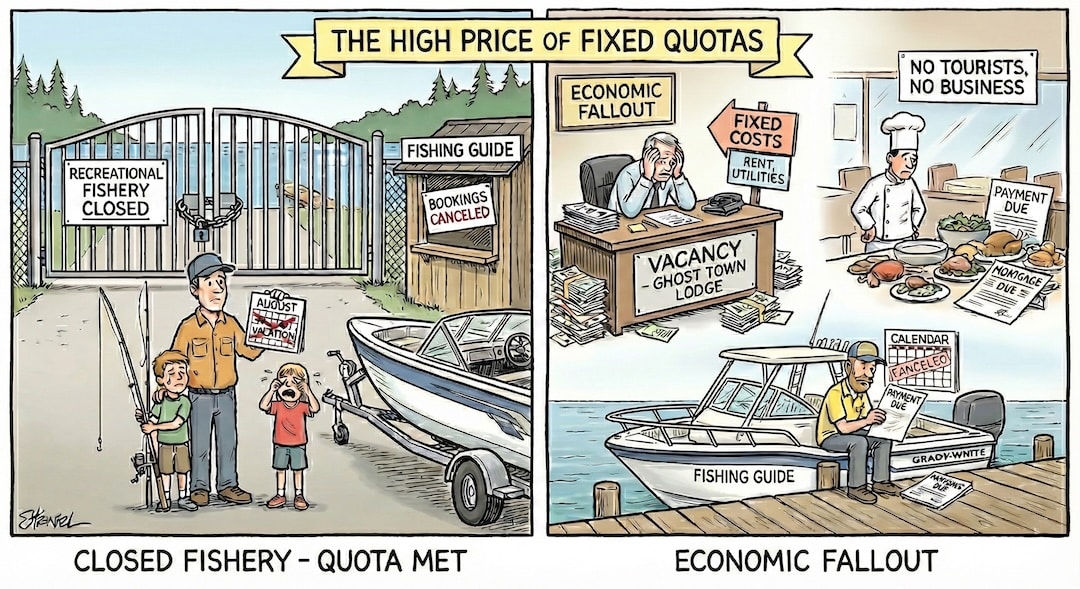
When you manage a public fishery with a strict numerical quota, a sudden “quota reached” notice can wipe out a season’s worth of business planning overnight. This unpredictability destroys public trust, turning a planned family vacation into a gamble. Just as it makes no sense to tell a commercial boat it can only catch two fish a day year-round, it is entirely destructive to force an industrial-scale quota onto an experience-based public fishery. Doing so would completely collapse the economic ecosystem of our coastal towns while offering absolutely no added conservation benefit.
Why the Economics are on the Recreational Side

When the original Salmon Allocation Policy was written in 1999, the recreational priority was established because it provided the highest economic return to Canadians per fish. That reality hasn’t changed—it has intensified.
- The $1.3 Billion Engine: The public fishery isn’t just a hobby; it’s a massive economic driver for coastal B.C.
- 9,000+ Jobs: These are real jobs in communities like Campbell River, Port Alberni, and Haida Gwaii that would vanish if the fishery became unpredictable.
- Conservation Power: Through the Salmon Conservation Stamp and community stewardship, anglers provide $1.5 million in annual revenue which leverages a total value of up to $16 million for salmon restoration every year.
- The Federal Mandate: This federal government has consistently messaged a commitment to the middle class and coastal sustainability. Moving a public resource away from a high-value community fishery toward a low-value, high-volume commercial model contradicts every economic goal they have.
According to 2025 analysis by the Sport Fishing Advisory Board (SFAB), the recreational fishery produces $693.31 of GDP per salmon caught, compared to just $7.59 of GDP per fish in the commercial sector.
Allowing commercial interests to “leapfrog” the public fishery makes no economic sense for Canada. It would mean taking a resource that generates massive local value and moving it into a low-value, commercial model that exports the majority of its product—and profits—overseas.
The Verdict: The March 31 Deadline
The DFO update is not the end of the story; it is a status report. The review is still active, and the final advice is being prepared for a March 31, 2026 deadline.
The status of salmon as a public resource has been defended. Now, the recreational sector and stakeholders need to defend the access that makes that resource meaningful.
Don’t let the “All Clear” on the DFO Salmon Allocation Policy website confuse you. The status is safe, but the priority is still at risk.