
The Eternal Question: Why Haida Gwaii?
I was recently asked a question that, on the surface, seems completely logical: “Joel, why go all the way to Haida Gwaii when it’s cheaper and faster to just hit the West Coast of Vancouver Island?” It’s a fair point if you’re just looking to fill a cooler. But if you’re looking for the soul of the Pacific—if you want to stand on the literal edge of the world where the science of the deep ocean meets ten thousand years of moss-drenched history—the answer becomes crystal clear.
There is a specific moment, somewhere over the churning grey of the Hecate Strait, where a transformation becomes absolute. The air changes; it takes on a crisp, electric bite. It’s the scent of the raw Pacific filtered through old-growth cedar. You’ve landed in Haida Gwaii, a wild archipelago so biologically distinct that it has earned the rightful reputation of being “The Galápagos of the North.” For an angler, this isn’t just a destination; it’s the beginning of the greatest salmon highway on the planet.
The Gateway: Meeting Chad and the Sandspit Way
Your entry point to this wilderness is often the 5,200-foot commercial runway at Sandspit. I recently sat down with Chad Whiteside, the owner of Sandspit Adventures, to get a pulse on why this place feels so inherently different. Chad is the kind of guy who meets you at the airport himself. Unless something truly drastic is at hand, he’s the first face you see, personally greeting arrivals because, to him, you aren’t just a “booking”—you’re a family guest in his dream come true.

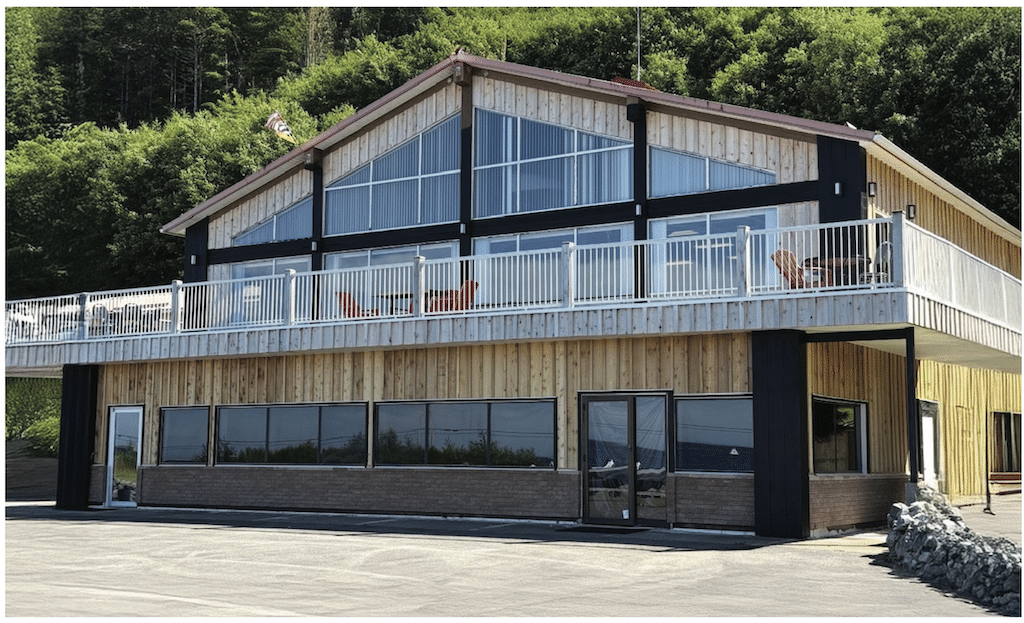
Chad’s path to Haida Gwaii is a classic passion play. After years navigating the corporate grind, he bought the lodge in 2020 and executed a complete top-to-bottom remodel in 2024. The result is a testament to “rugged luxury.” With 26 rooms featuring stunning live-edge cedar countertops and modern walk-in showers, it’s a place where you can find world-famous guests “hiding in plain sight.” The atmosphere is casual, Canadian family-style—a bit like winding back the clock to the 1980s when the world was a little less frantic and the fishing was a lot more legendary.
While the lodge operates as a high-end fishing hub in the summer, it stays active as a hotel in the winter to support local work crews and storm watchers. This year-round connection to the community is part of what makes the “Sandspit Way” so completely authentic.
Life Between the Tides: More Than Just a Downrigger

One of the biggest shifts I’ve seen in the resort industry is that guests want more than just a boat ride. At Sandspit Adventures, the adventure doesn’t stop when the rods are stowed for the day.
The Culinary Experience
Forget standard, uninspired “camp food.” Chad’s kitchen turns out the “Pitmaster’s Heritage Platter,” a feast of hickory-smoked chicken, beef brisket with a Pacific-style coffee rub, and slow-roasted prime rib. They even source local fish and shellfish through Haida Wild Seafood to ensure guests get a true taste of the coastal harvest.
Cultural Connection
A short boat ride to Skidegate allows guests to wander and visit the iconic Haida Heritage Centre]. It is a profound place to marvel at the deep connection between the land, sea, and the Haida people. You also have to see Balance Rock while you are there—a bus-sized boulder perched precariously on a tiny one-foot pedestal that has survived the Pacific’s wrath for millennia.
Leisure and Recovery
You can walk through the serene Louise Dover Trail—an old-growth forest right next to the lodge—or explore the rugged coast on the lodge’s premium e-bikes. For those who need to unwind and recover after an intense day on the water, there’s even a Nordic sauna circuit and cold plunge at nearby Hekate’s Retreat and the scenic Willows Golf Course.

The Journey: The Portal Through Skidegate Channel

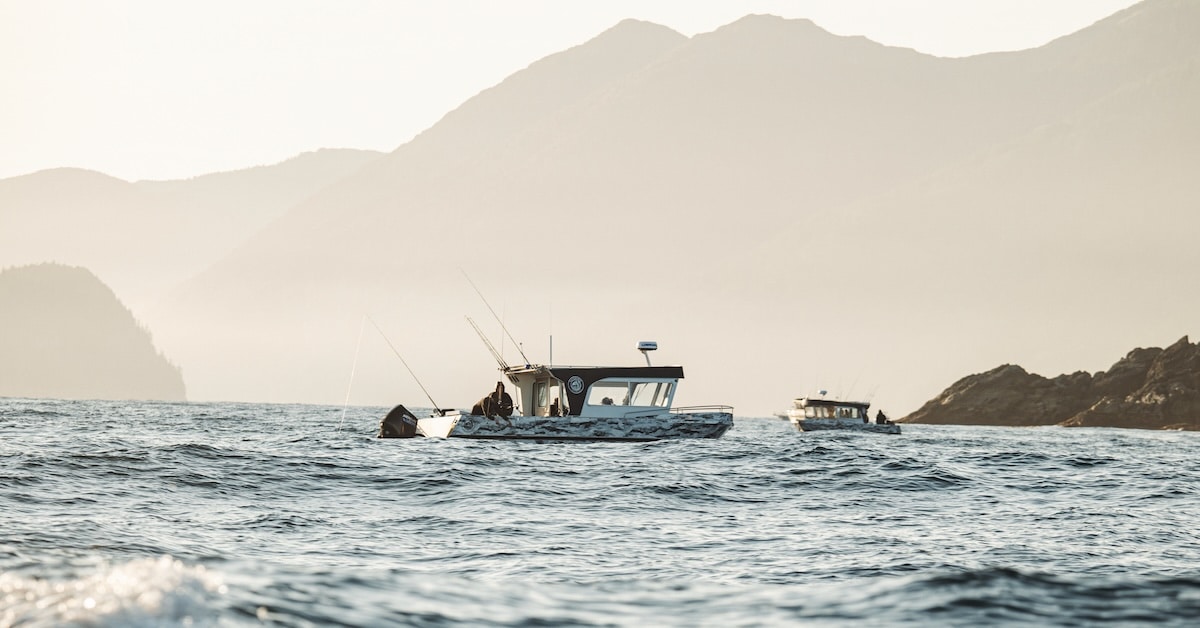
To get to the real action, you head west. Every morning, the fleet makes a breathtaking 45-minute run from the dock, navigating through the Skidegate Channel (also known as the Skidegate Narrows). Moving through the channel is like passing through a prehistoric portal. One minute you’re in the sheltered, tidal narrows, and the next, the horizon opens up and hits you in the chest as you emerge into the wild.
As you exit the mouth of the channel, Marble Island stands like a silent sentry, guarding the entrance to the legendary Cartwright Sound. To your left and right, the rugged coastline looks exactly as it did ten thousand years ago. But it’s what’s happening beneath your hull that should have your heart hammering.

To handle these powerful waters, Chad commissioned custom-built beasts from Outlaw Eagle. These aren’t off-the-shelf boats; they are 10.6-foot beam monsters built with 1/4″ plate bottoms and 3/16″ sides to handle the heavy demands of the open Pacific. They feature power-flush heads in the bow and maximized deck space, ensuring that even in 2-metre swells you are fishing from a rock-solid platform. These boats scream rugged as much as Haida Gwaii does itself.

The Science of the “Hanging Canyons”

Why is Cartwright Sound such an absolute magnet for fish? It comes down to a geographical cheat code. Just 2 to 4 miles past Marble Island, the continental shelf literally falls away into the dark abyss. We are talking about the legendary Hanging Canyons—massive submarine chasms.
This is where the marine science gets exciting. Deep, nutrient-dense currents from the ocean floor hit these vertical canyon walls and are forced upward in an intense upwelling. This creates a massive biological explosion. Cold, mineral-rich water hits the sunlight, triggering a massive phytoplankton buffet that supports everything from krill and needlefish to massive herring balls.
Think of Cartwright Sound as the “Ultimate 24-Hour Truck Stop” on the Pacific Highway. For salmon migrating to and from as far north as the Bering Sea or the Aleutian Islands, this isn’t a scenic detour—it’s a mandatory pit stop. These fish have travelled thousands of miles, and when they hit the “smorgasbord” of Cartwright, they stop to fuel up before their final push on to the Fraser or as far as the Columbia River.
The All-You-Can-Experience Fishery
Because of this unique canyon-to-coast proximity, you are fishing a very wild, incredibly diverse fishery. You aren’t just targeting one isolated run; you are intercepting a rich genetic mosaic of Chinook and coho.

| Species / Target | Peak Season Timing | Fishery Characteristics & Tactics |
|---|---|---|
| June Chinook | Early to Late June | Pure ocean-phase, chrome-bright, aggressive, and packed with high-octane oil. High-action release windows. |
| The Coho Arrival | Mid-July to October | Stack up heavily in salt water before pushing to 200+ local island rivers. Sensational aerial fighters. |
| Bottom Bounty | Full Summer Window | Lingcod and rockfish stack along jagged rock faces like cordwood. Halibut sit heavy on gravel humps. |
| The Deep Secret | By Request / Specialty | Deep-drop heavy sport tactics along canyon drops for buttery black cod (sablefish). |
- June Chinook: June is absolutely epic for Chinook. These are pure ocean-phase fish—chrome-bright, hyper-aggressive, and packed with high-octane oil. It’s common for boats to see 20 to 30 catch-and-releases in a single day.
- The Coho Arrival: By mid-July, the coho arrive in staggering numbers, stacking up in the salt before heading to the 200+ local rivers on the island. These are the high-flying aerial fighters that keep your reels screaming all the way through October.
- The Bottom Bounty: While the salmon are busy thrashing on the surface, the structure below is teeming. Lingcod and rockfish stack up along the jagged rock faces like cordwood. Move out to the gravel and sand humps, and you’ll find halibut practically littering the seafloor.
- The Deep Secret: Because the submarine canyons are so close to the coast, you can even drop a specialized line for black cod (sablefish)—a deep-gold delicacy usually reserved exclusively for commercial longliners but accessible here to properly equipped sport boats. And yes, Chad has the specific heavy gear ready for the job.


The Long Fin Frontier: Tuna Poke Derby

If you want sheer, high-octane energy, look no further than the emerging North Pacific Albacore Tuna fishery. Sandspit has recently evolved into the official hub for the inaugural Haida Gwaii Tuna Poke Derby, an event Chad and his team actively helped organize and fund.
Tuna fishing out here is a wild blue-water safari. It requires chasing precise temperature breaks and chlorophyll shots in the deep water right off the shelf. When the warm water fingers of the North Pacific current push toward the shelf, the voracious albacore follow. The tactics are high-speed and intense; boats hit 8 to 9 mph, dragging a massive spread of electric reels and hand lines. When you hit a “six-pack”—six tuna on six lines at the exact same time—the deck fills with chaotic action and 20 lb fish in a matter of minutes. The 2026 derby is officially set for August 28–September 2, proving that these remote islands still have plenty of secrets to share.

The Sandspit Difference: Teamwork Over Trophies
What truly defines the operations at Sandspit Adventures is a total, refreshing lack of pretension. In an industry all too often filled with tight-lipped “young hero” guides who refuse to share their tactical details, Chad’s crew—all seasoned veterans—operate as a tightly integrated team.
They talk openly over the radio, sharing hot spots, depths, and bite windows to ensure every single guest on every boat experiences a world-class day on the water. They are dedicated conservationists at heart, deeply encouraging the “Release the Giants” philosophy. They’d much rather you keep a perfect 20-lb table-fare fish for prime eating and let the big 40-lb genetic mamas swim away, ensuring the run stays strong and resilient for the next generation of anglers.
The Bottom Line
So, why go all the way to Haida Gwaii? Because it’s one of the last places left on earth where you can still feel the raw, unedited, ancient power of the Pacific. It’s a place where you can catch a six-pack of tuna in the morning, pick up hard-fighting salmon on your way back in, and sit by a crackling beach fire in the evening sharing stories with friends.
Plan Your Haida Gwaii Fishing Adventure
Charter Details
Did You Miss This Issue?
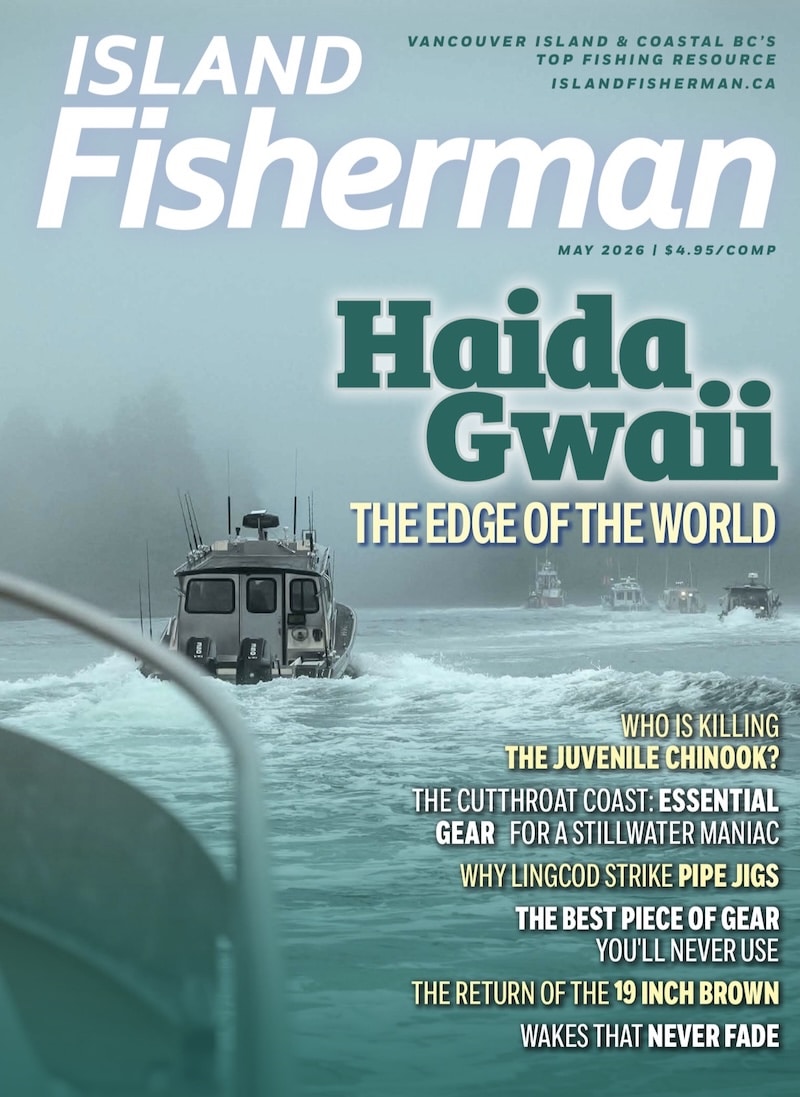
This article originally appeared in the May 2026 issue of Island Fisherman magazine. Did you miss this issue? Get the digital version here!