

How to Measure Fishing Leaders: The Ultimate West Coast Guide
Learning how to measure fishing leaders accurately might sound like something you do during an election, but for West Coast anglers, it is a critical yet often-overlooked aspect of preparing your gear for the water. Measurements lead to success, and while this might seem like an inconsequential detail, a few inches can completely alter your lure’s presentation. Whether you are targeting hard-striking saltwater Chinook or tracking finicky river sockeye, precision in your rigging is a fundamental building block of a successful day on the ocean.
Whether you are trying to perfect the erratic whip on your trolling hoochie or gently drift a soft bead into the strike zone on a crystal-clear river, using the correct length leader is critical for many types of fishing. Much ink has been used by fishing writers describing in detail how long a leader should be for each targeted environment. But one aspect that often gets overlooked by the authors (myself included) is a simple, standardized explanation on how to measure the leader itself. It’s all well and good to say, “Use a 36″ leader when trolling a hoochie for Chinook.” But is that 36″ the total distance between the flasher and the lure? Does it include the bead chain and quick snaps in the measurement, or not? And what about the length of the lure itself?
This guide will briefly explain the right way to measure your leader, analyze the technical details of hardware interference, and discuss when it matters versus when it doesn’t. A few inches might not seem like much on a modern boat layout, but sometimes it makes the exact difference between a screaming reel and getting skunked.

What is a Leader and Why Does it Matter?
The leader is the additional segment of specialized line that is tied to your lure at one end and your mainline (or terminal hardware like a flasher) at the other. If you just tie your mainline directly to your lure, then you are tying direct and do not have a leader. Leaders are deployed across many different coastal situations and provide distinct mechanical and optical benefits:
- Stealth in Clear Water: In gin-clear rivers or calm ocean conditions, a premium fluorocarbon leader from high-quality brands like Seaguar is highly necessary to hide the line and prevent spooking sharp-eyed fish.
- Abrasion Resistance: For bottom-dwelling giants like lingcod and halibut, a tough, thick, abrasion-resistant monofilament leader is mandatory to withstand the sharp, crushing teeth of the fish and abrasive rocky reefs.
- Action Transmission: When trolling behind a flasher, you often want a heavy leader (such as 30-lb to 50-lb test) because a stiffer, thicker line more effectively transmits the aggressive, whipping action of the flasher directly down to a lightweight lure.
- Mainline Protection: Conversely, there are times you want a leader that is rated at a lower breaking strength than your mainline. This ensures that if you snag the bottom, you only snap the leader—saving your expensive mainline and terminal configurations.

Tools to measure (Photo: Steve Vavrik)
The Sockeye Debate: Why Inches Rule the Alberni Inlet
It is well known that sockeye salmon are notorious for needing their leaders to be exact down to the absolute inch. Too much or too little action, and you will go home with an empty cooler while the boat next to you limits out. Leader length is a long-running, fiercely contested debate among veteran sockeye fishermen, with dogmatic claims that anywhere from 18″ to 24″ is the only correct length to trigger a strike response.
I spent half my childhood hanging around the bustling cleaning station at Clutesi Haven Marina in Port Alberni, listening to seasoned local fishermen endlessly debate this exact topic. But nobody ever explicitly mentioned where they actually measure from. The reality is that an array of bead chains, coastal swivels, and quick-snaps can easily account for several combined inches. This oversight could drastically change the hoochie’s action in the water column.
This realization makes me wonder if non-standardized measuring is what is causing the entire generational debate between sockeye fishermen. If one fisherman insists only an 18″ leader works, while another swears that they must run 22″, then just maybe they have the exact same functional length but completely different ways of calculating it at their prep stations.
Always look at the total profile of your rig. If you use heavy-duty bead chains or long, multi-sleeve brass swivels, keep it in the back of your head that you may need to reduce the raw line length of your leader to compensate for this extra mechanical footprint.
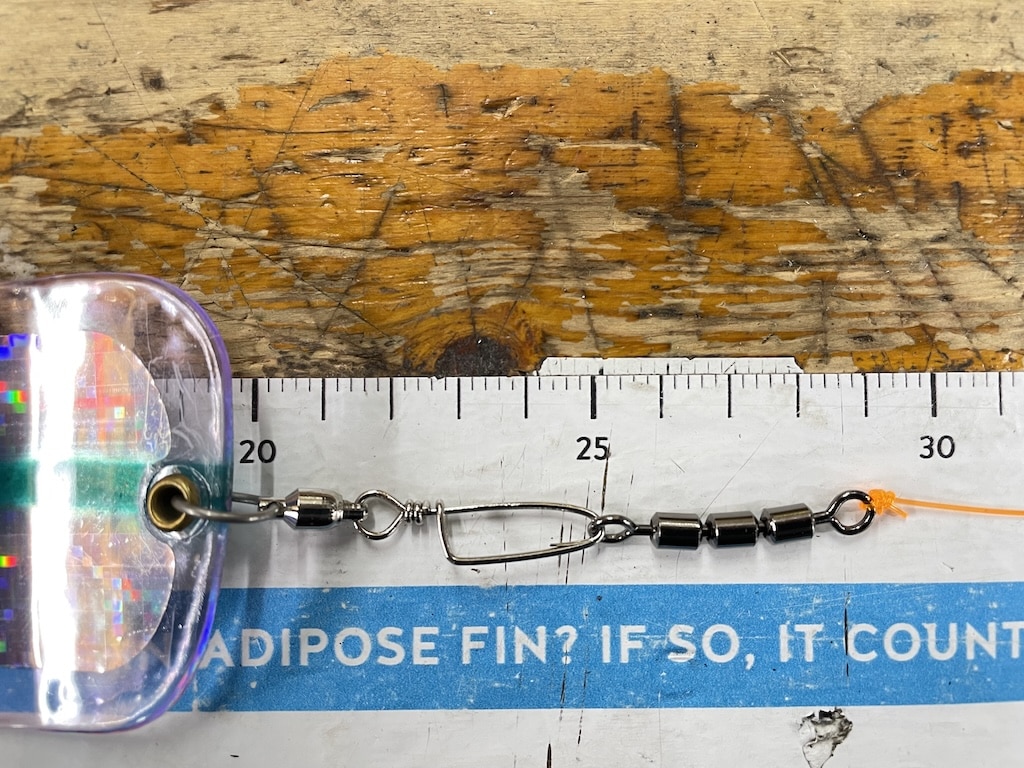
Almost three inches of hardware! (Photo Steve Vavrik)
🐟 Put Your Measurements to the Test
Ready to chase the best-tasting salmon on the coast? Once your leaders are tied to the exact inch, put them to work using our definitive Alberni Inlet Sockeye Fishing Guide.
How to Measure Fishing Leaders: The Knot-to-Knot Rule
To resolve these communication errors across tackle shops, I have always interpreted true leader length to be the knot-to-knot distance. After the leader is completely tied, I measure the length of the line directly from one knot to the other. I do not include the metal swivels, the snaps, or the body of the lure in that core number.
Furthermore, when tying your own gear, you must always measure out about 5″ of extra raw line prior to cutting. This safety margin beautifully makes up for the material used up inside the structural wraps of the knots (like a Snell or Uni-knot). That way, your intended 36″ leader finishes at exactly 36″ of clear line. Be explicitly aware, however, that the bead chain and quick changes may well add an extra 4″ to the overall physical setup. It could be strongly argued they have to be factored into your overall presentation calculations because they directly govern the behaviour of the entire rig.
📏 Bench Tactics for Precise Measuring
- The Workbench Sticker: Secure a durable, weatherproof fish measurement sticker or ruler directly onto your tying bench for immediate consistency.
- Account for Knots: Pull out an extra 5 inches of leader material from the spool before cutting to ensure your knots don’t shorten your target length.
- The Eyelet Pre-Check: Measure out the line right after it is threaded through the eye of the swivel and lure, but right before you cinch down the wraps.
- Post-Tie Double Check: Verify the finalized knot-to-knot spacing to maintain strict consistency across your entire seasonal gear tray.
- Ask Your Peers: Whenever you trade tactical secrets or discuss leader lengths with fellow fishermen, always ask them exactly where they measure from.

Every inch matters for sockeye.
Matching Leader Length to Lure Action
When trolling streamlined spoons or heavy plugs without a trailing flasher configuration, precise leader length is inherently less important—a few variant inches here or there aren’t going to destroy the lure’s engineered tracking. But when trolling soft vinyl hoochies behind an active flasher, where a shorter or longer line instantly changes the rotational translation of the lure, leader length becomes highly critical.
If your leader is too long, the hoochie will simply lazy-trail through the brine without snapping or whipping around. If it is configured too short, the action might be far too violent and fast for sluggish, low-temperature salmon to commit to. Most importantly, once your gear is rigged and ready, run it in the water directly beside the boat before dropping it down the downrigger. Carefully observe the action of the lure at your current trolling speed and check if it looks “fishy” to your eye. If it doesn’t look perfect, pull it right back in and adjust the knot spacing as needed. Once you discover a winning setup that starts triggering strikes, make sure to measure it knot-to-knot immediately so you can flawlessly recreate it the next time you head out.
🎣 Master Your Flasher Presentation
Now that you have dialed in your leader lengths, make sure your terminal attraction is operating at peak efficiency. Read our comprehensive guide on How to Rig Dummy Flashers for Deep Salmon Trolling to learn how separating your attraction from your mainline can completely revolutionize your downrigger game.
📊 Recommended West Coast Leader Reference
| Target Species | Lure Choice | Recommended Knot Length | Line Rating & Material | Presentation Style |
|---|---|---|---|---|
| Sockeye Salmon | Vinyl Hoochie | 18″ – 24″ | 25-lb – 30-lb Mono | Ultra-precise, erratic whipping behind a flasher. |
| Chinook Salmon | Trolling Hoochie | 36″ – 42″ | 40-lb – 50-lb Mono/Fluorocarbon | Classic sweeping action with strong action transfer. |
| Coho Salmon | Trolling Spoon | 48″ – 60″ | 25-lb – 30-lb Fluorocarbon | Longer leads allow the spoon to swim naturally. |
| River Salmon | Soft Beads / Jigs | 24″ – 36″ | 8-lb – 15-lb Fluorocarbon | Stealth focus; blends into current lines. |

Measure your fish and your leader for peak performance.
Pro Handling & Finishing
Once you have built your leader lines to matching specifications, take the time to coil them cleanly without putting sharp kinks into the monofilament or fluorocarbon materials. Always check that your structural lines are completely free of abrasions, nicks, or small wind-knots before you drop them into your tackle bags. Every fall, many anglers are forced to watch the fish of a lifetime snap off right at the swim step because they didn’t take twenty seconds to inspect their knots or verify their leader lengths. Don’t let your trophy get away by being unprepared at your tying bench.
🐟 Perfect Your Preservation
Once you’ve mastered your leader measurements and filled up your cooler with prime West Coast salmon, make sure your kitchen processing game is just as precise. Read our legendary guide to Smoking Salmon: Best Practices Guide and treat your catch with the culinary respect it deserves.
Words by Stephen Vavrik, an avid West Coast angler dedicated to dialing in the fine technical margins of terminal tackle. Island Fisherman Magazine — supporting local conservation and the West Coast lifestyle.