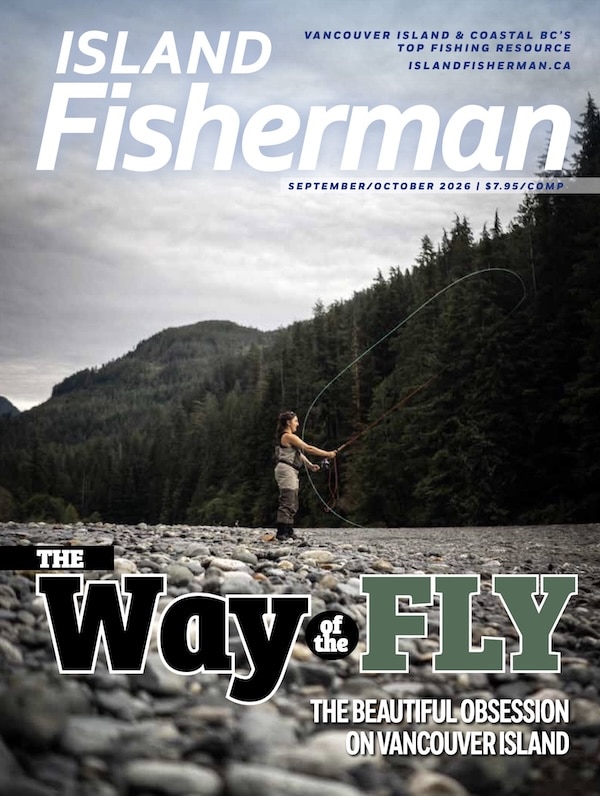


We Won’t Back Down: Standing Up Against the Salmon Allocation Policy BC
The town halls hosted across our coastal communities over the last several months regarding the federal Salmon Allocation Policy BC (SAP) review have been profound eye-openers. While it is incredibly encouraging that so many passionate anglers, business owners, and residents have sent direct feedback to the Minister and local MPs, those of us who live and work on the water know the stakes. The current silence from Ottawa feels less like peace and more like the heavy, breath-before-a-storm moment. While we are all trying to get on with our day-to-day operations, an unprecedented layer of economic uncertainty is hanging over the entire Pacific coast. It is a localized anxiety that touches every bait and tackle shop in Nanaimo, every guiding lodge in Campbell River, and every marina corridor in the Cowichan Valley.
West Coast anglers are unfortunately well-accustomed to the Department of Fisheries and Oceans’ (DFO) historical habit of dropping critical regulation notices at the absolute eleventh hour. This late-stage decision-making makes annual business projections and seasonal lodge planning difficult enough under normal circumstances. But what the coastal economy is facing with the current Salmon Allocation Policy BC review isn’t just another localized, temporary closure or a minor downward adjustment to a daily retention limit. This represents a fundamental, foundational policy shift that possesses the real potential to drastically alter the social and economic architecture of the Pacific coast forever. This level of operational instability is completely unworkable for any coastal small business, and it is exactly why we cannot afford to let our collective community pressure slip now.

Campbell River Town Entrance Welcome sign Vancouver Island BC Canada. Image shot 2008. Photo: Shutterstock
Investing in the Voices That Matter
You might wonder why three federal Members of Parliament have chosen the dedicated pages of Island Fisherman magazine to deliver this urgent warning, rather than distributing a generic press release to a national media syndicate. The reason is incredibly simple: we believe in investing our focus directly in the real people who are most heavily impacted by these federal decisions. This publication functions as the true journal of record for the BC coast, read thoroughly by community members with real skin in the game. We want to speak directly to the independent charter guides, the multi-generational shop owners, the regional boat dealers, and the specialized marine mechanics whose mortgages and family livelihoods directly depend on fair public access to tidal fisheries. By bringing our platform here, we are acknowledging that you are the primary stakeholders, and you fully deserve the absolute respect of a direct, honest conversation.
According to meticulous data validated by the Sport Fishing Advisory Board (SFAB), our public, recreational fishery serves as a massive economic engine for BC’s coastal communities because it extracts the absolute highest value for every single fish harvested:
- The public recreational sector generates approximately $693 in direct GDP for every single salmon caught.
- The sector reliably supports over 9,000 full-time jobs across the province.
- The angling community contributes a staggering $1.1 billion annually to the BC economy.
The Industrial Web of Coastal Survival
It is critical for decision-makers in Ottawa to understand that the threat of the Salmon Allocation Policy BC shift isn’t just about the single individual holding a fishing rod at the back of a boat. There is a massive, interconnected industrial web that directly supports that one angler. If the public sector loses its existing priority access to chinook and coho salmon, the downstream economic ripple effect will look like a catastrophic tidal wave. We are talking directly about our regional boat dealerships who move the heavy inventory that keeps our coastal harbours full, as well as the specialized marine mechanics who keep these high-performance offshore vessels running safely in heavy tracking seas.
Perhaps most importantly, this directly impacts our local manufacturing sector. Vancouver Island is internationally recognized as the home of world-class aluminum and composite boat builders. These manufacturing facilities represent high-skill, high-paying jobs in technical fabrication, precision structural welding, and advanced marine electronics integration. If the DFO removes the seasonal predictability of a stable recreational angling calendar, the incentive for a standard Islander to invest hard-earned capital into a new, locally built sport fishing boat completely vanishes. When those commercial orders dry up, the fabricators, floor technicians, and marine electricians are the very next people to feel the economic squeeze. We cannot stand by and allow a detached federal policy to systematically dismantle a mature manufacturing and service ecosystem that has taken our coastal communities decades to build.
 Island Fisherman graphic[/caption>
The Danger of a “Residual” Scraps Model
There is a deeply terrifying push developing within the upper echelons of the DFO toward what is known as a “residual” or “scraps” framework. Under this upside-down model, the general Canadian public fishery would only be permitted to access vital stocks of Chinook and coho salmon after every other harvesting sector has taken their absolute fill. This devastating policy choice would effectively downgrade our highly organized $1.1 billion tourism and recreation industry into an unpredictable, unmarketable scavenger hunt.
You simply cannot run a world-class fishing lodge, a coastal retail storefront, or a marine repair shop on a vague “maybe”. Sustainable business growth fundamentally requires predictable timelines. If an international tourist from the United States or Germany is looking to book an expensive excursion to our shores, they need to know months or even a year in advance that they will legally be allowed to put a line in the water. When the DFO blindly suggests implementing “fixed quotas” or “hard caps” for the public, they are showing that they fundamentally misunderstand how the recreational sector operates. We don’t merely “harvest” a raw resource; we market and sell an unforgettable West Coast experience. If that opportunity is forced into a secondary status, the predictability that sustains our entire infrastructure instantly vanishes. Once the bookings stop, the lodges close. Once the lodges close, the local hardware stores, regional grocery operations, and community service stations follow. Once that baseline infrastructure disappears from our small towns, it is gone for good.
⚠️ A Heritage Under Siege
This battle isn’t just about the bottom line of a balance sheet; it is a fight for our cultural identity. We witnessed the incredible grit, unity, and raw passion of this community firsthand at the Salmon Fishing Survival Rally in Victoria, as well as the packed Town Halls in Campbell River and Duncan. When hundreds of local coastal families stand up to demand regulatory transparency, they aren’t merely asking to protect a weekend hobby—they are actively fighting for their fundamental right to exist as coastal people.
Taking the Fight straight to Ottawa
The DFO has recently attempted to soothe rising community tensions by casually stating that salmon stocks technically remain “common property”. But that phrase becomes a completely hollow victory if the federal government simultaneously builds structural regulatory barriers that make it practically impossible for the average Canadian citizen to step off a dock and access that resource. Our social, historical, and cultural fabric is built entirely on this living resource. It is exactly how we teach our children to respect the ocean, and it is how we directly fund the massive grassroots conservation projects that keep these wild stocks alive via the mandatory Salmon Conservation Stamp. Without an accessible sport fishery, the most dedicated, boots-on-the-ground advocates for salmon recovery in British Columbia will be completely sidelined.
We are currently caught in a state of regulatory limbo that is deeply unfair to the citizens of Vancouver Island. We are continually told by bureaucrats that the “consultation meetings are over,” yet we are given absolutely no clear timeline on the final Salmon Allocation Policy BC decision. To intentionally leave a massive coastal industry completely in the dark during our busiest equipment prep and booking months is a glaring failure of federal leadership. Because of this, the community pressure directed at Minister Joanne Thompson must remain constant, loud, and entirely unrelenting.
We are asking every single reader of this magazine to take ten minutes out of their day today to reach out directly to her office. Tell her your personal story. Don’t just quote industry statistics—talk openly about your family mortgage, your valued employees, and the multiple generations of your family that have successfully fished and protected these pristine coastal waters.
📬 Direct Action: Contact the Minister
Minister Joanne Thompson — Department of Fisheries and Oceans
📧 Email: [email protected]
📞 Parliament Office Phone: 613-992-3474
Our Doors Are Always Open
While we fight tenaciously on your behalf inside the House of Commons, we constantly need the hard specifics, real-world data, and localized insights that only your lived experiences on the water can provide. We want to hear directly from you regarding how these proposed allocation shifts threaten to land on your seasonal bottom line. The DFO’s rigid, top-down bureaucratic approach completely depends on our communities quietly and submissively accepting whatever final decision they hand down from a desk in Ottawa. We are absolutely not going to do that. The recreational fishery is our heritage, our economy, and our future. Let’s work together to make sure Vancouver Island stands its ground. Tight lines, and we’ll see you out on the water—and inside our regional offices.
🏛️ Your Vancouver Island Representatives

Aaron Gunn, MP
North Island–Powell River

Tamara Kronis, MP
Nanaimo–Ladysmith

Jeff Kibble, MP
Cowichan–Malahat–Langford

Sponsored Content featured in Island Fisherman Magazine — Dedicated to preserving public access, supporting local small business, and defending our coastal way of life.