


If you listen closely, you can hear a collective groan echoing across coastal BC following the unexpected implementation of the new DFO Regulations 2026.
When the DFO’s Integrated Fisheries Management Plans (IFMP) were finally released, later than any time in recent memory and after July 1, the details about recreational fishing gear modifications came as an unexpected and unwelcome surprise—effective July 15, a complete ban on treble hooks for salmon fishing, a cap on hook gap size to 22 mm, and a maximum size reduction in the Juan de Fuca and Haro Straits.

The Pocket Change Gauge: A quick boat-side trick to verify if your single barbless hooks are compliant with the new 2026 throat limits.
💡 Pro Tip: The Pocket Change Rule
Keep this rule of thumb locked on your dashboard: A Canadian quarter (1953 to 2026) measures 23.88 mm across, meaning it is physically too wide to pass through a legal 22 mm hook gap. If a quarter slips completely inside the hook’s throat, your setup is oversized and illegal under the new DFO Regulations 2026 framework. Stick to using a Canadian nickel (1922 to 2026)—at 21.2 mm wide, it provides an instant visual safety buffer to guarantee your gear easily passes a dockside check.
Let’s skip the diplomatic bureaucratic tango and look at what the latest DFO Regulations 2026 actually mean for the average angler, the tackle shops, and the guides who make their living on the water.
⚓ REVIEW THE PROCESS
Review the complete visual breakdown of the “players” and what they asked for in the 2026-2027 Draft IFMP massive 363-page feedback package in our full summary feature: 2026-2027 BC Salmon Fishing Regulations Analysis.
The Mid-Season Tackle Trap: “Unacceptable Timing”
Let’s be perfectly clear: nobody in the sport fishing community argues against science-backed conservation. When the data shows a path to better survival rates for released fish, we sit up and take notice. But dropping a sweeping tackle ban smack in the middle of the season—with virtually zero notice—is like changing the rules of traffic court while you’re already in the intersection.
As the SFI rightly pointed out in their July 8 newsletter:
Think about the sheer amount of time and capital sitting on the shelves of local tackle shops right now. Think about a guide who spent his entire winter and spring pre-tying hundreds of teaser head rigs with trebles. For DFO to treat our coastal economy like an afterthought carries significant, painful impacts. Had they actually consulted with the Sport Fishing Advisory Board (SFAB) or the SFI, both groups would have strongly advised a phased-in approach leading up to the 2027 IFMP. Instead, we get a surprise mid-season pivot that leaves a lot of hard-working folks holding the bag.
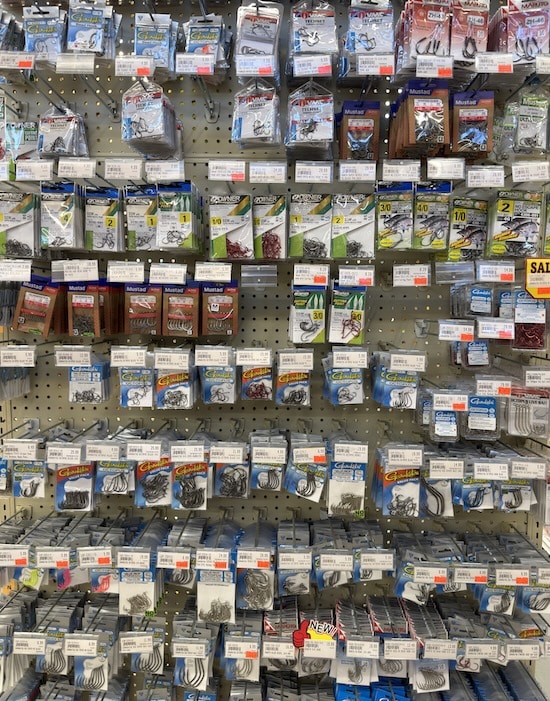
The Inventory Logjam: A full wall perspective of the staggering retail volume and tied seasonal gear facing immediate compliance barriers and sudden mid-season sales halts.
Is a ban on trebles for salmon really so urgent or so effective that it couldn’t be rolled out more thoughtfully and with appropriate consultation? The science is clear that the most important factor in improving survival of released salmon is minimizing contact, so shouldn’t waterline release be part of the discussion too?
Understanding the advisory chain is vital to making our community voice land with impact. Find out how the regional process works by reading our feature on The SFAB Process: Why and How Anglers Can Become Engaged.
New Salmon Fishing Regulations: What the Science Actually Says (And Where DFO Got It Twisted)
The irony here is thicker than a mid-summer fog. If you actually dig into the 2024 Final Report – Enhancing the sustainability of capture and release marine recreational Pacific salmon fisheries using new tools and novel technologies, you’ll see that the data and findings run aground on DFO’s logic.
DFO claims these sweeping gear changes are designed to increase the survival of released Chinook and coho. They point to recent research conducted by UBC’s Salmon Ecology Lab. However, if you look closely at Dr. Scott Hinch’s five-year telemetry and holding project, the actual numbers tell a different story about where the real damage happens:
Landing Nets are the Real Villains
The study explicitly notes that landing nets are fundamentally not fish-friendly. In the tagging studies, 90% of Chinook salmon landed without nets had zero visible fin damage. Meanwhile, net interactions (especially knotted polypropylene nets) caused major fin splitting and severe scale loss—which directly hammered survival rates.
The Treble Hook Twist
While smaller single hooks (gap widths of 15 mm or less) did reduce eye punctures compared to massive commercial hooks, the study actually noted that treble hooks were less likely to cause eye injuries. The issue with trebles was strictly wound severity in smaller, sub-legal fish.
So what does DFO do? They leave nets completely unregulated and slap a sudden ban on trebles mid-season. It’s the regulatory equivalent of trying to fix a leaky boat hull by polishing the steering wheel.
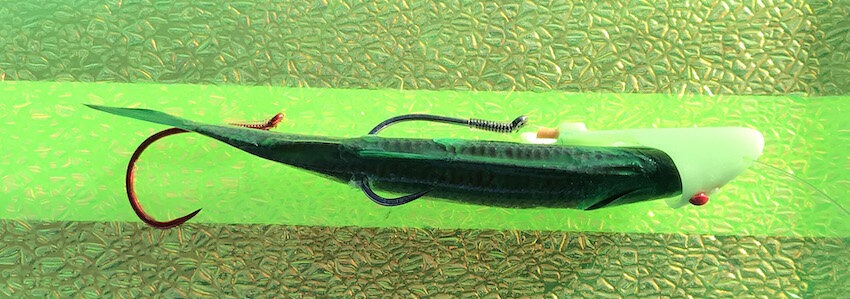
Juan de Fuca and Haro Straits: Chinook Size Restrictions
The reduction in maximum Chinook size from 80 cm to 75 cm in Juan de Fuca and Haro Straits is another confusing choice that misses the mark. The SFAB, with support from the SFI, rejected this option flat out.
Why? Because Fraser summer 5.2 Chinook are already on a known rebuilding trend, and Food, Social, and Ceremonial (FSC) fishing effort and requirements are expected to decrease anyway due to the massive availability of Sockeye this year. As a result, the risk of an increased FSC catch on this stock is incredibly low. This size reduction appears completely unnecessary from a conservation perspective and serves no purpose other than to deal a negative economic blow to our local angling communities.
Cowichan Chinook: A Hard-Earned Win
It’s not all bad news, though. After more than a decade of Cowichan Chinook consistently and significantly blowing past their science-based escapement goals, DFO is finally—as referenced in the newly released Southern BC Salmon IFMP—considering recreational opportunity on this highly abundant stock.
This is welcome news for southern Vancouver Island anglers who have invested countless volunteer hours and tens of thousands of dollars out of their own pockets to help rebuild this stock to its current, exceptionally strong status.
The logic is simple: when the entire salmon community contributes meaningfully to recovery efforts, the entire salmon community should share in the benefits of that recovery. With Cowichan Chinook now demonstrating sustained abundance, we are cautiously optimistic that DFO will take the right next step and provide an actual, sustainable recreational opportunity for anglers in the Cowichan local area.
Best Release Practices: The Real Salmon Survival Guide
Great fishing carries the great responsibility of releasing a fish properly and carefully. If we want to maximize survival rates under these new restrictions, we need to look past DFO’s paperwork and rely on the actual, hard data generated by UBC’s Salmon Ecology Lab.
When you encounter non-target species or sub-legal fish this season, drop the old habits and commit to these science-based best practices at all times:
- Ditch the Landing Nets Completely: Dr. Hinch’s project proved that even “fish-friendly” rubber or coated-nylon nets split fins and scrape off vital scales. Keep your net on the boat deck unless you are explicitly landing a keeper.
- Release at the Waterline: Use a gaff, long pliers, or a hook-disgorger tool to pop the single barbless hook out while the fish is fully submerged over the side of the boat. Eliminating air exposure prevents acute tissue anoxia and keeps their protective slime layer intact.
- Fight Fast, Land Faster: If you know the fish will be released, avoid fighting it to the point of exhaustion. Prolonged fight times create a significant oxygen debt that can lead to cardiac failure, and they lengthen recovery periods when a fish is far more vulnerable to predation.
- Stop the “Rocking” Routine: Do not swim a fish back and forth in a rocking motion beside the hull. The physical constraint actually elevates their stress levels, delays their escape to safe depths, and removes protective slime and scales. If a no‑touch, waterline release isn’t possible, the next best option is a torpedo release, which gets the fish back with a blast of water over its gills and momentum.
- Mind the Thermocline: The UBC study noted a massive drop-off in post-release survival when surface water temperatures hit or exceed 18°C. When the top layer of the salt gets warm, you have zero margin for error—get that hook out instantly.
- Lessen Your Footprint: The absolute best way to lower release mortality is to stop releasing fish. If you catch a legal salmon that fits your quota, retain it, wrap up your gear, and either fish some other species or stop fishing rather than high-grading or continuing to catch and release.

Waterline release in action: Reaching down with a gaff to safely pop a single hook eliminates abrasive net contact entirely, keeping vital scales and mucosal linings 100% intact just like the UBC telemetry data recommends.
🎣 Master Your Handling Tactics
For a comprehensive checklist on handling field targets safely without causing lethal scale loss, view our blueprint on: BC Salmon Catch and Release Best Practices Guide.
The Bottom Line: Keep the Pressure on Ottawa
We’re heading into a highly dynamic, heavily monitored season under these rewritten rules, and everyone is going to be adapting in real time. While we all have to keep clamping barbs, checking hook gaps, and doing everything we can to protect fish on the water, we also can’t afford to stay quiet about the way these policies are being dropped on us. Well considered implementation and proper consultation matter just as much as compliance, and we need to keep pressing for both.
The fact is that DFO’s collaborative review of the 1999 Salmon Allocation Policy is now finished, but the outcome is still undecided, and the decision now sits with the Minister. Because potential revisions to priorities and access are being considered behind closed doors, it’s essential to keep communication lines open with Ottawa and continue offering steady reminders about the importance of a balanced decision that acknowledges the tremendous benefits and values of the public fishing sector.
Is the core resource division framework hanging in the balance? Track the shifting landscape of allocation shares by exploring our feature: Is the Salmon Allocation Policy (SAP) Review Settled?
Grab your keyboard, find your local Member of Parliament (MP) via the Parliament of Canada website, and tell them you haven’t forgotten about the SAP and how important the outcome is to you and how this mid-season ambush creates unnecessary financial hardship for your local businesses, lodges, charter operations, and the common angler.
Send your comments directly to the Minister:
• Minister of Fisheries and Oceans: The Honourable Joanne Thompson
• Direct Email: DFO.Minister-Ministre.MPO@dfo-mpo.gc.ca
• Mailing Address: The Honourable Joanne Thompson, House of Commons, Ottawa, ON K1A 0A6 (Remember: Letters mailed to a Minister at the House of Commons do not require postage!)
Let’s make sure the honest feedback from the West Coast is loud enough to be heard across the country.
See you out on the salt.
