
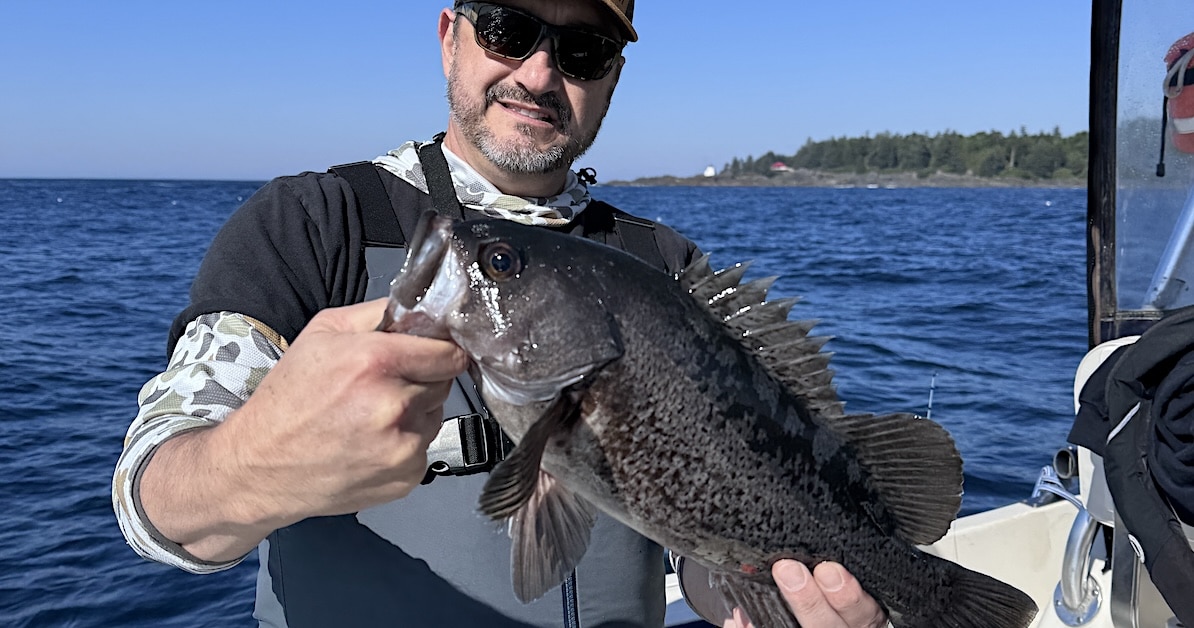
A comprehensive scientific study on black rockfish british columbia populations reveals remarkable insights into one of the West Coast’s most targeted species. Known locally as black bass, black rock cod, or “black bombers,” black rockfish (Sebastes melanops) are caught more than any other rockfish in British Columbia’s recreational fishery.
Despite their popularity, managing black rockfish is uniquely challenging. They are a long-lived, slow-growing, and late-maturing species, with scientists only recently unraveling the full extent of their biology, lifespan, and offshore migrations.
Black Rockfish British Columbia: Lifespan & Biology
The groundbreaking discovery that rockfish live to extraordinary ages was made at Nanaimo’s Pacific Biological Station in the early 1980s. Prior to this research, biologists believed rockfish lived for only 10 to 20 years. In reality, rockfish lifespans are similar to humans—with some species, like the rougheye rockfish, verified at over 200 years old.
For black rockfish, about half mature between ages 6 and 8 at lengths of 38 to 42 cm (15″ to 16.5″). By age 10 (45 cm), virtually all individuals are mature. They are primarily found nearshore around rocky reefs and shallow structures, though large schools frequently assemble near the surface. Because most adults remain within a small home range, they are excellent candidates for Marine Protected Areas and Rockfish Conservation Areas (RCAs).
Unique Reproduction: Internal Hatching & Parturition
Unlike salmon or flatfish that broadcast eggs into the water column, black rockfish fertilize their eggs internally. Females receive sperm from males around October or later and store it for several months before internal fertilization occurs. The eggs hatch inside the female’s body, and after developing for a few months, live larvae are released between January and May.
Technically, this process is known as parturition rather than spawning. Depending on her age and size, a single female can give birth to between 125,000 and 1,200,000 larvae.
Long Lives, Small Populations, and Rare Year Classes
Despite releasing massive numbers of larvae, long-term survival to maturity is extremely low in most years. In unfished populations, strong year classes—where ocean conditions align perfectly for larval survival—occur only once every few decades.
For example, an unexploited black rockfish fishery sampled in Alaska showed ages ranging from 4 to 48 years. However, a single strong year class (the 1979 spawn) accounted for over one-third of the entire catch. This demonstrates why careful fisheries management is critical: populations must maintain enough mature females to weather long stretches of unfavorable ocean survival conditions.
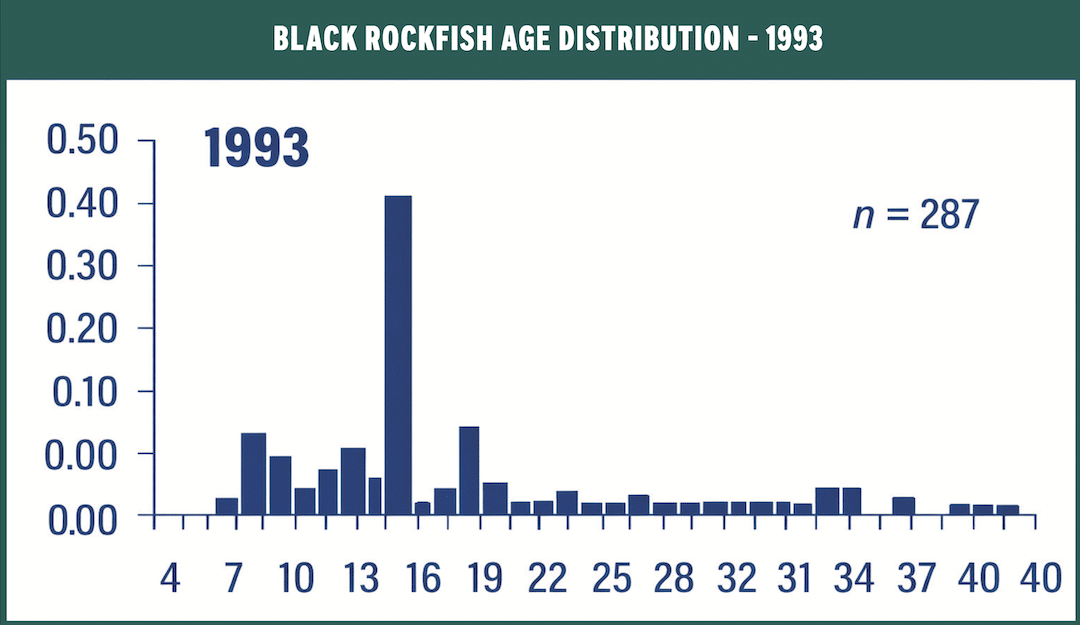
Figure 1: Age distribution of black rockfish sampled in 1993 showing a dominant 15-year-old cohort (1979 year class) making up over 40% of the sample population.
Surprising 1,000 km Offshore Migrations
While most black rockfish stay close to their home reefs, recent ocean research revealed surprising long-distance migrations. In March 2022, researchers setting surface gillnets in the open Gulf of Alaska captured 22 black rockfish over 1,000 km offshore.
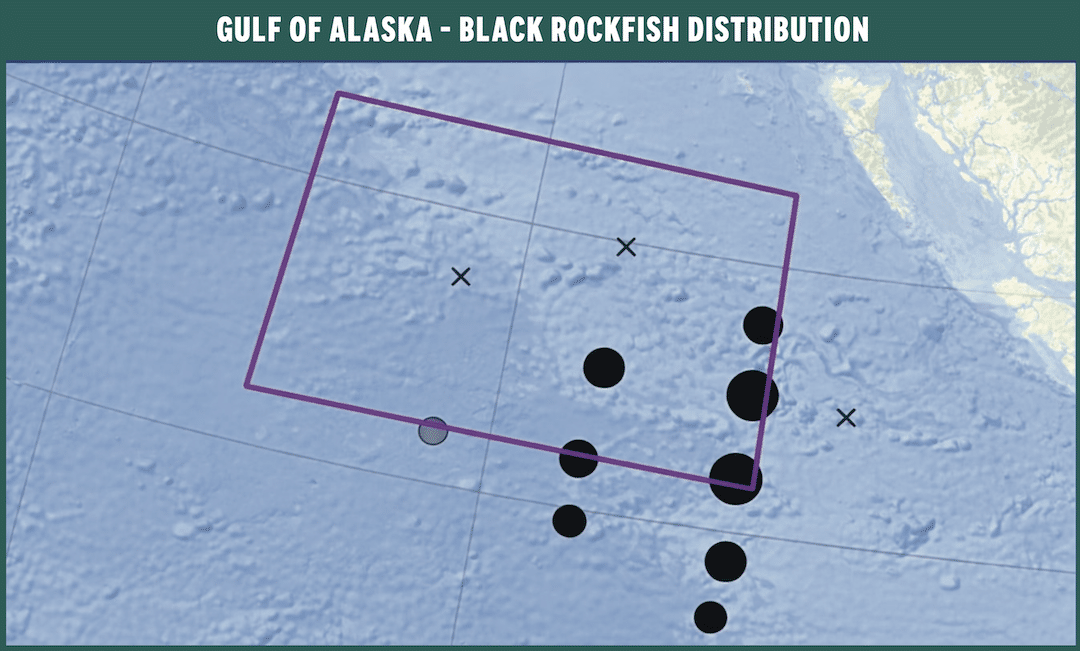
Figure 2: Offshore survey sampling points in the Gulf of Alaska where adult female black rockfish were captured in surface gillnets over 1,000 km offshore.
These offshore travelers ranged from 9 to 15 years old and 380 mm to 600 mm in length. Crucially, almost all were females that were either giving birth or had just released their larvae. Scientists hypothesize that these long-range oceanic migrations may help distribute larval fish across the continental shelf during their 3- to 5-month larval drift stage.
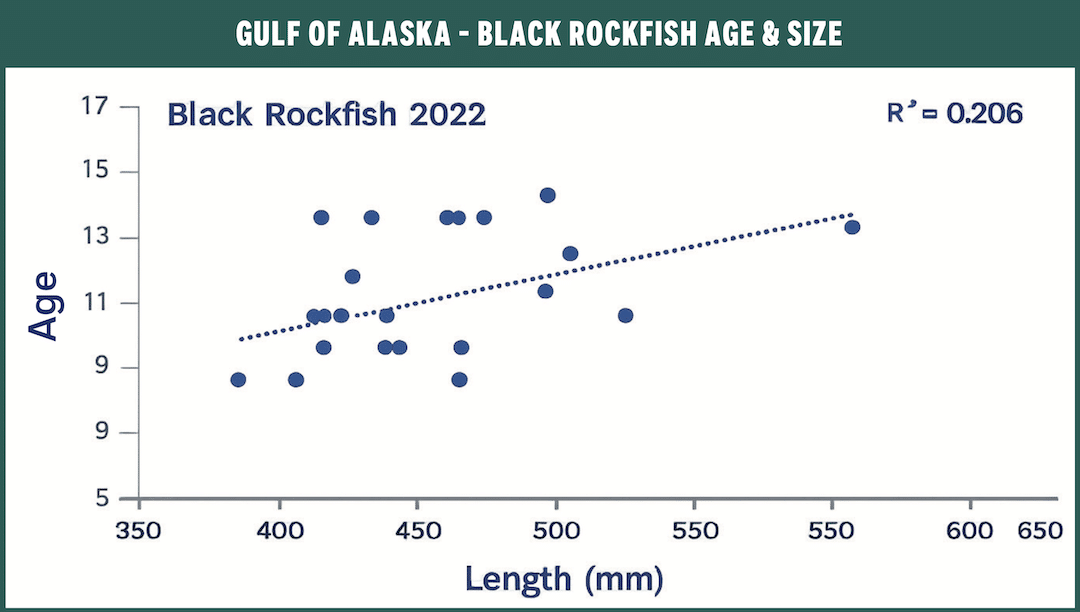
Figure 3: Age vs. length correlation for female black rockfish caught offshore in the Gulf of Alaska (2022), ranging from 9 to 15 years old and 380 mm to 560 mm.
Recreational Anglers to the Rescue: Citizen Science
To maintain healthy recreational fishing opportunities, British Columbia needs a clear understanding of current black rockfish population structures and age classes across coastal regions. DFO’s establishment of over 160 Rockfish Conservation Areas (RCAs) in the early 2000s provided essential protection, but ongoing data collection is needed.
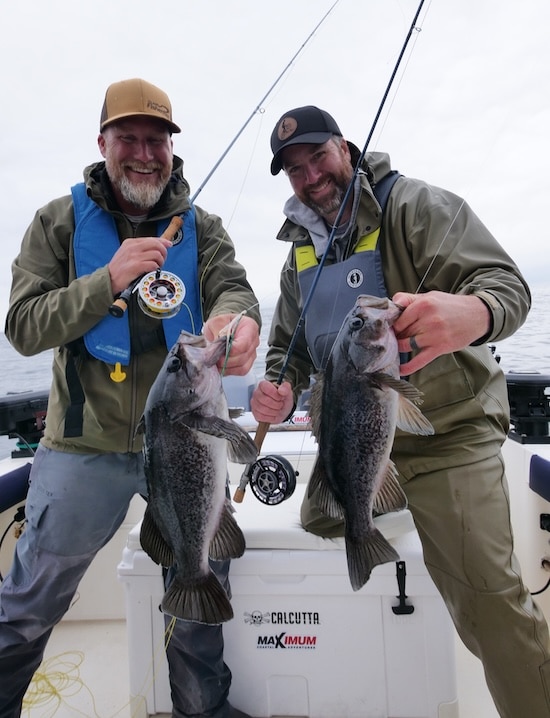
Black rockfish on the fly? Yes please! Two anglers show off healthy black rockfish landed on saltwater fly gear off the BC coast.
A proven path forward is citizen science. A decade ago, recreational anglers formed the Avid Anglers program to collect vital winter coho and Chinook data in the Strait of Georgia. A similar angler-led sampling program could gather size, age, and maturity data for black rockfish british columbia stocks, providing fishery managers with the precise data needed to safeguard the fishery for future generations.
🎣 EXPLORE BC FISHING LODGES & GUIDES
Looking to experience world-class bottomfishing and salmon angling on the West Coast? Plan your next adventure with our directory of verified BC charter captains and lodges: Island Fisherman Magazine Directory.

Dr. Richard Beamish
Order of Canada recipient and internationally recognized Pacific fisheries scientist.

Chrys Neville
DFO research biologist with over 30 years specializing in Strait of Georgia marine ecosystems.
Words by Dr. Richard Beamish and Chrys Neville. This feature appeared in Island Fisherman magazine. Never miss another issue—subscribe today!