


Photo: Owen Drisdale
Words by DICK BEAMISH, CHRYS NEVILLE, BRIAN RIDDELL
Steelhead are rainbow trout that go to sea. When they return from the ocean to their spawning rivers, they provide a highly esteemed, globally renowned recreational fishery in British Columbia.
Steelhead numbers in British Columbia have declined for years, with populations in the mid-Fraser River now considered endangered. However, it is the ocean life of steelhead that regulates their abundance, and this ocean life is mostly a mystery, particularly in the open ocean. Thus, it is time that the causes of this increased ocean mortality are better understood if we want to maximize steelhead abundance in a future of ocean change.
In 2022, we studied the winter ecology of steelhead in the Gulf of Alaska.
Steelhead mostly spend 1 to 3 years in the ocean before returning to spawn for the first time. Unlike Pacific salmon, steelhead can spawn more than once. Their ocean life can extend for 8 years, with up to five repeat spawnings, although one or two spawnings is normal. Steelhead also can migrate vast distances throughout the northern Pacific Ocean. They are closer to northern North America in their first ocean year but can be found on the Asian side of the North Pacific after their first ocean winter. Historically, tagging studies provided population distribution, but aside from some recent coastal research, there has not been open ocean research for decades. Winter is when ocean mortality of all salmon is thought to be greatest, because their survival depends on their ability to feed, grow, and store energy before food resources decline in the winter.
Steelhead by the Numbers
We captured steelhead using research gillnets fished from the Canadian charter trawler Raw Spirit from February 25 to March 25, 2022. Gillnets were 2.4 km long, consisting of panels of different mesh sizes 50 m in length and 8 m in depth.

Example of a gillnet with a steelhead caught in the mesh (Photo: Chrys Neville)
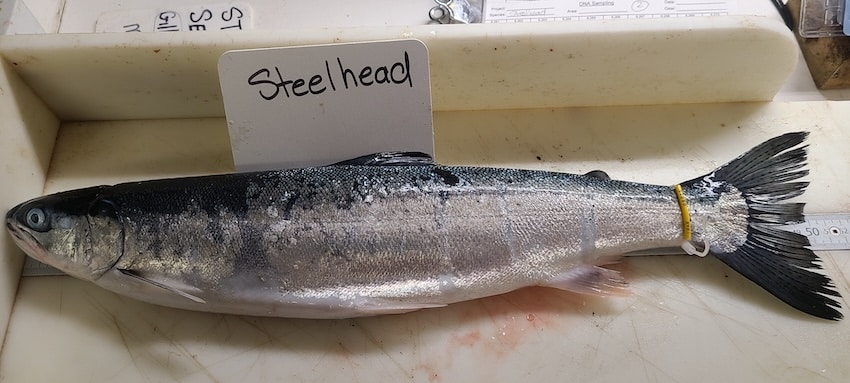
Typical steelhead caught in the study (Photo: Chrys Neville)
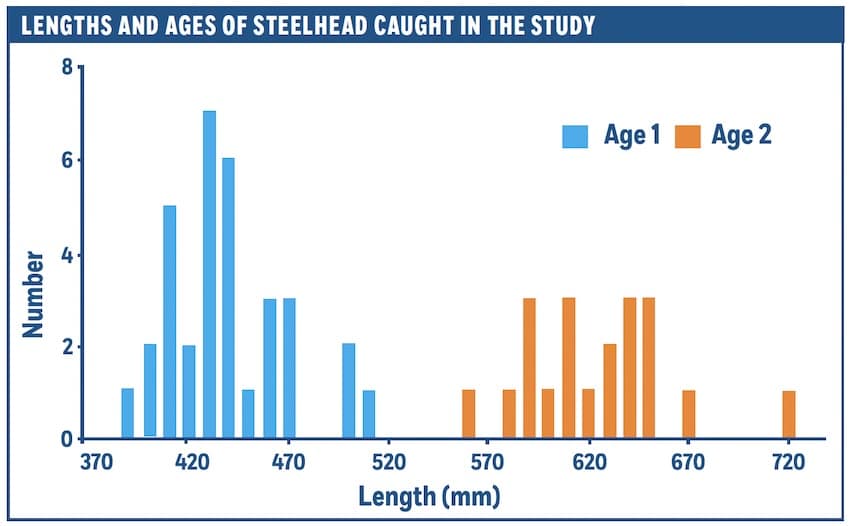
We caught 57 steelhead. We were able to determine the ocean age of 55, with 34 in their first ocean year and 21 in their second ocean year.
Screenshot
The fish in their first ocean year averaged 424 mm, and those in the second ocean year were 624 mm. Our DNA identifications were limited by the number of populations in the database, but we were able to identify 54 fish with general locations. There were 18 from the Nass River, 16 from the west coast of Vancouver Island, 12 from Puget Sound, 4 from the Skeena River, 3 from the Columbia River, and 1 from the Fraser River.
None of the fish in their first ocean year were mature, but 9 in their second ocean year were mature—7 females and 2 males. There was no evidence from the scales that these 9 fish had spawned previously. The DNA analysis indicated that these fish would be returning to rivers in the general location of the Columbia River, Puget Sound, the west coast of Vancouver Island, and the Nass River.

Rivers of origin of mature steelhead caught in the study
Two mature fish identified as originating from rivers on the west coast of Vancouver Island had an adipose clip but no coded-wire or PIT tag. It is possible that these fish originated from the Robertson Creek hatchery. The most direct distance to the approximate entrance to natal river areas from the capture sites would be approximately 1,100 km for Puget Sound, 650 km for the west coast of Vancouver Island, 700 km for the Nass River, and 1,000 km for the Columbia River. These fish would be winter-run life types—steelhead that reach maturity in the ocean before returning to freshwater to spawn.
Winter-run steelhead can arrive in fresh water as late as April and spawn immediately. Spawning can happen as late as July, with spawning in some rivers in Alaska commonly occurring from mid-April to early June. It appears that the mature fish in our catches would spawn very soon after returning to their natal rivers.
All steelhead were caught in the top 6 m of the ocean. This is consistent with limited evidence that steelhead spend virtually all their ocean life in the top few metres of the ocean. In an Alaskan study, 2 post-spawning steelhead (kelts) were tagged in freshwater after spawning and recovered back in freshwater after 16 months in the ocean. The data on the tags showed that these two fish spent 97% of their months at depths less than 6 m and mostly at 3 to 4 m. There are a few other examples supporting the theory that steelhead have an inherited behaviour to remain at the ocean surface. Thus, there is convincing evidence that steelhead live mostly in the top few metres of the ocean.
Steelhead are reported to have relatively narrow thermal limits at the sea surface of 6° to 12.5°C as a general reference level and 5° to 11°C in the winter. These are not upper lethal temperatures, but temperatures that define the known boundaries of steelhead in the open ocean. In our winter survey in the Gulf of Alaska in 2022, temperatures ranged from
8.4° to 13.1°C, with three stations where steelhead were caught that had surface temperatures that exceeded the range for winter thermal limits of 5° to 11°C.
The high temperatures found in our study would be a concern, as steelhead will be threatened in a future of ocean warming events that have recently occurred. The combination of living at the ocean surface and the current trends in ocean warming indicate an urgency to better understand the ocean ecology of steelhead.
Steelhead that had stomach contents in our study were feeding mostly on squid and small fish commonly known as lanternfishes or myctophids.
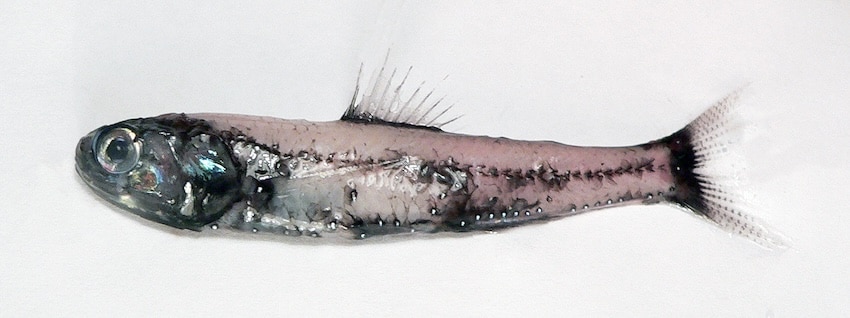
Example of a lanternfish (myctophid) that was a common food of steelhead. There are several species in the diet, and this species is a northern lampfish (Stenobrachius leucopsarus). These fish lose most of their dark scales when caught.
Because steelhead are virtually confined to the surface waters for their entire ocean residence, their diet items would be prey that reside in the first few metres of the surface. Squid and myctophids are mostly not in the surface waters during the day but migrate from deeper water to the surface at dusk “and return to depths at dawn. This vertical migration of the preferred prey appears to be an abundant food source for steelhead.

A daggertooth (Anotopterus pharaoh) caught in the study. This is a known predator of juvenile steelhead and Pacific salmon. From left to right: Rebecca LaForge, Svetlana Esenkulova, and Chrys Neville.
What Did We Learn
A major contribution was the confirmation that steelhead are programmed to remain at the surface of the ocean. We observed surface temperatures that, according to other studies, could be challenging for their survival. As surface temperatures increase, this may reduce surface space for steelhead, but food availability may be less likely impacted because of the reliance on vertically migrating food sources. As the ocean surface waters warm, it will be important to identify populations with the best resilience for surviving in the warming ocean surface.
Steelhead Facts

One of the most remarkable aspects of steelhead is their “homing” behaviour. They possess an incredible ability to navigate vast expanses of ocean and return to their natal stream (the very stream where they were born) to spawn. This is believed to involve a combination of sensing the Earth’s magnetic field, an inherited map of the ocean, and an imprinted chemical “signature” of their home stream.

Steelhead are categorized into “winter-run” and “summer-run” based on when they enter freshwater from the ocean. Winter-run fish typically enter rivers from November to May and spawn soon after, while summer-run fish enter from April to October and may hold in freshwater for several months before spawning the following spring.”
A few of the spawning fish will also return to the ocean and thus spawn more than once. The repeat spawning steelhead, called kelts, have been reported to spawn up to five times, with females being the most frequent repeat spawners.
This article appeared in Island Fisherman magazine, never miss another issue—Subscribe today!