
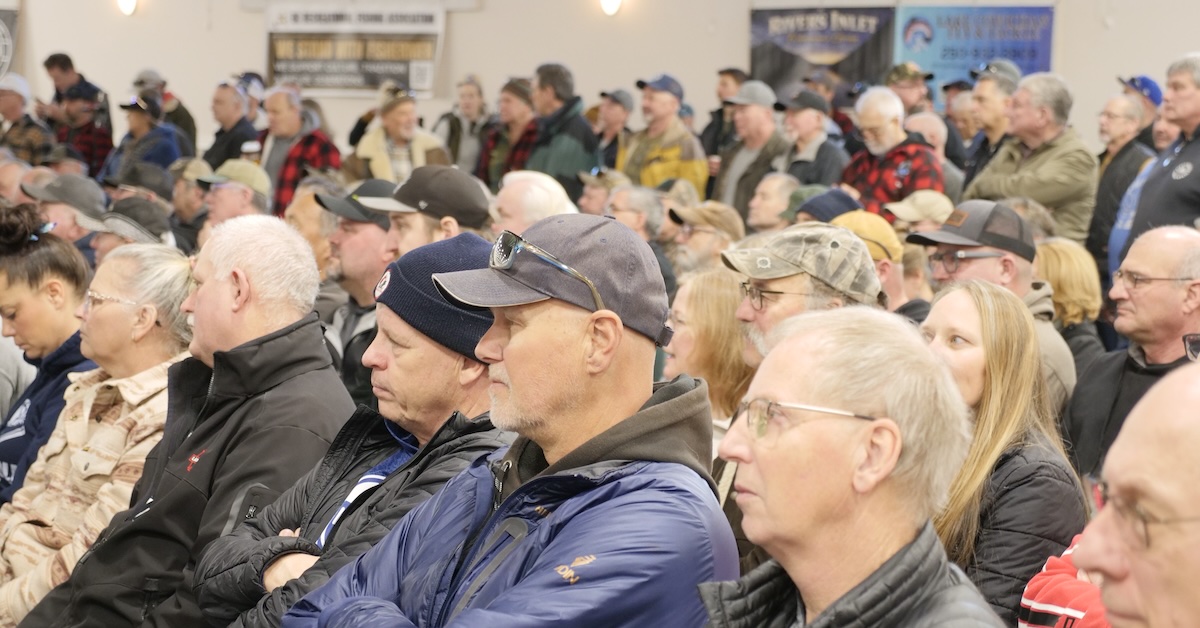
DUNCAN, BC — The Cowichan Exhibition Park was standing room only this past weekend as the sport fishing community on Vancouver Island gathered for a massive informational town hall. In a significant display of industry unity, over 1,400 people arrived to discuss and better understand the Salmon Allocation Policy (SAP) potential changes currently facing the fishery.
The event was hosted by the BC Recreational Fishing Association (BCRFA). While the BCRFA is a relatively new organization, it has quickly established itself as a vital conduit for information. Following their initial meeting last November focused on SRKW measures, this weekend’s turnout confirms the BCRFA is now a voice for anglers seeking clarity on if—and how—their industry will survive.

Organizers and volunteers of the BC Recreational Fishing Association gather after the successful Duncan town hall, which saw record-breaking attendance.
Understanding the Salmon Allocation Policy
The primary goal of the town hall was to unpack the complexities of the current Salmon Allocation Policy (SAP) review.
The Legal Threat: Stripping “Common Property” Status
The DFO is currently considering removing the designation of salmon as a “common property resource” from federal policy. This is more than a change in wording; it is a breach of the trust agreement between the government and the public.
-
Public Ownership: Currently, the public owns the fish, and the federal government manages them in trust for all Canadians.
-
Loss of Rights: Stripping this language would effectively end the common-law right to fish that has existed for hundreds of years, turning a public right into a government-granted privilege. As Jesse Zeman noted, if they aren’t common property, the question becomes: “who owns them?”.
The second proposal seeks to replace the recreational sector’s current priority access to Chinook and coho with a “fixed share” or “cap” system.
-
Ending Priority: Since 1999, recreational anglers have had priority access to these species. Flipping this structure would mean public waters could be closed until commercial fleets catch their allotted portion, even during high-abundance years.
-
The “Wall” of Memories: For BC families, this is an emotional crisis. The public fishery is a multi-generational legacy—what many call “The Wall” of family photos and memories. The public’s right to pursue salmon in our tidal waters is a heritage stretching back over a century; as early as 1896, Campbell River was gaining international fame for its Tyee Chinook sport fishery. This “modernization” threatens to auction off that 125-year-old heritage, treating it like a cold commodity.
-
Economic Lifeblood: The sport fishing industry generates $1.3 billion annually and supports over 9,100 jobs. And unlike other sectors, this is a “user-pay” system where over 372,000 licensed anglers personally fund the very conservation and hatchery work—like clipping fins and clearing streams—that keeps the resource alive.
As the owner of Island Fisherman, I have never seen the sport fishing community—guides, lodge owners, and family anglers—organize and come together with this level of speed. The consensus in the room was that the SAP review represents a pivotal moment for the industry, and the need for organized, informed action has never been higher.

The scale of the crisis: Over 1,400 anglers and community members gathered in Duncan to understand the impact of proposed changes to the Salmon Allocation Policy (SAP) on the future of the public fishery.
I asked Mark Roberts, President of the BC Recreational Fishing Association why he started the group, and he told me that misinformation about the Southern Resident Killer Whales (SKRW) and the impact on businesses like his own, was too much to bear. Their first Town Hall was in October 2025 with an impressive few hundred people in attendance. When the Salmon Allocation Policy review was quietly launched by the DFO in December with a short period for public feedback (over the holidays, no less), he figured people would benefit from a frank discussion about what the repercussion really ment.
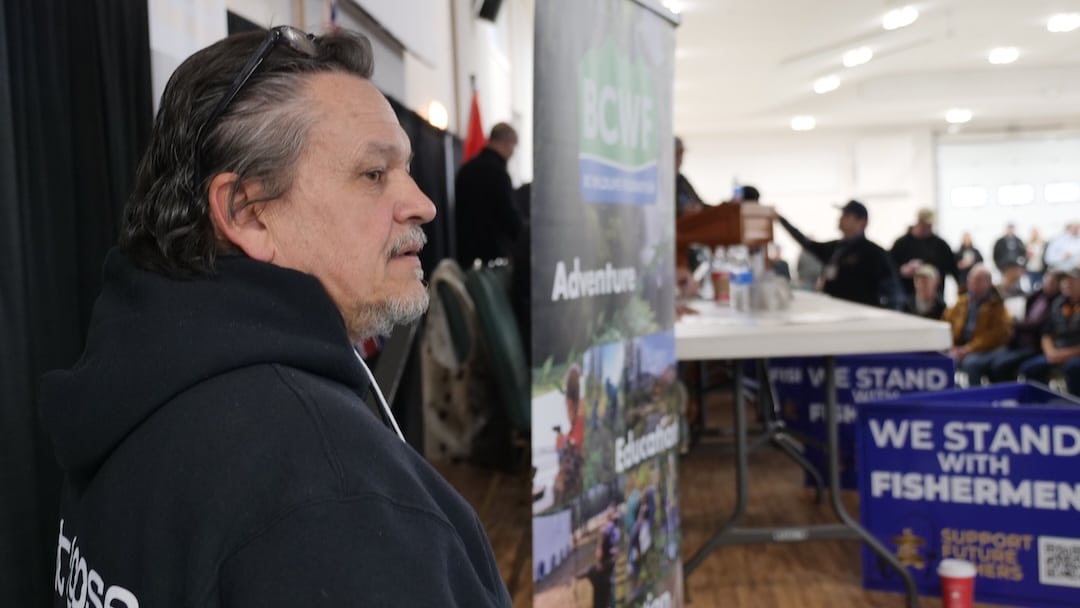
Mark Roberts, President of the BC Recreational Fishing Association (Photo: Island Fisherman)
A Standing Ovation for Jesse Zeman
A key moment of the town hall was the address by Jesse Zeman, Executive Director of the BC Wildlife Federation. Zeman, known for his advocacy for transparent, data-driven management, received a standing ovation from the crowd.
Zeman spoke to the frustration many feel regarding the DFO’s lack of transparency, previously noting that “The federal government is using salmon and whales as a political tool.” At the Duncan meeting, he urged anglers to dig into the data, emphasizing that the survival of the industry depends on holding the government accountable to its own science and the actual abundance of Chinook.
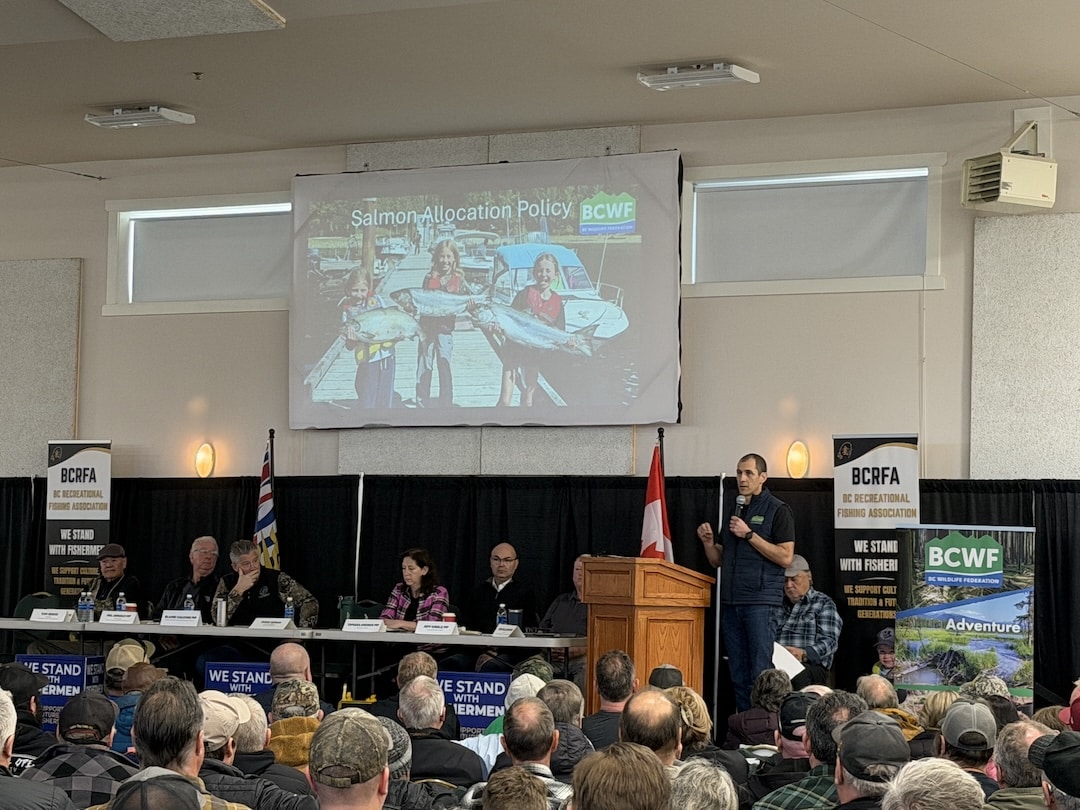
Jesse Zeman, Executive Director of the BC Wildlife Federation, speaks to a capacity crowd of over 1,400 about the Salmon Allocation Policy (SAP). Zeman received a standing ovation for clearly explaining the facts. (Photo: Island Fisherman)
A New Chapter of Engagement
The Duncan gathering was a clear indication that the sport fishing industry is no longer waiting for answers; it is seeking them out. With the DFO largely utilizing closed-door advisory groups for the SAP process, the BCRFA’s town hall served as an essential public forum.
For an industry that generates $1,276 billion in revenues to Canada and supports over 9,100 jobs in BC, this meeting was about more than just fishing—it was about protecting a culture and a livelihood. The message from Duncan was clear: the public fishery is getting informed and organized.
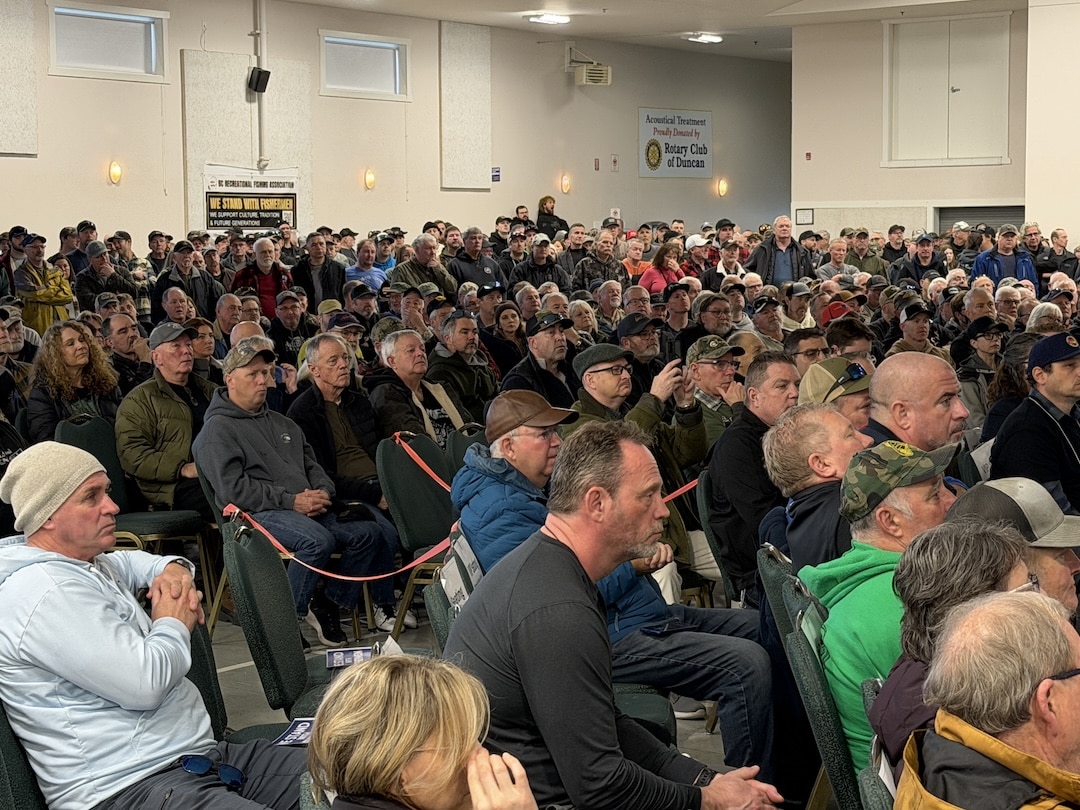
The scale of the crisis: Over 1,400 anglers and community members gathered in Duncan to understand the impact of proposed changes to the Salmon Allocation Policy (SAP) on the future of the public fishery. (Photo: Island Fisherman)
A Note on the Silence
While the hall was filled with over 1,400 concerned citizens, there were some glaring vacancies. One has to ask: Where was mainstream media? Why isn’t this story—which has the potential to collapse local economies, hollow out coastal communities, and erase a generational culture—leading the 6 o’clock news on every channel?

powerful reminder of what’s at stake: a child’s drawing presented during the town hall pleading “Don’t stop salmon fishing. (Photo: Island Fisherman)
Furthermore, the political representation in the room was strikingly one-sided. While Conservative MPs like Blane Calkins, Tamara Kronis, and Jeff Kibble, were present as speakers to hear from their constituents, the NDP, Liberal, and Green parties had no visible representation. When an industry that represents the backbone of Vancouver Island’s culture and economy gathers in record numbers to discuss its very survival, one would expect every representative from every party to be in the front row or on stage to help answer people’s questions. At the very least, findable in attendance.
The silence from the media and the empty chairs from three major political parties are more than just an oversight—they are a direct dismissal of a crisis that demands to be heard. Are they not?